


It should come as no surprise that AI tops the list of inquiries we receive at Insights by Blueprint. Owners and operators across asset classes are wrestling with how to apply artificial intelligence to nearly every part of their business.
Yet the optimistic narrative pushed by many technology vendors often contrasts sharply with reality. On the ground, rollouts frequently stumble over unclear requirements, incomplete data, overextended managers, and hesitant on-site teams.
Today’s letter distills eight lessons for successful technology implementation, drawn from conversations with our Advisory Council. We’ll cover data integrity, on-site team buy-in, vendor evaluation, and the “old-school” automation strategies that remain essential—a must-read for anyone serious about strengthening their firm’s technology and AI capabilities.
(If you want to go deeper and get AI readiness insights specific to your firm, complete this 15-minute AI readiness assessment for an individualized report on your firm’s preparedness to embrace AI.)
1. Know What Data is Out There and Where it Lives
Successful AI implementations are built on the foundation of data; AI is only as powerful as the data it can access. For multifamily operators, that access is often fragmented, inconsistent, or outright blocked. It’s not enough to have the data. Operators must know where it resides, how it’s structured, and what it takes to extract it. In practice, this can be more of a political and contractual challenge than a technical one.
Many building systems, particularly property management systems (PMS), are designed as closed ecosystems. They store essential information—leases, rent rolls, maintenance records—but often restrict data export, API access, or real-time integration. Financial data is especially guarded, sometimes requiring vendor approval or custom middleware to reach at scale. “I knew there would be challenges implementing automation at the property level,” said one operator, “but it turned out our property management system [Yardi] was the biggest challenge of all.”
These access barriers complicate AI deployment. Predictive models, recommendation engines, and automated workflows depend on continuous data flows. Without direct access, operators resort to workarounds—periodic CSV exports, custom APIs, or in extreme cases, data scraping. One operator described hiring a consultant to build scrapers that “read” the PMS interface and pull data directly from the UI because Entrata didn’t provide reliable exports.
This approach may solve the problem temporarily but introduces risk. Scrapers are brittle: a minor UI change can break them, causing silent data failures. They also often violate PMS user agreements, even if the data belongs to the operator. Beyond compliance issues, scraping increases operational fragility—when the data pipeline fails, the AI model fails with it.
The better path is strategic data architecture:
- Use available APIs where possible, even if it requires vendor negotiation.
- Build a data warehouse or data lake (e.g., Snowflake, BigQuery) that ingests exports from PMS, CRM, and accounting systems on a regular schedule.
- Document data ownership clauses in vendor contracts to ensure long-term access rights.
- Invest in lightweight ETL tools like Fivetran, Hevo, or Airbyte to automate data extraction legally and reliably.
Access, not algorithms, is often the real bottleneck in AI adoption. Operators that take ownership of their data create the foundation on which AI can actually deliver value. The rest is just engineering.
2. Be Prepared for Data Quality Surprises
Access to data is not the same as readiness to use it. Many multifamily operators begin AI projects assuming their data is clean and consistent—only to discover a maze of inconsistent labels, duplicate records, and undefined terminology. “We thought we had great data,” said one operator, “until the AI flagged 14 different ways our teams recorded a ‘one-bedroom’ unit.”
The first step toward AI readiness is defining a shared language. Canonical terminology and models ensure that when one property reports “1BR” and another says “one bedroom,” both map to the same category. Establish conventions across key concepts:
- What constitutes a unit, lease, or tenant?
How is occupancy defined when roommates, early terminations, or mid-month move-ins complicate reporting? - Are rents standardized to $/month or $/sqft/year?
- Are areas stored in sqft or sqm, and dates in MM/DD/YYYY or ISO format?
Even subtle inconsistencies can derail downstream analytics. A 5% mismatch in occupancy definitions or unit counts can translate into major discrepancies in NOI models. Establishing centralized data dictionaries and schema enforcement is a prerequisite to any AI or BI deployment.
Next comes deduplication and consolidation. AI tools perform poorly when confronted with redundant or siloed datasets—say, duplicate resident records across CRM and accounting systems or overlapping property codes in Yardi and Entrata. The same principle applies to free-text fields. If maintenance logs contain both “AC not working” and “HVAC broke down,” a model might treat them as distinct issues rather than one common failure. Normalizing such data (“HVAC failure”) unlocks more accurate predictive maintenance and cost analysis. Ironically, this is where AI itself can help—using natural language models to categorize and structure unstructured data automatically.
Below is a reference table of tools and approaches that improve data quality and consistency across real estate portfolios.
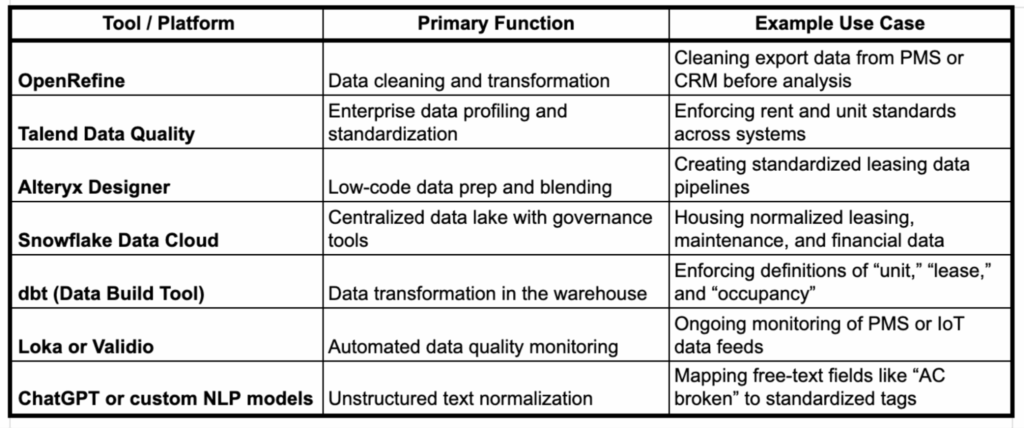
Data hygiene isn’t glamorous, but it’s foundational. Operators that invest in standardization, deduplication, and normalization find their AI models train faster, dashboards reconcile cleanly, and decision-making improves dramatically. As one VP of Operations put it: “AI didn’t just expose our bad data, it forced us to finally fix it.”
3. Get the On-Site Teams On Board
AI adoption in multifamily succeeds or fails not on technical merit, but on trust. For many property staff, the phrase “we’re rolling out AI tools” sounds less like innovation and more like a warning. Leasing associates, maintenance coordinators, and assistant managers often hear “AI” and think “job cuts.” This reaction is understandable. When daily workflows—renewals, service requests, lead follow-up—are automated, employees worry their experience and judgment will be replaced by software.
The first step toward successful rollout is empathy. Operators must acknowledge these fears directly, making clear that automation and AI are meant to augment, not eliminate, on-site roles. “We told our teams that AI should handle repetitive tasks so they can focus on residents,” said one multifamily operator. “Once they saw the system taking care of scheduling and data entry, they became advocates instead of skeptics.”
Equally important is recognizing that every property has its own standard operating procedures. A single playbook rarely fits a 300-unit suburban asset and a 50-unit urban mid-rise. Forcing both onto identical AI workflows creates friction and resentment. Operators must avoid layering new technology onto unstable or outdated SOPs; otherwise, teams face simultaneous change fatigue—relearning both process and platform at once.
Landmark Properties’ rollout of EliseAI offers a strong example. Rather than deploying a universal template, Landmark’s operations team went property by property, mapping leasing processes and communication norms before configuring the AI assistant. Some sites emphasized after-hours leasing; others needed multilingual support or integrations with unique CRM setups. This site-by-site customization took longer but produced far higher adoption. Once teams saw their local quirks respected, participation jumped.
Tools like Venn have built their success on this property-level flexibility. Their workflow builder allows nontechnical managers to create or adjust automations—say, routing delinquency follow-ups differently for student housing versus conventional multifamily—without coding. That accessibility turns AI from something “done to” the site team into something “done with” them.
This localized, empathetic approach may seem slower, but it lays the foundation for durable adoption. A model trained on global data means little if the people closest to residents don’t trust or use it. The best AI deployments in multifamily start not in a data center, but in a leasing office—where technology earns its place by making everyday work easier, not more uncertain.
4. Don’t Send Your Team on Data Safaris
“Executives, asset managers, and site teams need the right metric at the right time–not a data safari,” said Jonathan Gheller, CEO of UDP. In other words, it’s not enough for multifamily operators to have data locked in systems and spreadsheets; it must be instantly available, consistent, and actionable.
Modern BI tools solve this by aggregating data in real time and presenting it in a usable format. Leni, for example, sits on top of a company’s existing data sources and allows users to query them conversationally. A manager can ask, “Which properties are underperforming on renewals this month?” and Leni generates a dynamic dashboard and narrative summary instantly. By removing friction between data and decision, it enables true operational responsiveness.
Real Estate Business Analytics (REBA) takes a complementary approach: prebuilt dashboards for common property metrics like occupancy, rent growth, and work order completion. For Yardi-based operators, REBA delivers plug-and-play visibility without requiring a full data warehouse buildout.
Still, access alone doesn’t guarantee alignment. Conflicting data definitions can send teams chasing discrepancies instead of outcomes. One operator described a recurring 1–2% difference between Yardi’s occupancy report and their custom dashboard—a gap traced back to whether early-terminated leases counted as “occupied.” Small definitional inconsistencies like this can erode confidence and waste hours in reconciliation.
The antidote is centralized, canonical data: a single version of the truth that all systems reference. With it, teams stop hunting for data and start acting on it.
5. Ask Vendors the Right Questions
If you’re in charge of any technology budget at a multifamily portfolio, there’s a good chance you’re getting dozens of pitches from “AI” companies every week. But the technology is evolving fast, and separating meaningful innovation from hype isn’t easy. From early adopters across the industry, several lessons have started to emerge about what works—and what to watch for. Some insights from our Advisory Council:
Clarify What’s Actually “AI.”
Many tools marketed as AI are really advanced automation. That’s not always a bad thing, but it’s important to know what you’re buying. True AI systems learn from data and adapt; automation follows fixed rules. Ask vendors to be specific about what parts of their system are model-driven versus rule-based, and how they retrain or improve over time.
Integration Matters More Than Flash.
Even the most powerful AI tool fails if it doesn’t connect cleanly to your property management, accounting, or project management systems. The most successful implementations pair domain-specific AI tools with tight integrations into systems like Yardi, Entrata, or Procore. Request proof of working integrations, accuracy metrics from real deployments, and examples of how humans stay involved in decision-making.
Protect Your Data Early.
Owners underestimate how much data these systems process. Before signing, confirm where data lives, whether tenant or financial information is used to train external models, and who owns the outputs. Basic compliance (like SOC 2) and privacy options—such as private-cloud hosting—are worth prioritizing.
Structure Contracts to Measure Value.
Pricing models vary widely. Early adopters stress tying vendor contracts to clear outcomes—improvements in leasing speed, delinquency rates, or maintenance turnaround—rather than broad promises. Push for reporting transparency, uptime guarantees, and realistic ROI benchmarks.
Look for Staying Power.
AI vendors are popping up fast, but not all will last. It helps to understand how the company is funded, what its roadmap looks like, and whether it plans to broaden or stay focused. The best relationships feel like partnerships—both sides learning and iterating together.
Think Strategically about PMS vs Point Solutions
Finally, operators should take a strategic approach to choosing between native PMS tools versus standalone point solutions for each specific need. For instance, most property management systems have their own tenant screening and fraud detection modules, although some operators decide to go with a third-party tool like VERO or Snappt. (We did a deep dive into fraud detection tools last month here.)
The decision should be made on a tool-by-tool basis, but there are some general pros and cons of each approach:
- PMS-provided tools typically integrate well with other modules of that system, limiting data transfer and quality risks;
- The flip side is that PMS-provided tools often do not integrate well with other property management systems, potentially posing an issue to operators working across several PMS platforms.
- Point solutions are often built by companies focused solely on solving a specific problem, so they often do that one thing really well. They are also more like to be “AI native,” built with modern technologies and tools in mind.
- They’re also more likely to integrate well across multiple PMS platforms
- On the flip side, PMS-provided tools are less likely to run out of money and shut down – or sell to a different technology company that may not maintain the tool.
For many operators, the decision comes down to the importance of the tool – is the PMS-provided version “good enough”? – and the cost. In some cases, the PMS-provided tool will come with a module already purchased. In other cases, a usage-based model may make it appealing to go third-party. (Fraud detection is a good example of this with many operators choosing third-party tools.)
6. Don’t Ignore Old-School Automation
Many multifamily operators now treat “AI” as a magic word—deploying chatbots, predictive models, and GPT-style assistants with high expectations. But seasoned operators caution that AI is most effective when paired with traditional, rules-based automation. “Everyone wants to jump straight to generative AI,” said one multifamily operator. “But if your workflows still rely on people moving data between systems, AI will just automate chaos.”
Rules-based automation remains the backbone of operational efficiency. Before layering in AI, operators should ensure that repeatable processes—such as late-fee posting, work order routing, or unit-ready workflows—are handled by deterministic scripts, not humans. For example, if a maintenance ticket includes the phrase “AC not cooling,” a rules engine can automatically assign it to the HVAC queue and trigger an SMS confirming receipt. That logic is simple but powerful, freeing staff to focus on exceptions rather than routine tasks.
AI’s strength lies in handling ambiguity; automation’s strength lies in handling predictability. A well-run property operation blends both. Retrieval-augmented generation (RAG) is a case in point. RAG combines AI’s natural language capabilities with a deterministic data retrieval layer that ensures the model references approved sources—like policy documents or maintenance SOPs—rather than hallucinating. Without that structured retrieval layer, generative models risk producing inconsistent or misleading responses. “RAG is really just a smart wrapper around a rules-based data pipeline,” said another operator. “It’s AI sitting on top of process discipline.”
Agentic AI—systems that autonomously take actions across tools—is another area where traditional automation foundations matter. A leasing agent built on an agentic framework might draft emails, update CRM records, or escalate delinquency cases. But each of those actions depends on well-defined API connections and clear business rules. If those underlying automations aren’t solid, agentic AI will stall. Operators who already have standardized workflows in property management and CRM systems (such as Yardi or Entrata) find agentic AI far easier to deploy.
AI amplifies the structure it’s given. Poorly integrated systems and undefined workflows will yield unreliable outcomes no matter how advanced the model. Smart operators treat “AI readiness” as synonymous with “automation readiness.” They start by mapping every process that touches data—renewals, turns, collections, service requests—and identifying what can be standardized through rules and APIs. Only once that plumbing is reliable does AI add real value.
“AI is the frosting, not the cake,” said one COO. “You still need to bake the layers of automation underneath it.”
7. Measure Outcomes and ROI
Technology spending in multifamily has surged, but many operators still struggle to prove what’s actually working. The issue isn’t just measurement; it’s culture. “We’ve bought every new tool under the sun,” said one multifamily operator, “but until we started tracking outcomes, we didn’t realize how much software wasn’t moving the needle.”
An outcome-driven culture starts by treating every technology initiative—AI or otherwise—as an investment with a defined return. Operators should articulate the metric they expect to improve before implementation: higher renewal rates, faster turns, lower delinquency, fewer service tickets per unit. Without those baselines, post-deployment ROI analysis becomes anecdotal. The goal is to transform technology from a cost center into a measurable driver of operational performance.
This discipline requires consistent data capture and attribution. If an AI leasing assistant claims to improve conversion rates, the operator must isolate its contribution against variables like seasonality or marketing spend. Similarly, workflow automation that reduces maintenance backlog should be quantified in hours saved or cost per work order.
The best operators institutionalize this rigor, including ROI reviews in quarterly business meetings and tie tech vendor renewals to measured outcomes. They assign technology owners—often department heads—responsible for defining, tracking, and reporting impact metrics. This approach creates internal accountability and ensures that enthusiasm for innovation doesn’t eclipse performance measurement.
AI heightens this need for discipline. Because AI often produces probabilistic, rather than binary, results, its ROI can be fuzzier. That ambiguity reinforces the importance of hard baselines. If rent delinquency drops by 30 basis points after deploying an AI collections platform, was it the model, the macro environment, or better staffing? Operators with robust pre-AI data can answer that.
Ultimately, outcome tracking is less about cutting underperforming tools and more about compounding wins. By consistently measuring results, operators learn which technologies integrate best, where automation drives margin, and where human judgment still adds value. “The metric isn’t whether the tech is shiny,” one operator said. “It’s whether it moves NOI.”
A culture of ROI turns technology adoption from a series of disconnected pilots into a continuous performance loop—measure, refine, redeploy. AI may accelerate this loop, but it only thrives in organizations already fluent in the language of measurable outcomes.
8. Make AI a Habit, Not a Project
Of all the lessons about AI, this may be the most important: AI isn’t a single-purpose tool—it’s a way of thinking. It can analyze rent rolls, but it can also plan a vacation, write a thank-you note, or explain your kid’s homework. Its limits are defined less by the technology itself than by our creativity in using it.
The best operators develop that creativity not through enterprise rollouts, but through everyday use. Tell it what’s in your fridge and ask for recipes. Have it summarize a podcast, draft a maintenance checklist, or plan a birthday party. Ask it to compare mortgage options, write a contractor scope of work, or outline a community newsletter. Each small use builds familiarity with prompts, context, and feedback, skills that later translate into better AI adoption across the organization.
Enterprise AI initiatives often move slowly; personal use moves fast. The people who use AI daily develop an intuition for its strengths and weaknesses that no training can replicate. As one operator put it, “The more AI becomes second nature in your personal life, the easier it is to see where it fits professionally.”
Becoming personally AI-native ensures that when the next generation of tools arrives, you’re already fluent in the language of possibility.
-Brad Hargreaves