
Parking technology may not be the flashiest corner of commercial real estate innovation, but it has recently earned a bigger spotlight. Parking has long been treated as little more than a logistical necessity or a compliance box to check, and that’s starting to change.
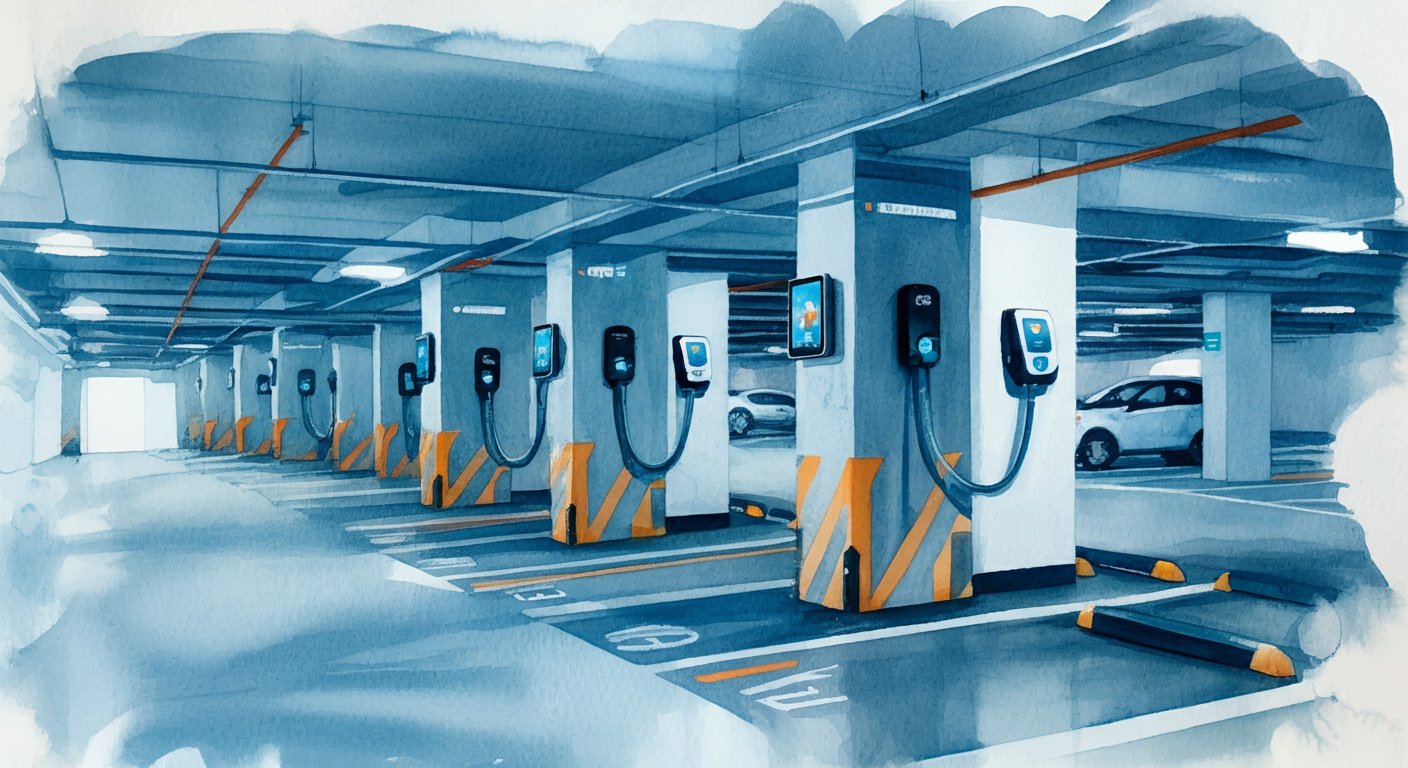
New technologies are being introduced to parking garages, including checkout-free payment, license plate reader cameras, and advanced dynamic pricing models. Meanwhile, the continued rise of electric vehicles is making many commercial real estate operators add or expand charging infrastructure.
CRE operators acknowledge that parking remains relatively low on their list of strategic priorities. Yet many are beginning to reassess garages and lots, recognizing them as underutilized assets with potential to drive both revenue and tenant engagement. Importantly, monetization doesn’t always mean charging residents and tenants more. A new wave of creative strategies is emerging to address both scarcity and oversupply, from dynamic pricing in dense urban markets to repurposing surplus spaces for RV or boat storage in suburban communities.
In this Insights by Blueprint report informed by Advisory Council surveys and interviews, we’ll explore the future of parking tech in CRE, including the innovations gaining the most traction, the case for integrating parking within broader building management systems, and a comprehensive overview of the vendors and technology companies leading the way in the parking industry with specific reviews of providers including Wayleadr, Metropolis, AirGarage, Parkade, and more.
Parking’s evolving role in CRE
Parking in commercial real estate is increasingly being recognized as a vital part of the tenant and guest experience, as well as a meaningful revenue driver. Urban densification, sustainability goals, and digitization are forcing owners and operators to rethink how parking fits into the broader building ecosystem.
Tenant satisfaction remains the central measure of success. Barbara Garrett, VP of Ancillary Revenue at Jamestown, explains that parking feedback at her company is systematically collected at every transaction, compiled monthly, and shared with stakeholders to ensure accountability. This data-driven approach surfaces issues quickly and strengthens trust with guests and residents.
“Any rating less than four stars gets a call from the parking manager,” Garrett notes. While five stars is the goal, proactive follow-up turns negative experiences into opportunities to build loyalty.
This attention is particularly critical in dense urban markets, where parking is often limited and stressful. Garrett emphasizes that parking is a “Class A experience not only for customers and guests but also for employees.” By integrating reliable technology that is simple to use, strong customer service, and safe, well-maintained facilities, Jamestown aims to transform parking from a static necessity into a dynamic touchpoint.
Historically, parking has often been managed at arm’s length from the core property management function. Many operators structure their garages and lots under third-party management agreements, treating them almost as if they were another tenant in the building. As Joe Stokes, Global Head, Digital Operations and CX at CBRE, explains, “Car parks are almost like another lessee within the building, kind of carved off into that world where the operator runs them.”
This arrangement has meant that property managers have traditionally viewed garages as peripheral, rather than integral, to the overall tenant experience and revenue strategy. Yet this perception is beginning to shift. Stokes notes that “every investor and landlord is trying to squeeze as much revenue out of the buildings as possible, and car parks have arguably been an untapped resource.”
Most management agreements are structured with a fixed lease fee and a revenue-sharing model, meaning operators and landlords both benefit from maximizing income. In Stokes’ view, “it’s definitely an underutilized resource and an underutilized opportunity for income.”
Technology is playing an increasingly central role in that shift. From marketing available spaces to managing inventory more effectively, and even subleasing unused stalls, digital tools are transforming parking into a more dynamic and profitable asset. For example, a garage with 100 spaces may reserve 50 for tenants and 50 for public use. Optimizing occupancy across both pools is “mission critical if you want to max out the income,” Stokes explains.
The next wave of parking tech
Smart parking systems are evolving into multi-use infrastructure that goes well beyond managing cars. Combining IoT, AI, computer vision, and cloud platforms, these systems optimize utilization, cut congestion, and improve user experience, while opening up new revenue streams.
Adoption is rising, though unevenly. Only 19% of CRE operators on the Insights by Blueprint Advisory Council report using occupancy sensors, while 31% have adopted digital payment and reservation systems.
EV charging is further along, with 81% already deploying or expanding charging stations. Automated enforcement through license plate recognition (LPR) is also common, used by 56% of surveyed operators. Integration into unified dashboards, however, remains limited. Just 25% report using a cloud-based parking management platform.
According to some, the trajectory of parking tech may shift away from standalone systems. Jameson Hartman, Vice President at RET Ventures, a venture capital firm focused on PropTech, argues that the future lies in integration with broader building IoT.
Existing security camera networks, for example, can increasingly support license plate recognition, anomaly detection, and access control when paired with AI overlays. This avoids costly, parking-specific hardware while creating multi-use infrastructure that delivers both operational efficiency and security.
The implications for CRE are significant. A system that can identify an unknown car entering a garage, trace its driver to a unit, and alert residents demonstrates how parking technology can double as a safety tool. This convergence underscores why 44% of Insights by Blueprint Advisory Council operators cite security and surveillance among their top parking priorities, behind only tenant satisfaction (93%) and revenue generation (56%).
ROI and payback periods
Many parking vendors charge per space, car, or tenant, leaving owners skeptical about ROI. Hartman of RET Ventures argues the stronger path is embedding parking into broader platforms (treating it as an extension of security or building management) so costs align with owner expectations.
Still, operators are spending: 56% of those we surveyed on the Insights by Blueprint Advisory Council have invested in parking tech within the past 24 months, with operational efficiency (44%) as the main driver. The top priorities are EV charging, with 63% evaluating or expanding infrastructure, and dynamic pricing, with 31% piloting new systems. This suggests parking is gaining traction when positioned as part of larger efficiency and amenity strategies rather than a siloed investment.
Barbara Garrett at Jamestown notes that the right parking technology can pay for itself surprisingly quickly, sometimes in as little as two months. The timeline depends on factors like system complexity, asset class, and project size. Still, Garrett has a rule of thumb: she expects ROI within 24 months. “If it takes longer than that,” she jokes, “I start to get grumpy.”
Dynamic pricing in action
Documented cases of ROI are hard to come by and often provided by vendors, but some case studies offer valuable insights.
The Yard at Ivanhoe, a Class A residential property in Orlando owned and managed by Greystar, partnered with AirGarage to manage its mixed-use parking garage. Although operations were already running smoothly, fluctuating demand made it challenging to maximize revenue with a static pricing strategy.
AirGarage introduced dynamic pricing, which automatically adjusts rates in real-time based on occupancy and other factors. Prices rose during peak demand to capture more value, while lower off-peak rates kept the garage competitive. The system required no manual input and integrated with tenant and restaurant validations.
Results:
- +10.5% average monthly revenue growth in the first three months
- Shorter average stay times, improving space turnover
- Higher driver satisfaction thanks to improved availability despite higher rates
Capturing value without losing trust
While dynamic pricing has clear benefits, it has emerged as one of the most debated tools in parking management. RET Ventures’ Jameson Hartman calls it “the future” and likens it to the amenity-based pricing already common in CRE. “You pay more for the corner apartment unit with good views,” he says. “So why wouldn’t you pay slightly more for the parking spot right next to the entrance?”
The logic is straightforward, but execution is tricky. Frequent price changes can spark swift tenant backlash. Hartman points to scenarios where residents arrive during a special event to find parking at $50 when it was $4 the night before. Such volatility risks eroding trust if not managed carefully.
While often pitched as a revenue tool, dynamic pricing’s deeper value lies in balance. Used transparently, it can reduce congestion, improve efficiency, and enhance the driver experience. Urban economist Donald Shoup argued curb parking should be priced always to leave one or two spaces free per block, not to maximize revenue but to keep traffic moving smoothly. Applying that principle in CRE means shorter search times, less frustration, and a more reliable system.
Coordination is key. If operators align rates with demand, they can strategically undercut peak pricing, drawing drivers into underused garages while boosting occupancy. The result is not arbitrary swings but calibrated adjustments that make parking work better for everyone.
Clear communication and measurable outcomes are critical to building tenant trust. If done right, dynamic pricing can shift from a controversial revenue strategy into a collaborative tool that balances economics with customer satisfaction.
Top vendors driving parking tech
The parking technology landscape is increasingly crowded, with companies taking very different approaches to modernization. Some, like Metropolis and AirGarage, combine technology with operations to reimagine the entire parking experience.
Others, such as Xeal, Flash, and Parkade, focus on specialized solutions ranging from EV charging to multifamily automation. Meanwhile, emerging startups like BreatheEV and Curo are carving out niches with software-first and fleet-focused models. Together, these vendors illustrate the diverse strategies reshaping how parking is monetized, managed, and integrated into the broader CRE ecosystem.
Metropolis

Metropolis, founded in 2017, has become a dominant player in U.S. parking technology following a $1.8 billion financing and the completion of its acquisition of SP Plus Corporation. The recent acquisition has given it control over more than 4,000 locations, positioning it as the largest parking operator in North America.
The company utilizes AI and computer vision to facilitate checkout-free parking. Entry, exit, and billing are managed through a “vehicle fingerprint” based on the vehicle’s unique characteristics, not just license plate information. Their business model combines technology and operations, and they offer tiered pricing plans that they claim are “entirely zero CapEx to drive the highest ROI of the asset.”
Metropolis also faces risks. From July 2020 to 2024, Tennessee’s Attorney General received 247 consumer complaints against the company, with local news frequently reporting grievances over fraudulent parking tickets. Adding to the pressure, a pending class-action lawsuit accuses the company of violating the Drivers Privacy Protection Act by improperly accessing driver addresses to mail citations.
Metropolis claims that consumer complaints remain extremely rare, representing less than 0.01% of all transactions, and they have continued to decline month over month.
As the largest parking operator in the U.S., Metropolis says it is not immune to legal challenges. “It is not surprising that we’re the target of frivolous lawsuits,” says Eric Roseman, Senior VP of Sales & Partnerships at Metropolis.
Roseman claims that many of these lawsuits stem from broad, repurposed class actions filed by plaintiffs’ firms across the industry. In response, Metropolis has filed motions to dismiss and has reaffirmed its stance that the claims are without merit. Roseman says the company has committed to “vigorously defend against them.”
Blueprint’s take:
Metropolis has redefined parking by merging operator scale with tech-first execution. Its $1.8B SP Plus acquisition gives it unmatched reach, while AI-driven, checkout-free systems promise fast modernization and new revenue for landlords.
But with scale comes risk. Billing errors and even a class-action lawsuit have sparked a vehement public backlash. For CRE owners, partnering with them means betting that frictionless tech can outweigh potential consumer mistrust.
AirGarage
Also founded in 2017, AirGarage operates over 300 U.S. parking facilities. It partners with property owners such as Hines, Greystar, and Starwood Capital, as well as office campuses, to manage lots and garages using a combination of technology and operational services.
Its platform leverages license plate recognition, QR/web payments, dynamic pricing, and cloud-based analytics. The company also handles maintenance, enforcement, and local operations.
Strengths include aligning incentives through upside sharing, reducing staffing costs through automation, increasing transparency through analytics, and a frictionless user experience that eliminates the need for tickets or kiosks in many use cases.
Blueprint’s take:
AirGarage strips parking down to a lean, tech-first model with no gates or kiosks. The company relies primarily on LPR cameras, QR codes, and automation. The revenue-share approach is particularly appealing for underutilized assets, where owners seek to generate more revenue with reduced overhead.
The flip side is the risk inherent in such a lean approach to parking. There may be consumer distrust of “gate-free” systems, and as noted above, dynamic pricing has proven unpopular among consumers. CRE operators may want to pilot AirGarage at secondary or lower-profile locations before trying it at flagship properties, where tenant experience matters most.
Xeal

Xeal is a U.S.-based EV charging company focused on multifamily and commercial properties. Its Level 2 chargers range from 32 A to 80 A for indoor or outdoor use.
A key differentiator is Xeal’s patented “self-reliant” protocol, enabling authentication, payments, diagnostics, and over-the-air updates without relying on WiFi or cellular networks. Drivers use a mobile “tap-to-charge” app for streamlined sessions, while property owners benefit from integrated metering, dynamic load management, revenue-sharing options, and reduced IT overhead.
Xeal’s focus on Level 2 charging limits applicability for high-turnover or fleet needs, and some users report challenges with the app and fees.
Blueprint’s take:
Xeal smartly solves one of CRE’s biggest EV headaches: unreliable connectivity. Its self-reliant protocol makes chargers simpler to deploy and less likely to go offline, a clear win for multifamily and office assets with limited IT support.
The tradeoff is scope. Xeal only plays in Level 2 charging, leaving out faster, high-demand use cases. App reviews also suggest some friction despite the sleek “tap-to-charge” pitch. For most CRE owners, though, Xeal’s reliability and ease of rollout outweigh its limits, making it a pragmatic choice for scaling EV amenities.
Flash Parking
Flash Parking is a mobility and parking-technology company operating at over 16,000 locations and processing more than one billion transactions annually.
Its cloud-native platform integrates access control, payments, reservations, license-plate recognition, EV charging, and analytics to optimize performance in garages, surface lots, valet operations, mixed-use sites, and campuses.
Flash positions parking as a revenue-generating amenity by improving efficiency and automation. However, adoption requires upfront investment in hardware and connectivity, driver buy-in to digital tools, and alignment with broader EV-charging infrastructure and strategy.
Blueprint’s take:
Flash has built one of the most comprehensive parking platforms in CRE. For owners looking for a one-stop solution that unifies parking access, payments, analytics, and EV charging, Flash offers a robust, cloud-native ecosystem that can genuinely modernize an asset.
The flip side is complexity. Flash’s full-stack approach can mean heavy installs, hardware dependencies, and reliance on drivers embracing a fully digital experience. It’s best suited to large portfolios or high-traffic assets where the ROI of streamlined operations and new revenue offsets the upfront investment.
Parkade

Parkade provides a software-first parking-management platform designed for multifamily, office, hotel and mixed-use properties.
Parkade’s system replaces manual parking operations, such as spreadsheets and guest tags, with a unified mobile app and dashboard that enable tenants to reserve, pay for and manage parking, while property managers integrate seamlessly with PMS systems to automate assignments, payments and enforcement.
The platform also supports monetization of underutilized spots. While the core business is software, success can depend on hardware/gate integration, user adoption and the underlying utilization of the parking asset.
Blueprint’s take:
Parkade has built a clever niche by attacking one of CRE’s most frustrating pain points: parking operations that are still run on spreadsheets, decals, and guesswork.
Its software-first model gives owners a low-friction way to automate assignments, payments, and guest access while also unlocking new revenue from underutilized spaces. For multifamily portfolios especially, Parkade delivers both operational efficiency and a clear resident-experience upgrade.
However, Parkade’s model leans heavily on tenant adoption. If residents don’t download or consistently use the app, the value proposition weakens fast. Hardware integration at gated sites can also add costs that dull the software’s “lightweight” appeal.
Parkade shines where owners want a modern, scalable fix for messy parking management, but its success hinges on user behavior as much as on the platform itself.
Get My Parking

Get My Parking (GMP) provides a white-label smart parking platform combining driver apps (find, reserve, pay) with a cloud-based operator dashboard.
A key differentiator is GateKit/Access IoT, a retrofit system that upgrades existing barriers for ticketless, app-based use without replacing legacy hardware. GMP reports deployments in 2,200+ lots across multiple countries, serving commercial assets, shared mobility hubs, and municipal parking.
The model’s strengths lie in cost-efficient retrofits, mobile-first software, and scalability across asset types. Still, successful ROI depends on effective hardware integration, tenant adoption, and utilization of parking assets.
Blueprint’s take:
Get My Parking has carved out a pragmatic lane in an industry crowded with moonshots. Instead of reinventing the garage, GMP focuses on retrofitting what’s already there.
Its GateKit solution is especially appealing for CRE owners with legacy hardware, transforming clunky gates and kiosks into digital, app-based systems without ripping and replacing expensive infrastructure. For portfolios heavy on older assets, that retrofit angle is a major advantage.
The challenge is execution. GMP is only as strong as the adoption of its white-label apps, and property managers still face the same hurdle: getting residents and visitors to consistently engage with yet another platform. Hardware retrofits also introduce integration headaches, and the company’s global footprint can make customer support feel less localized.
Wayleadr

Wayleadr is a software platform that helps manage parking for workplaces, multifamily and mixed-use properties by enabling booking of spaces, viewing real-time availability, and integrating with access control systems (including mobile credentials and LPR in some cases).
The system supports automation of space allocation and integrates with access/parking hardware and software. User reviews emphasise its ease of use, intuitive booking and responsive support.
Its usefulness is clearest in assets where parking is constrained, hybrid work patterns require flexible bookings, and operators are looking to replace manual processes. However, the depth of EV charger management and large-scale revenue transformation require careful implementation and user adoption.
Blueprint’s take:
Wayleadr gets the fundamentals right: instead of trying to reinvent parking with flashy hardware, it zeroes in on the everyday headaches of space allocation, visitor access, and hybrid workforce logistics. The result is software that feels practical and usable, with reviews consistently praising its intuitive booking and customer support. For properties where parking is constrained and spreadsheets are still the norm, Wayleadr can be a game-changer.
The flip side is that its impact is highly situational. If a property has ample, free parking, the ROI case weakens quickly. Its EV-charger management features, while promising, remain thinner than those of hardware-first charging companies. Wayleadr shines where operators need to wring more efficiency out of scarce parking resources, but it’s not the answer for every portfolio.
BreatheEV
BreatheEV, founded around 2022 and located in the Phoenix/Tempe area, offers a software platform targeting EV charging in multifamily and commercial properties.
The business emphasizes a reservation-based system that allows drivers to book charging sessions in advance, and positions itself as hardware-agnostic so it can work with existing charging infrastructure. The company promotes lower upfront infrastructure cost for property owners and a pathway to monetize EV charging amenities.
Its earliest focus is on multifamily housing, where demand for chargers is growing. While the concept is strong, execution remains in early stages. Owners must still manage charger hardware compatibility, user adoption, and a rapidly evolving competitive environment.
Blueprint’s take:
BreatheEV is trying to solve one of multifamily’s thorniest problems: not enough chargers to meet growing demand. By focusing on reservations and hardware-agnostic software, it pitches itself as a low-cost way to stretch limited infrastructure and turn charging into a managed amenity. That’s a smart angle in buildings where adding new circuits or power upgrades is expensive or impractical.
But the company is still early-stage, with limited proof points beyond pilots. Success hinges on resident adoption. If tenants don’t actually book time slots, the system’s value evaporates. Hardware compatibility also remains a wild card, and BreatheEV faces an increasingly crowded EV-tech landscape.
For CRE owners, BreatheEV represents a lightweight, promising option that reframes charging as a reservable service rather than a free-for-all plug. It’s an idea worth watching, but still one to pilot before scaling.
Curo

Curo is a U.S.-based startup that markets a “Virtual Depot” model: it enables property owners (hosts) to monetize under-utilized EV-charging stalls or parking assets by leasing them to fleet operators.
The platform is advertised as reducing the need for fleets to build dedicated charging infrastructure, while enabling hosts to unlock value from existing assets. Curo has announced partnerships to scale its network and support fleets and hosts. While the model shows promise, publicly verified data on state-by-state deployment, host returns, and fleet outcomes remains limited.
Owners considering Curo should evaluate site compatibility, operational support, and realistic utilization dynamics.
Blueprint’s take:
Curo is tackling one of the most significant friction points in fleet electrification (access to charging) by flipping the model on its head. Instead of every fleet operator pouring money into dedicated infrastructure, Curo matches them with property owners who already have chargers sitting idle.
It’s a clever “Airbnb for EV charging” approach that promises to turn stranded assets into cash flow while giving fleets a flexible, distributed network.
The risk is in the details. Utilization windows must align perfectly between hosts and fleets, and property owners still need confidence that site access, security, and billing won’t become headaches. Being early-stage, Curo also has to prove it can scale beyond pilots and deliver consistent ROI across markets.
For CRE owners with chargers that sit empty overnight, Curo offers an intriguing new revenue stream. But until the model matures, it’s best viewed as an experimental upside play rather than a guaranteed solution.

Urban scarcity vs. suburban oversupply
For all its promise, parking technology still faces a fundamental challenge in CRE: demand varies widely across markets and asset types. In dense urban areas like New York City or San Francisco, scarcity makes tools such as dynamic pricing logical. But in suburban and Sunbelt communities, oversupply is the norm, and investments in new systems are hard to justify.
RET Ventures’ Hartman says this is why his firm is cautious on investing in parking tech. “We have a multifamily community where there are ten different buildings,” he explains. “The parking spots are dispersed. We really don’t have parking as a finite resource. So is somebody going to pay this much to park there, or just take the free spot 40 yards away?”
Instead of complaints about scarcity, many operators struggle with too much parking. That makes portfolio-wide tech contracts difficult, particularly if only a fraction of assets benefit. As Hartman notes, “If I’m paying portfolio-wide for something that is only applicable to 20% of my portfolio, then the economics become very difficult.”
This tension helps explain why parking tech adoption lags other building innovations: ROI works in constrained markets, but falls apart where parking is abundant and unmonetized.
Rather than monetizing parking directly, some owners are repurposing surplus space. Hartman notes LPs experimenting with accessory dwelling units or leasing areas for boat and RV storage, turning idle asphalt into incremental revenue. These strategies show how parking is increasingly a land-use question: when oversupply is the issue, the challenge isn’t pricing spaces but transforming them into higher-value uses.
The future of parking in CRE
When asked how parking will evolve across CRE portfolios over the next five years, Barbara Garrett, VP of Ancillary Revenue at Jamestown, was clear: it will be as a tenant experience platform, sustainability tool, and profit center, “but in that order.”
The first priority is enhancing the tenant and guest journey. Autonomous vehicles (AVs) are expected to streamline and elevate the arrival process, creating a smoother and more efficient experience. “AVs directly support our sustainability goals, but with their precision technology, they also allow us to shrink the size of parking spaces,” Garrett explains.
Technology integration is central to this vision. Real-time sensors paired with mobile apps can reduce frustration by communicating availability directly to users, cutting down wasted time searching for spaces. Meanwhile, license plate recognition combined with payment systems can create a frictionless and consistent process for both guests and landlords. Profitability will follow. By focusing first on experience and sustainability, operators position parking as an integrated, value-enhancing asset that naturally generates revenue.
When asked what advice she would share with other CRE leaders, Garrett emphasizes simplicity and empathy: “Keep it simple and focus on your guests and tenants. Put yourself in their shoes and own their journey from start to finish. If you struggled with it, then so did many of them.”
The message is clear: parking’s role in commercial real estate is shifting from static infrastructure to a strategic platform, one that drives satisfaction, sustainability, and returns.
– Nick Pipitone