


The idea of “innovation” is increasingly popular in commercial real estate. But embracing new technology and tools requires a focus on something a little less glamorous: the organizational structure of technology and operations teams and the process of making technology decisions.
Who actually owns technology decisions? How do pilots move from “interesting” to “standard”? And what does “due diligence” look like when half the PropTech ecosystem seems to be either raising money or going out of business? For this report, we spoke with four senior leaders from the Insights by Blueprint Advisory Council who sit at the intersection of operations and technology:
- Carrie Denning Jackson, Director of Innovation & Sustainability, Jamestown
- James Whalen, Senior Vice President & Chief Technology Officer, BXP
- Scott Pechersky, Chief Technology Officer, RPM Living
- Harshit Shah, Chief Technology Officer, DivCore Capital
Along with a new survey of the entire Advisory Council, the responses form a practical playbook for structuring technology and operations teams, running pilots, and choosing vendors in a market where the stakes (and the noise) are higher than ever.
How leading firms structure tech and ops
When we asked operators how their technology function is structured, a clear pattern emerged.
The majority (71%) of Advisory Council respondents say their organization relies on a traditional, standalone IT or Technology department. Another 29% report a more blended model, where technology is embedded within operations or shared across IT, Ops, and Finance. Meanwhile, only 14% report having a dedicated “digital operations” or “innovation” team driving tech initiatives.
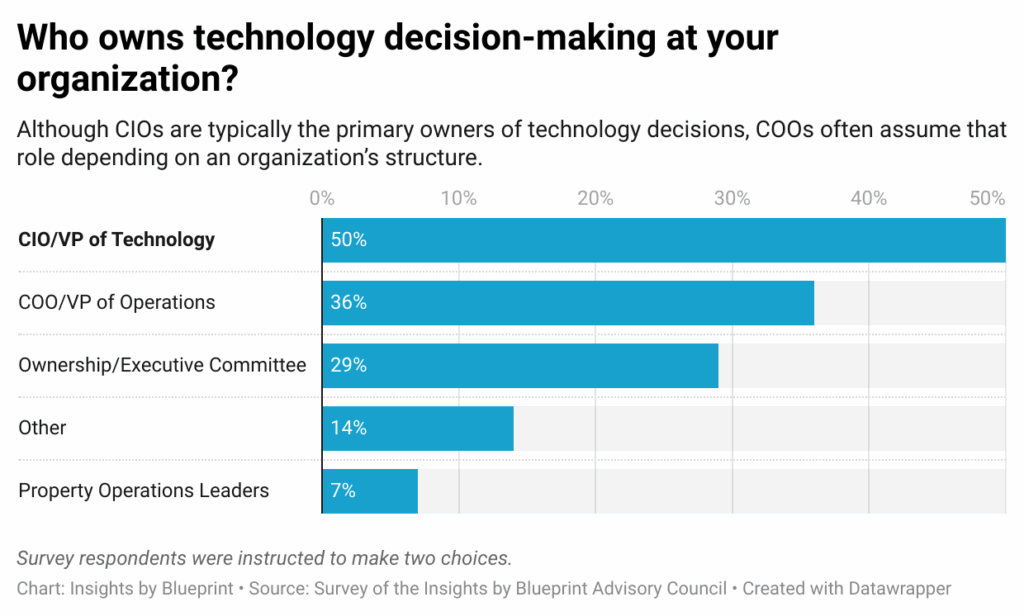
Half of the operators surveyed say technology decision-making ultimately sits with their CIO or VP of Technology. Another 36% report that responsibility lies with the COO or VP of Operations. For roughly 29% of respondents, technology decisions are owned at the highest level by the Ownership group or the Executive Committee.
A majority of operators surveyed (57.4%) say most technology or process improvement ideas originate from Operations Leadership or the IT/Technology team.
Here’s what the senior leadership at Jamestown, BXP, RPM Living, and DivCore Capital told us:
Jamestown: Innovation + Sustainability, but no central budget
Jamestown has a dedicated innovation team—now merged with sustainability under Carrie Denning Jackson—that functions across three primary areas:
- First, it manages pilots and rollouts, led by a global innovation lead who partners with individual assets to test and evaluate new tools.
- Second, it oversees data and consumer research. This function began with asset-level metrics such as foot traffic and sales and has since expanded to include a dedicated researcher who explores new markets and broader trends.
- Third, the team includes an in-house engineer who develops internal products, including abstraction tools, generative AI capabilities, data-warehouse infrastructure, and AI policy frameworks.
The twist is that innovation at Jamestown does not control its own capital budget.
Any pilot or rollout that requires meaningful spending must be funded by the business unit or asset that wants to use it. Innovation may lead the process, but the dollars must come from the people who will ultimately rely on the tool.
That structure forces natural alignment: if an asset manager or building engineer isn’t willing to fund the experiment, the idea simply doesn’t move forward.
BXP: One organization spanning IT and OT
BXP explicitly frames its world in three “lanes” of technology:
- Running the company – Corporate systems: accounting, finance, HR, and 100+ other applications that hold a $3B+ public company together.
- Embedded tech in the real estate – Everything tenants and visitors touch: access control, turnstiles, amenity tech, mobile credentials, guest experience, and in-building connectivity.
- The physical plant – Systems you don’t see: controls, energy management, sustainability tools, and the applications delivering conditioned air to every room.
Historically, many owners have split these lanes between IT and OT functions. BXP instead moved toward one group that enables all three, with:
- A CIO primarily focused on the corporate stack but supporting OT technologies, and
- A CTO (James Whalen) focused almost entirely on embedded tech and the physical plant.
The key is not just the org chart but the mindset: a single technology organization across different domains with shared standards.
RPM Living: The third-party manager problem
RPM Living manages roughly 250,000 units as a third-party operator. That changes everything. Instead of a single ownership entity, RPM has dozens of ownership groups, each with its own preferences, relationships, and, in some cases, financial ties to specific PropTech tools.
On the internal side, RPM’s IT organization includes:
- Infrastructure
- A software support group closely aligned with operations
- A data engineering team
- A business systems team largely focused on Salesforce development
Above that sits an innovation intake and review process:
- Requests often start with an ownership group pushing a specific tool.
- Ideally, they flow through an intake form reviewed by an innovation team spanning strategy, technology, finance, and operations.
- RPM first checks: Do we already have something that solves 80–90% of this? If so, the default answer is to use the existing tool and avoid stack bloat.
In practice, the model is stressed by owner-driven exceptions. “We’re not going to walk away from the business,” Pechersky says. That may mean adopting a new tool, even if it disrupts RPM’s standard “secret sauce” for managing a property.
It’s a stark reminder: organizational structure is only one layer. Ownership dynamics and capital structures are just as decisive.
DivCore Capital: Centralizing tech governance
DivCore Capital, an approximately $40–50 billion AUM investment firm spanning both equity and credit platforms, has taken a deliberately centralized approach to technology governance. Rather than scattering technology responsibilities across business lines, the firm operates with a single technology organization that supports the entire enterprise.
At DivCore, the CTO reports directly to the COO, not the CFO. This was an intentional choice. By placing technology under operations, DivCore ensures its tech strategy is aligned with the firm’s core operational functions—HR, legal, compliance, and portfolio operations—rather than being narrowly tied to finance.
Harshit Shah, DivCore’s CTO, describes this structure as critical for fostering tighter collaboration between tech and the teams most affected by process redesign, workflow modernization, and enterprise systems. The COO relationship also positions technology as a driver of strategic capability rather than simply a cost center.
When DivCore established its current tech organization, Shah moved quickly to centralize every technology-related expense across the firm. Everything from HR systems to tenant experience platforms now falls under the centralized technology budget. This decision was rooted in a clear rationale:
- It brings rigor and consistency to procurement and vendor evaluation.
- It ensures tighter contract language and negotiation standards, especially as platforms scale across the portfolio.
- And it prevents business units from making fragmented, duplicative, or incompatible purchases, a common failure mode in firms where technology is decentralized.
How pilots actually work – and why they fail
Among operators surveyed on the Insights by Blueprint Advisory Council, operations leadership is most likely to own pilot evaluation, with 43% saying Ops primarily assesses performance. IT and Technology teams follow at 21%, matched by another 21% who say pilot evaluation ultimately falls to Ownership or the Executive team.
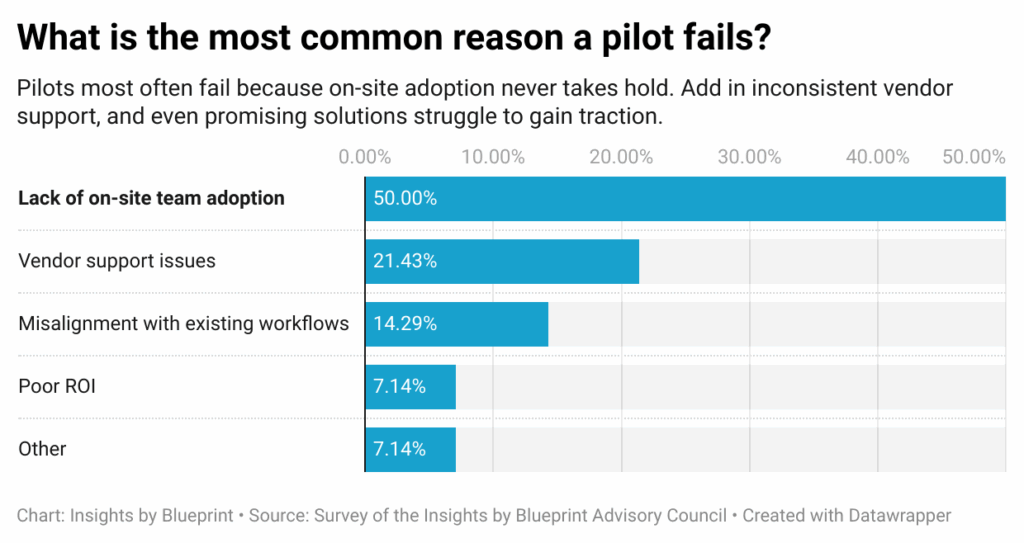
Half of operators surveyed (50%) say the most common reason a pilot fails is simple: site teams never fully adopt it. Other leading causes include inconsistent or insufficient vendor support (21%) and poor alignment with existing workflows (14%).
Every company we spoke to relies heavily on pilots. The details differ, but a similar pattern emerges among the senior leadership at Jamestown, BXP, and RPM Living: lightweight entry, rigorous gating, and a very real willingness to kill projects.
Jamestown: Lightweight entry, heavy privacy review
At Jamestown, the front door of the pilot process is deliberately easy:
- Someone meets a vendor at a conference or via inbound.
- Innovation vets references and engages an asset or property manager who appears to be a good fit.
- If the asset team is on board, they move quickly. “There’s not a lot of bureaucracy,” Denning Jackson says.
Where it gets serious is compliance:
- Any tool that touches PII, phones, or location data undergoes a rigorous privacy review.
- GDPR exposure (due to European operations) sets a higher bar than Denning Jackson experienced even at a Google-owned company.
- That review can take months, especially for data warehouses or systems that ingest device data.
Once live, innovation typically hands day-to-day management to the asset team and shifts into a monitoring and “lessons learned” role.
Success isn’t just ROI, either:
- Return on cost is the primary metric for monetary tools.
- For experience tools (e.g., access control), they’ll survey users and look at NPS.
- Property managers’ qualitative feedback carries serious weight, especially around customer service and implementation support.
- There’s explicit recognition that some “failures” are normal, especially in a volatile PropTech market.
“We’ve never gotten in trouble for a pilot failing,” Denning Jackson says. “A big part of our job is instilling a culture where it’s okay to try things and okay to fail, as long as the bets aren’t huge.”
BXP: Crawl–walk–run with built-in exit ramps
BXP uses a more formal crawl–walk–run approach:
- Pilots and implementations are structured with contractual exit strategies. If the tool doesn’t meet outcomes, BXP can walk.
- They focus on hard ROI, particularly in the post-COVID environment. Soft benefits are acknowledged but insufficient to scale.
- Before commitment, BXP conducts deep due diligence, often “going to the mountain”—visiting a vendor’s HQ to assess culture, leadership, and talent.
Recent example: a major rollout with SwiftConnect to enable Apple Wallet credentials for clients.
- BXP built a business case tied to NOI.
- Secured executive sponsorship.
- Proved outcomes in limited pilots.
- Then, it was scaled portfolio-wide.
The opposite happens too. Whalen described a significant RFP in which, after months of due diligence and narrowing down the field, BXP ultimately withdrew. “We wound up walking away and saying the market isn’t ready for what we’re trying to do,” he says.
Three pilots decommissioned in late 2023–2024 followed the same logic: no trajectory toward scale, so they were turned off.
RPM: Pilots in a fragmented, owner-driven world
At RPM, pilots are where governance meets reality. In an ideal case:
- A problem is identified in annual operating planning.
- It’s escalated if multiple departments share the pain.
- The PMO, under strategy, runs the pilot, covering scoping, asset selection, project plan, and measurement.
Assets are selected to provide a cross-section of regions and property types, and are consolidated under specific regional managers or ownership groups to simplify approvals. Success metrics are a blend of:
- Time savings and cost savings (especially if consolidating tools).
- Measurable expense reductions.
- Consolidation benefits (fewer integrations, fewer vendors to manage).
- Subjective property-level feedback via PMO-run surveys.
The pilots that don’t go well tend to share a theme: they skipped the PMO and stakeholder alignment step.
- A department buys a tool directly.
- IT, cyber, and data needs are discovered late.
- Integration proves expensive or limited.
- The tool may duplicate functionality already available in the PMS or another system.
For Pechersky, virtually every failed pilot traces back to a simple root cause: someone assumed they understood everyone else’s needs and systems, and they didn’t.
DivCore: A clear path to rollout
DivCore’s technology team owns the end-to-end structure of each pilot—scoping, contracting, success metrics, and vendor management—which allows business users to focus on what matters most: whether the tool meaningfully improves their workflow.
A recent example is REN Systems, an AI-powered CRM deployed initially to front-facing teams in leasing and asset management. By focusing the pilot on measurable behavioral improvements, DivCore was able to quantify value early. Once the lift became clear, the platform advanced quickly to portfolio-wide rollout.
Despite the firm’s disciplined approach, Shah emphasizes that pilot failures remain common—and valuable.
The breakdowns tend to fall into three categories:
- Process mismatch: The technology cannot fully translate or adapt to DivCore’s unique business processes. Even well-designed platforms struggle when the firm’s structures or approval flows differ from SaaS defaults.
- User adoption issues: If users resist the tool or struggle to adapt to the new workflow, the pilot quickly loses momentum. DivCore views adoption as a leading indicator of whether a solution is intuitively aligned with real-world operations.
- Vendor misunderstanding: Some vendors—particularly horizontal or cross-industry platforms—do not grasp the nuances of the CRE business model. DivCore encountered this with a large, generalist portfolio management tool whose team underestimated the complexity of real estate asset, leasing, and fund workflows.
How these firms evaluate vendors (and walk away)
When evaluating vendors, Advisory Council operators prioritize ease of integration with their PMS and CRM systems, as well as total cost and expected ROI. They also emphasize strong vendor support and responsiveness, as well as the ability for a solution to scale effectively across their portfolio.
All five leaders we spoke with have become more conservative and more structured about vendor selection. Denning Jackson at Jamestown has watched multiple vendors—particularly in EV charging—go bankrupt or fade.
- Denning Jackson asks about runway, capital raises, and who the investors are, but acknowledges you’re still placing a bet.
- She has a clear soft spot for bootstrapped companies and those that have grown slowly without heavy outside capital, because the “belly-up risk” feels more contained.
- Early in her tenure, she preferred tools that JLL, CBRE, or other large owners had already tried to de-risk during the early vendor phase.
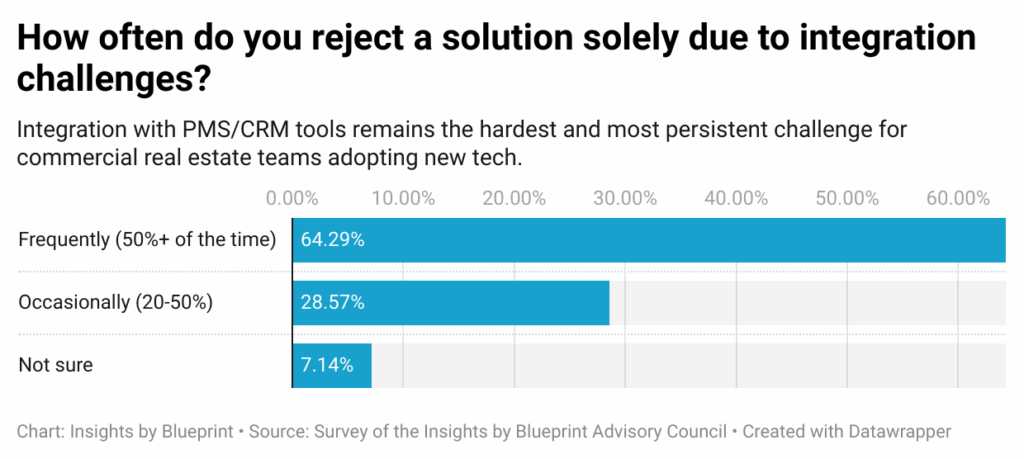
Integration remains one of the most significant barriers to adopting new technology. Sixty-four percent of Advisory Council operators say they “frequently” reject a solution outright if the integration requirements are too uncertain.
Every interview pointed to integration and redundancy as make-or-break issues.
- RPM explicitly challenges its teams: Are we buying something we mostly already own? Can we push an existing vendor to add features instead of onboarding another platform?
- Pechersky is skeptical of any vendor that claims “We integrate with your PMS” without being in an official integration program or offering true API-based connectivity. “Trust, but verify,” is his mantra.
- He also emphasizes identity management: tools that don’t support SSO or modern identity platforms create hidden labor and risk.
DivCore uses a multi-channel approach to identifying and vetting new technology solutions, ensuring that any platform entering the pipeline is grounded in real operational need and validated by trusted industry partners.
Divcore uses several intentional channels to bring new solutions into the organization. Each one ensures the tech pipeline remains aligned with real business needs rather than vendor noise or hype cycles.
Most technology sourcing begins with requests from business units, including:
- Asset Management
- Accounting
- Investor Relations
- Operations and field teams
These groups surface:
- Workflow bottlenecks
- Capability gaps
- Repetitive or error-prone processes
- Areas where automation or analytics could drive lift
The technology team then translates these needs into structured problem statements that serve as the foundation for evaluating potential tools. This keeps sourcing grounded in operational relevance, not novelty. DivCore technology leaders place significant weight on peer validation. They frequently tap:
- CIO and CTO networks across other CRE operators
- Informal peer groups focused on technology, integrations, and vendor performance
- Benchmark conversations about pricing, support quality, and roadmap maturity
Peers provide:
- Candid feedback on integration complexity
- Real-world performance insights
- Warnings about gaps not obvious in sales decks
- Confirmation of whether a tool is actually delivering ROI
This “peer-first diligence” acts as an early filter before any deep engagement with the vendor.
Once a vendor enters the pipeline, the evaluation process becomes structured and technical. DivCore conducts deep dives, live demos, architecture walkthroughs, and integration assessments. The evaluation team includes leaders with both business and technology backgrounds, ensuring solutions are vetted not only for feature fit but also for workflow alignment, data model compatibility, and long-term scalability.
What “success” really means (beyond ROI)
Across these organizations, success is measured in several layers:
- Hard financial outcomes
- Return on cost and NOI impact (Jamestown, BXP).
- Expense reduction and vendor consolidation (RPM).
- Clear business cases tied to specific owners (all).
- Operational resilience
- Vendors that continue to provide reliable customer service six months after the pilot.
- Tools that survive corporate reorgs, asset sales, and changing leadership priorities.
- Cloud-ready systems that can handle an industry shift to SaaS in access control and building controls (BXP).
- Cultural impact
- At Jamestown, experimentation is part of the employer value proposition: people see the company as innovative because it tries things, not because every pilot succeeds.
- RPM emphasizes psychological safety: allowing some “failure” as long as it moves the organization forward.
- Strategic positioning
- BXP is investing heavily in mobile access, cloud-based facility systems, amenity tech, and DAS as a long-term differentiator.
- Jamestown is focusing on energy, AI, and healthy building materials as dual sustainability + cost levers.

Adapt, learn, improve
If there’s a single throughline across every interview and survey response, it’s this: real innovation doesn’t happen in the pilot lab or the boardroom but in the structure around them. High-performing operators are redesigning how decisions are made, how teams collaborate, and how technology is evaluated in an increasingly crowded and uncertain market.
They’re methodical in sourcing, ruthless in prioritization, and pragmatic in scaling. They know that a failed pilot is far less costly than a platform that never fits. And above all, they understand that innovation isn’t about novelty but about building organizations that can adapt, learn, and improve at speed.
– Nick Pipitone