


Pets have quietly become an influential force shaping multifamily housing. What was once treated as a secondary amenity or a marginal risk has evolved into a core operational consideration that affects leasing velocity, resident retention, compliance exposure, maintenance costs, revenue strategy, and brand perception.
As pet ownership approaches saturation levels among U.S. renters, operators are no longer deciding whether to accommodate pets, but how deeply pet strategy should be embedded into daily operations.
This shift has exposed a growing gap between properties that market themselves as pet-friendly and those that are truly pet-inclusive in practice. Amenities, policies, documentation workflows, and enforcement mechanisms now play a direct role in resident satisfaction and can create a competitive advantage.
This report examines how pets are reshaping multifamily operations and why operators who continue to treat pets as a simple checkbox risk falling behind those who recognize pet strategy as a core component of the modern renter experience.
Who let the dogs in?
One of the clearest shifts in multifamily operations recently is the reclassification of pet amenities from a discretionary luxury to a competitive necessity.
With a growing number of U.S. pet-owning renters, especially since the pandemic, communities that want to remain viable can no longer treat pet accommodations as optional. This means properties must provide the basics—explicit pet-friendly signaling, inclusive policies, and functional infrastructure—simply to compete.
At the ground level, this shift translates into modest but critical amenities that support everyday behavior. Dog waste stations, visible and well-stocked bag dispensers, and clearly marked receptacles are now part of the expected operating environment. Rather than premium upgrades, they represent table stakes for maintaining cleanliness and reinforcing responsible pet ownership across the community.
This operational reality is reflected in how large property management companies present themselves to the market. Many of the largest PMCs now weave pets directly into their brand identity and marketing collateral.
Pets appear prominently on website landing and home pages, as well as in promotional imagery, often without explicit calls to action or pet-specific messaging. Instead, the strategy is psychological and cultural.
In some cases, operators are subconsciously using pets in all their marketing to attract pet owners. The presence of pets in imagery signals inclusivity, warmth, and lifestyle compatibility, even when the marketing spend is not explicitly labeled as “pet-focused.”
This phenomenon extends well beyond real estate. Brands with no direct connection to housing—or even pets—routinely incorporate animals into their visual language to create emotional resonance. Pets are a powerful emotional connector, and ignoring that reality may create a competitive hindrance.
Underlying this shift is a simple demographic truth. Roughly 46% of U.S. households own at least one dog, and 32% own at least one cat, according to the American Veterinary Medical Association.
Zillow’s latest analysis of more than 11 million rental listings also found that pet-friendly units are typically leased about eight days faster than comparable non-pet-friendly listings. These trends help explain why pet inclusion has shifted from a niche consideration to a core strategic focus for many rental property operators.
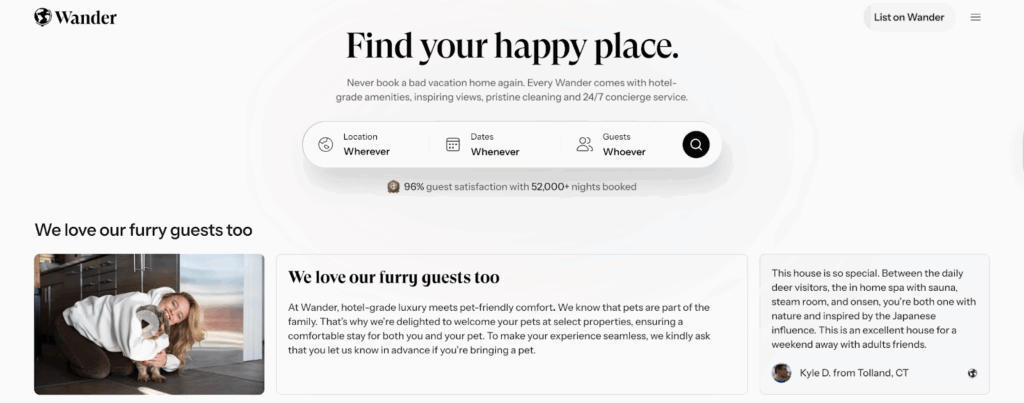
Caption: Wander, the short-term rental platform, prominently mentions on its website that “we’re delighted to welcome your pets at select properties.”
The cost of undisclosed pets
One of the most persistent operational challenges in multifamily is not the presence of pets themselves, but the gap between actual pet ownership and what is formally disclosed to property managers.
The average pet-owning U.S. household owns 1.5 dogs and 1.8 cats, according to the American Veterinary Medical Association. Within rental housing, that figure drops to approximately 1.2 pets per household, according to PetScreening. This technology company provides pet policy management and animal compliance software for the rental housing industry.
John Bradford, Founder and CEO of PetScreening, says the statistics point to a persistent issue in multifamily: a meaningful share of pets are living in apartment communities without being surfaced through official channels.
That gap—roughly 0.4 pets per household—represents more than a statistical anomaly. It translates directly into unknown liability and lost revenue.
Whether intentionally or not, some residents choose not to disclose their pets, creating blind spots that expose operators to risk while undermining fairness for compliant residents who follow the rules and pay associated fees.
To address this, some operators have adopted a compliance-first approach applicable to all residents, not just pet owners. Under this model, every incoming resident completes a standardized profile acknowledging community pet policies, even if they do not have a pet. These no-pet profiles include explicit attestations that residents will not foster animals, host pet visitors, or engage in pet-sitting activities that often fall into gray areas but carry real risk.
Visiting dogs, in particular, are a recurring source of incidents. Weekend scenarios—such as a partner bringing a dog to stay overnight—are common, and operators report that many dog bites occur with visiting dogs.
Fostering presents a similar challenge. While well-intentioned, foster animals often have unknown histories, which can introduce elevated risk in shared residential environments. As a result, policies increasingly prohibit both fostering and visiting pets unless explicitly approved.
The operational value of documentation becomes especially clear when incidents occur. In one example, Bradford said a large multifamily customer faced a lawsuit after a visiting dog bit someone on the property. The operator demonstrated that the resident had completed a no-pet profile, explicitly stating that there would be no pet visitors.
“They were able to show the lawyers the no-pet profile, and it got them out of the lawsuit,” Bradford said. It underscores a critical point: property managers cannot realistically police every entry point. What they can do is ensure that residents are formally documented and acknowledge the rules.
This approach reframes pet management as a documentation and compliance exercise rather than a punitive enforcement strategy. The goal is not to penalize residents without pets, but to ensure clarity and defensibility in the event of an issue.
ESAs remain a persistent pain point
Assistance animals—particularly emotional support animals—have long represented one of the most complex and sensitive operational challenges in rental housing.
As Bradford described it, this issue has been “the Achilles heel” of pet policy enforcement and, ultimately, a key reason why his company, PetScreening, was created. Drawing on experience as a state legislator responsible for tenant–landlord law and as a former property manager, he observed a steady rise in residents claiming their pets were ESAs.
While many of these requests are legitimate and tied to real disabilities, those residents are not the problem, according to Bradford. Instead, widespread misuse—such as buying certificates online or placing vests on untrained animals—has created confusion and skepticism that unfairly impacts those with genuine needs.
Frontline property managers are often caught in the middle. They’re trained to avoid actions that could trigger discrimination complaints, making ESA claims particularly fraught. Lacking confidence in how the law applies, many default to acceptance. While understandable, this approach exposes operators to inconsistent enforcement, legal risk, and internal inequity across portfolios.
The core issue is not malicious intent but uncertainty.
Fair housing law is highly specific, and even experienced real estate attorneys may not fully understand its nuances. As a result, operators face two realistic options: build and staff a specialized internal compliance function—often with outside counsel—or outsource the process to a platform designed specifically for this purpose.
When pet policies push renters toward workarounds
As ESA claims have proliferated, many operators have also begun to worry that traditional pet revenue models are breaking down. Kerry W. Kirby, Founder and CEO of 365 Connect, summarized a concern he hears frequently from property owners: “Everybody’s got an ESA, and my pet revenue is going to zero.”
In portfolios where pet rent averages $20–$25 per pet per month, operators are increasingly questioning whether the administrative friction and resident dissatisfaction created by pet fees are worth the marginal revenue they generate.
Third-party platforms such as PetScreening can help manage ESA claims, but Kirby outlines a different approach to handling pet fees and revenue.
Rather than charging monthly pet rent per pet, he suggests operators run the numbers and consider blending that revenue into base rent. “Why don’t I just blend that in my rent and say, pets are free?” he said. From a marketing perspective, the appeal is clear: removing pet rent entirely creates a simple, differentiating message while preserving overall revenue through modest rent adjustments spread across the full unit base.
This does not mean eliminating all financial or ESA safeguards. Deposits still play a role in addressing real wear-and-tear risks, particularly with younger animals. In that context, deposits and clear criteria remain important, even if monthly pet rent disappears.
“Removing or restructuring fees can be a differentiator for price-sensitive renters. But operators would need to replace fee removal with a smarter risk- and maintenance-management strategy,” Kirby says. “Otherwise, you risk creating hidden costs that exceed the marketing gains.”
But it’s worth noting that from the renter’s perspective, friction matters.
Kirby says that interviews and renter feedback suggest that when pet policies feel overly complex or expensive, residents are more likely to look elsewhere or attempt to classify their pets as ESAs. Portals and documentation requirements are not inherently problematic, but when combined with high recurring fees, they can push residents toward workarounds rather than compliance.
What pet-owning renters actually value
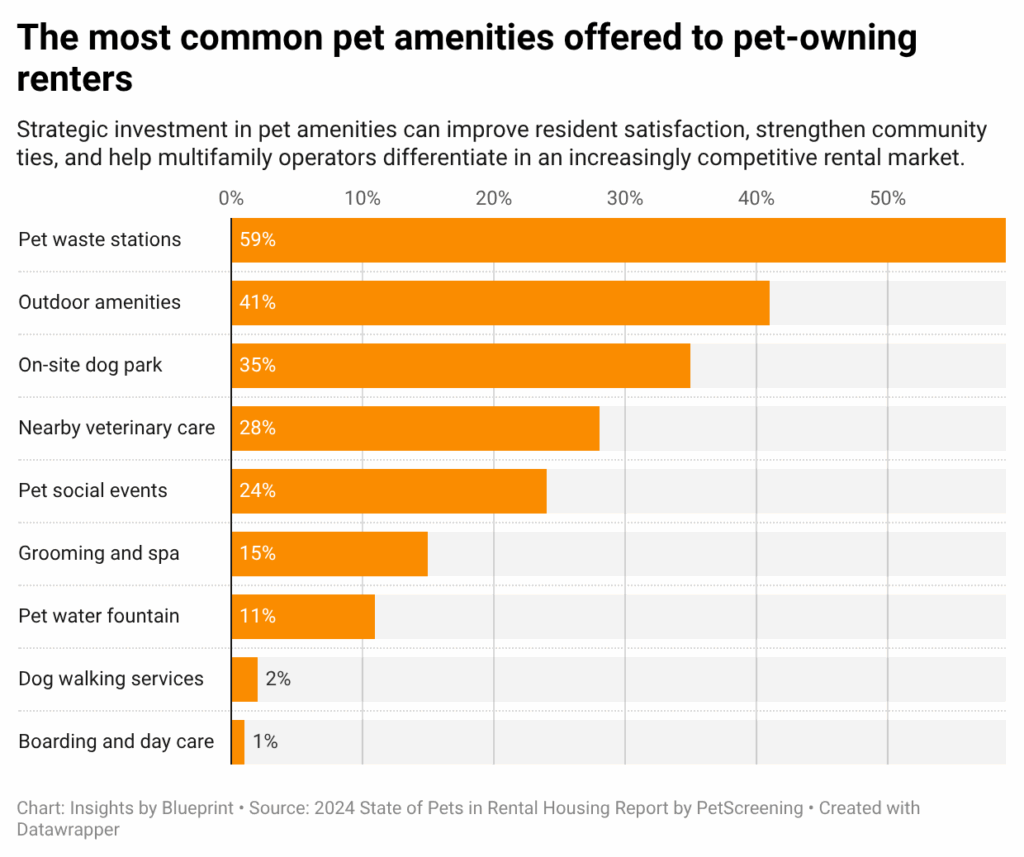
Operator assumptions about pet amenities often skew toward high-visibility, “Instagram-friendly” features, but survey data suggests that pet owners prioritize practicality over polish. In a multi-year collaboration with Jay Turner Research, PetScreening tested a range of pet amenities and found that “the flashiest things aren’t always the most valuable.” While stainless steel dog wash stations photograph well and are featured prominently in marketing materials, they were not the amenities pet owners valued most in day-to-day use.
Instead, the research pointed to a clear hierarchy of functional needs.
Pet owners consistently favored enclosed dog areas, such as basic dog parks, over more elaborate installations. Shade emerged as a surprisingly critical factor, as owners often need to stand and wait while their dogs play.
Perhaps most telling was the emphasis on waste management. Pet owners did not simply want waste stations. They wanted assurance that bags would actually be available. Responsible pet owners intend to clean up after their animals, but they need reliable infrastructure to support it.
These findings, drawn from a survey of more than 30,000 respondents, reinforced that consistency and upkeep often outweigh novelty in determining amenity value.
Beyond physical infrastructure, operators are recognizing that experience and community play equally important roles. One customer survey of renewing residents found that some tenants stayed in their apartments not just for the unit, but because they believed their pet had formed social connections within the community.
“Some residents know their co-residents’ pets’ names before they know the person’s name,” Bradford said.
This insight has shifted attention toward pet-centric programming and informal interactions. Small events, on-site gatherings, or even the daily rituals of meeting other dog owners can have an outsized impact on resident satisfaction and renewal decisions.
Compared to standalone amenities like dog wash stations, these shared experiences often reinforce the idea that successful pet strategies are less about expensive installations and more about creating functional spaces and social environments that support everyday life with pets.
When ‘pet-friendly’ breaks down
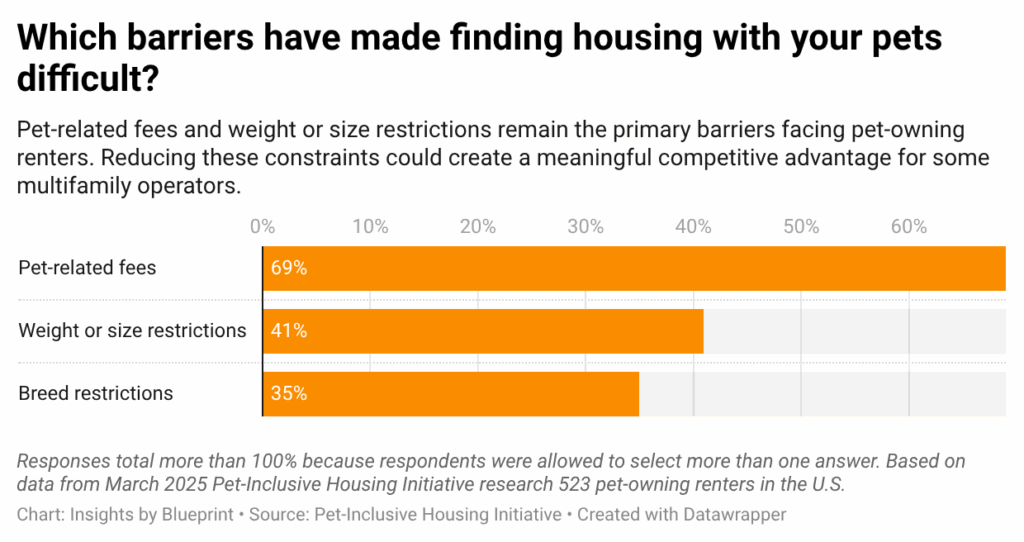
Breed restrictions remain widespread in multifamily housing, but operators are increasingly questioning them. From an operational standpoint, the persistence of these policies reflects a mix of genuine risk concerns and institutional inertia. In practice, however, legacy plays a larger role than many owners are willing to admit.
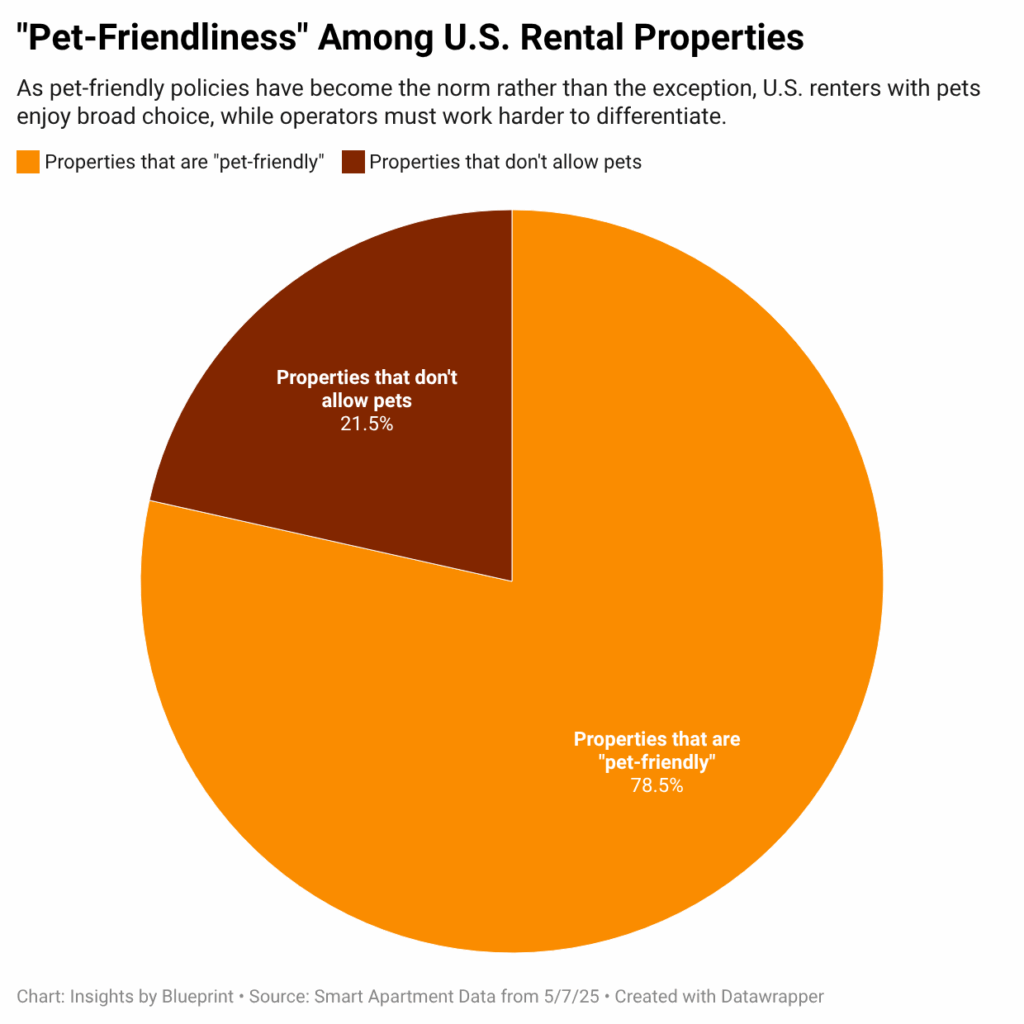
Market data shows a meaningful gap between perception and reality in pet-friendly rentals. Although many communities describe themselves as pet-friendly, less than 10% of those properties allow pets without breed or size restrictions, according to national housing data compiled by Smart Apartment Data.
This disconnect highlights a broader tension between branding and operations. Properties may signal openness to pet owners while relying on decades-old policy frameworks that limit true inclusivity.
What is beginning to change is not overnight policy reversal, but the questions operators are asking. Instead of defaulting to breed-based exclusions, more owners are reconsidering whether those rules truly address risk.
“Are we managing behavioral risk, or just using breed as a proxy because it’s easy?” has become a more common internal debate. In response, some operators are shifting toward individualized screening models that emphasize vaccination documentation, owner accountability, and behavior-based rules.
These approaches are often seen as more legally defensible, more data-driven, and better aligned with modern resident expectations, even as the industry continues to unwind long-standing assumptions at a measured pace.
Some operators have begun to drop breed restrictions entirely after implementing more structured pet management tools, a shift that reflects both evolving attitudes and increased confidence in data-driven oversight.
Despite these shifts, breed restrictions remain common in rental housing pet policies. Many communities still rely on broad “dangerous breed” lists that prohibit dog types, a practice rooted in long-standing industry assumptions about liability and risk rather than in solid predictive data.
According to PetScreening’s State of Pets in Rental Housing report, breeds such as pit bulls, Rottweilers, and Dobermans are among the most frequently banned, even though the data do not show a clear link between breed and property damage or incident rates. Bradford and others in the industry have publicly challenged the logic of breed-based policies, arguing that they are grounded in stereotype rather than behavior-based risk assessment.
There is also a strong correlation between restrictive pet policies and higher volumes of assistance animals entering properties. As Bradford noted, “If they don’t allow dogs over 60 pounds, they’re going to have larger assistance animals. If they don’t allow pit bulls or German Shepherds, those are coming in anyway as assistance animals.”
This dynamic has prompted some operators to reconsider whether rigid restrictions are achieving their intended outcomes or simply shifting risk into more complex compliance territory.
Even so, most observers agree that change is slow. Many property managers prefer to stick with familiar policies rather than risk unintended consequences. The prevailing mindset remains “don’t change what you already have,” particularly among operators who lack the data or internal bandwidth to experiment.

Multifamily has gone to the dogs
When asked to identify the single biggest mistake operators still make in their approach to pets, industry leaders consistently point to framing. Too many owners treat pets as either a pure risk problem to be controlled or a standalone revenue line item to be monetized, rather than as a core component of the resident lifecycle.
This narrow view can be costly.
Operators who over-index on restrictions and fees may reduce a limited category of risk, but often at the expense of higher vacancy friction, increased resident conflict, negative reviews, and a rise in ESA-related disputes.
Conversely, those who market themselves as “pet-friendly” without enforceable standards invite avoidable unit damage, liability, neighbor complaints, and operational inconsistency. The optimal approach lies in the middle: a balanced, enforceable, and resident-friendly pet program that aligns risk management with lived experience.
Over the next five years, operators who successfully “figure out” pet strategy will distinguish themselves through a more mature, systems-level approach.
Rather than relying on breed as a proxy for risk, they will adopt behavior-based policies that emphasize accountability and documentation. Pricing will become more sophisticated and market-tuned, with flexible options that may include traditional deposits or insurance-style models where legally appropriate.
Operationally, these leaders will treat pet inclusion as a design and execution challenge, not just a policy choice. Pet-inclusive design and operations—durable interiors, clear cleaning standards, simple and enforceable rules, and low-friction compliance—will be built into day-to-day management.
Operators who continue to treat pets as a checkbox, by contrast, are likely to fall behind, losing ground to competitors who recognize pets as a central part of the modern renter experience rather than an afterthought.
– Nick Pipitone