

Electric vehicles are moving into the mainstream of American transportation—and into the parking lots and garages of multifamily properties. Yet while EV sales continue to climb, access to charging remains uneven for renters.
For multifamily operators, this creates a new strategic challenge. EV charging is increasingly expected by some residents, but it collides with real-world constraints around power capacity, parking design, vendor reliability, and cost recovery.
Some portfolios are already finding ways to monetize charging and improve resident retention, while others are struggling with stalled projects, underused equipment, and uncertain returns.
This new report draws on exclusive survey data from our Insights by Blueprint Advisory Council to examine where the market truly stands—and what it will take for EV charging to evolve into durable, scalable building infrastructure.
An underserved EV charging segment
Global electric car sales surpassed 17 million in 2024, rising more than 25% year over year, according to the International Energy Agency. The roughly 3.5 million additional EVs sold in 2024 alone exceeded total global electric car sales for all of 2020.
BloombergNEF forecasts that U.S. passenger EV sales will grow from about 1.6 million in 2024 to around 4.1 million by 2030, even as federal policy changes slow adoption compared with earlier expectations. But not all EV users are benefiting equally from the build-out of EV charging infrastructure.
Multiple reports show that residents of multifamily housing often face disproportionately limited access to EV charging compared with single-family homeowners.
Because many renters lack dedicated off-street parking and building electrical infrastructure, multifamily properties frequently face EV-readiness challenges, such as inadequate panel capacity and conduit, which complicate charger installation. Utility interconnection processes, delays, and unexpected upgrade costs can also slow or derail multifamily EV projects before chargers are installed.
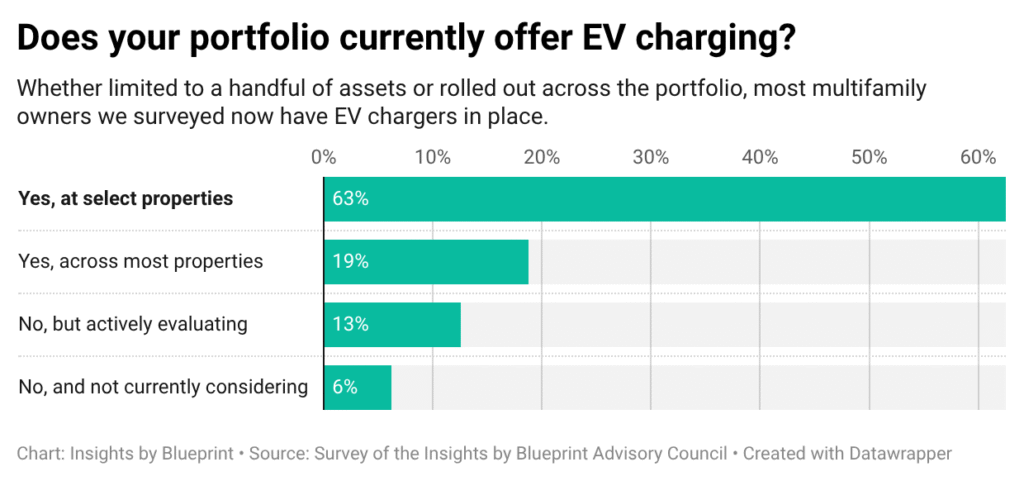
According to our survey, multifamily operators are beginning to catch up. In a survey of the Insights by Blueprint Advisory Council, 63 percent of operators said they currently offer EV charging at select properties, while another 19 percent have deployed it across most of their portfolios. Just 6 percent reported that they neither offer EV charging nor plan to.
Demand is real, but not universal
For many renters—especially higher-income urban and suburban professionals—access to EV charging is becoming an important amenity. This is reflected in how institutional real estate firms are expanding their investments into EV charging infrastructure nationwide.
Last year, CBRE tapped Santa Monica–based EVPassport to deploy more than 3,600 EV chargers across roughly 600 U.S. properties, with a focus on multifamily and hospitality assets. The deal reflects how quickly EV charging is becoming a core real estate amenity.
And while the federal EV tax credit has expired, a patchwork of state and local incentives continues to support new charging deployments and sustain market growth. As David Aaronson, founder and CEO of Refuel EV Solutions, puts it: “Just one new or retained resident provides property owners with an accretive return.”
“They are necessary at every property,” one operator told us in our survey. “It is helpful to monitor usage reports and plan for additional installs as usage grows. It can become a negative amenity if there are not enough.”
Another operator told us, “Having EV charging at our properties is table stakes. We can’t not have it in our market. We install as many chargers as possible at our sites, but it’s never enough.”
Not everyone agrees with this view, reflecting that EV charging remains an amenity whose demand varies from market to market. Despite the increasing build-out of charging infrastructure, most operators we surveyed say resident demand has yet to fully materialize.
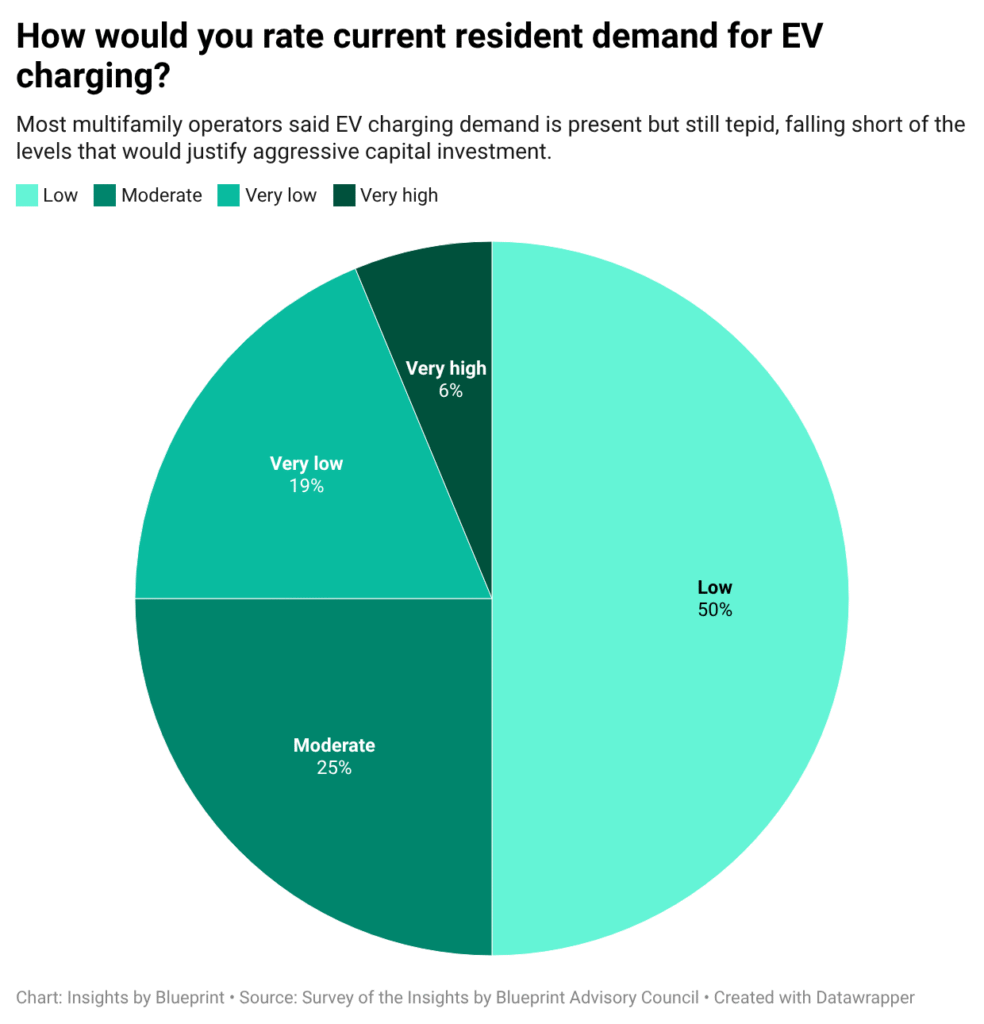
In a survey of the Insights by Blueprint Advisory Council, 50 percent of respondents described demand for EV charging as low, and another 19 percent said it was very low. Just 6 percent reported very high demand. This gap suggests many portfolios are still in the early stages of EV adoption, even as long-term expectations continue to rise.
According to the survey results, EV charging has also not produced a clear, measurable lift in leasing or retention for most operators. In the survey, 31 percent of respondents said EV charging has had no measurable impact or that it is still too early to tell. Only 6 percent reported a significant impact, while another 13 percent described the effect as modest. This suggests that, for now, the financial upside is more about long-term positioning than immediate leasing gains.
Power, parking, and payments
EV charging in multifamily housing is not a matter of “installing a few outlets.” It is a systems problem that collides with three fundamental constraints inside every building: electrical capacity, parking design, and the ability to meter and bill electricity. How well those three layers are managed largely determines whether charging becomes a value-adding utility or an ongoing operational headache.
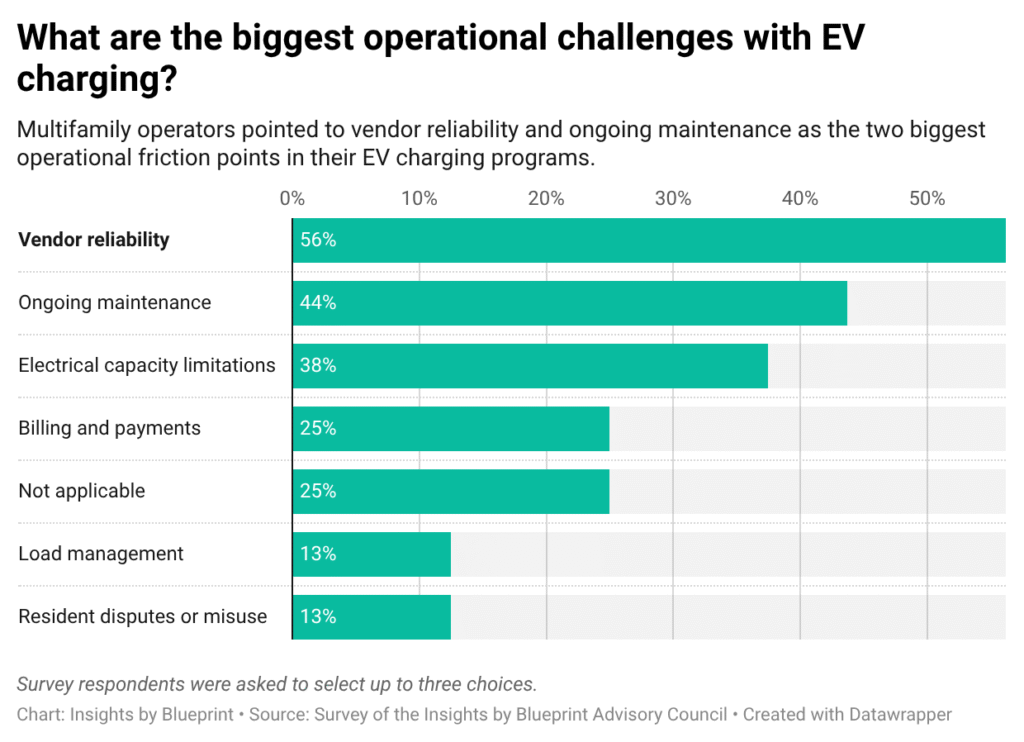
Most multifamily properties were never designed for dozens of high-load charging sessions running overnight. Without intelligent load management, even 10 to 20 Level-2 chargers can overwhelm a building’s electrical service, triggering costly upgrades or reliability issues. In our survey, 38 percent of operators cited electrical capacity as their single biggest challenge. But that technical bottleneck is only part of the story.
Many operators say the smartest EV strategy begins long before the first charger is installed. “We need to lay the conduit for every building during construction,” one operator told us. “You may not use it for years, but it’s dramatically cheaper to do it upfront. There are also companies willing to take on the capital risk in exchange for most of the charging revenue. For a $100 million building, the roughly $5,000 in potential EV revenue just isn’t worth the investment for us — but it is for them.”
That tension between long-term infrastructure planning and near-term economics is evident in the survey data. Forty-seven percent of respondents said EV charging is easiest to deploy in existing, stabilized properties, where usage is more predictable, and upgrades can be targeted.
Another 33 percent said ground-up developments offer the best opportunity, since conduit, panels, and parking layouts can be designed for EVs from day one. This reduces future retrofit costs and keeps options open as adoption grows.
Operators are just as likely to struggle with the companies that install and maintain the equipment. More than half of respondents (56 percent) pointed to vendor reliability as their top concern, while 44 percent cited ongoing maintenance.
“Startups fail, and identifying replacement carriers/vendors can be a challenge,” one operator told us in the survey.
The choice of charging provider has cascading implications for a property’s electrical design. Many buildings must extend power to distant parking areas, reconfigure panels, or distribute chargers across multiple circuits to avoid overloads and voltage drops. Those engineering decisions shape everything from project budgets to how many chargers can realistically be deployed to which parking spaces can be designated for EV use.
Parking layouts add another layer of complexity. Charging works best when residents return to the same assigned space each night. But many communities rely on unassigned parking, tandem spots, or surface lots far from electrical rooms. Each of those layouts increases trenching costs, cable runs, and management friction, making scale harder and more expensive.
Then there is the question of money. Electricity has to be measured, assigned, and recovered. Without integrated software, properties end up giving away power, mediating resident disputes, or manually reconciling usage.
In our survey, one quarter of respondents said billing and payments were their biggest operational challenge, a sign that the financial plumbing of EV charging is just as critical as the electrical wiring.
Put together, these constraints explain why EV charging in multifamily housing is not a simple amenity. It is infrastructure — technical, operational, and financial — and success depends on getting all three right simultaneously.
Most portfolios are still playing it safe
Early approaches to multifamily EV charging—such as installing just a handful of shared chargers in common parking areas—may have sufficed when EV adoption was low. But they quickly fall short as more residents adopt electric vehicles. Various reports on multifamily charging emphasize that resident interest and demand are growing rapidly, often far outpacing limited, shared charger deployments.
As EV penetration increases, these limited resources can lead to queuing and access conflicts, especially when residents expect dependable, guaranteed access to charging. Multifamily charging experts emphasize that higher adoption requires structured system design, access management, and expanded capacity to prevent operational friction.
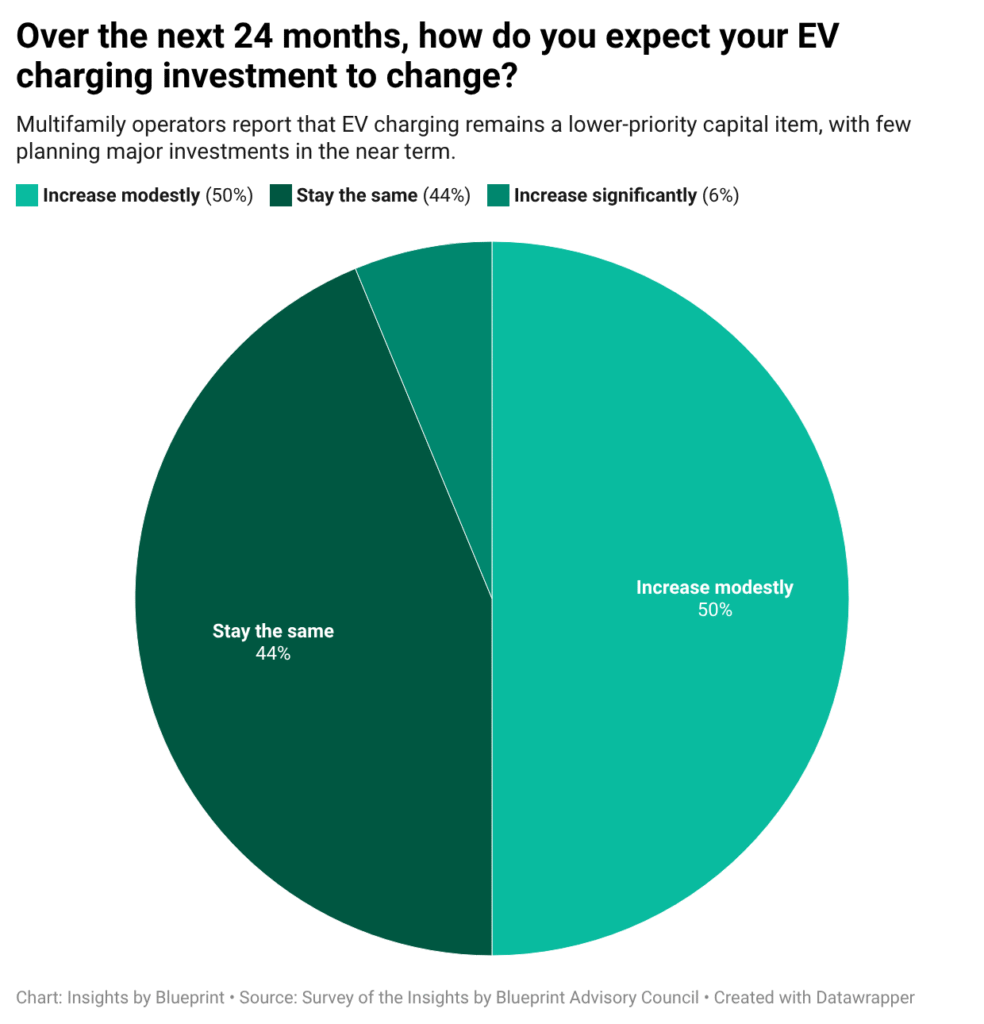
But despite warnings from EV charging providers about accelerating adoption and looming capacity gaps, most multifamily operators are not yet treating charging as a high-priority capital investment. In our Blueprint survey, 50 percent of respondents said their spending on EV charging over the next 24 months will increase only modestly, while 44 percent expect it to remain roughly flat. Just 6 percent anticipate a significant increase. This suggests that, for now, many owners see EV charging as something to manage incrementally rather than aggressively scale.
The varying ROI of EV charging
EV charging is increasingly viewed not as a sunk capital cost but as a revenue-generating utility. Property owners can monetize chargers by charging tenants and visitors per kWh, applying monthly access or subscription fees, bundling charging with parking, or implementing hybrid pricing models.
Most multifamily operators are already treating EV charging as a recoverable utility rather than a free amenity. In the Blueprint survey, 56 percent of respondents said they pass charging costs directly to residents through usage or access fees, while just 13 percent said they offer charging at no cost.
With the right pricing strategy and utilization, charging income can help cover operating costs and contribute positively to net operating income, in some cases allowing properties to recoup installation costs within a few years.
Still, the return on EV charging remains uneven across portfolios.
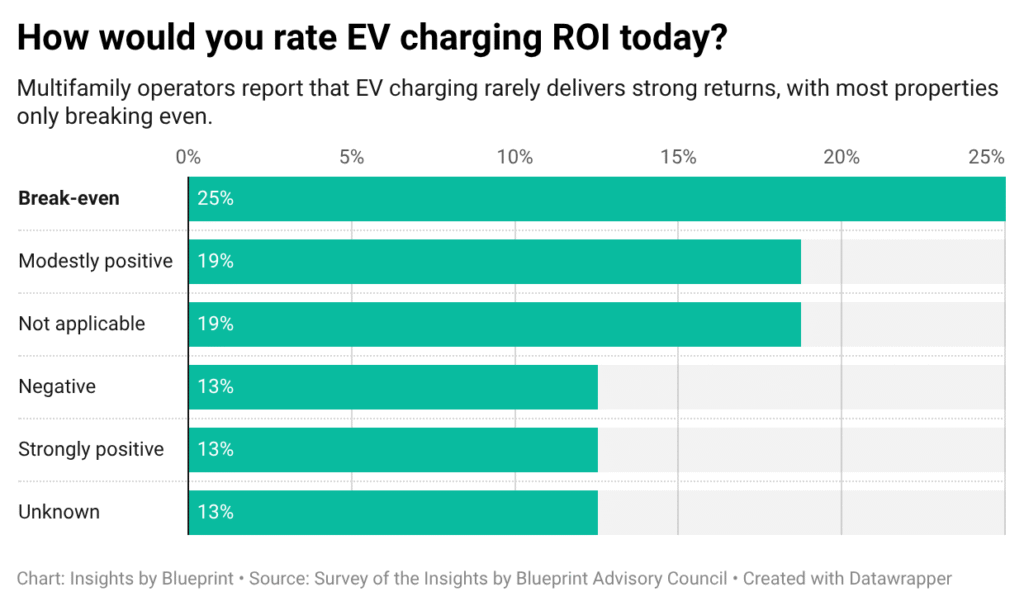
In our survey, 25 percent of respondents said their charging programs are roughly breaking even, while 19 percent reported modestly positive returns. At the same time, 13 percent said their programs are operating at a loss, and another 13 percent described ROI as strongly positive. This highlights how outcomes depend heavily on how systems are designed, priced, and scaled.
The road ahead for multifamily EV charging
EV charging in multifamily housing has entered an awkward but decisive middle phase.
The technology is proven, adoption is accelerating, and resident expectations are rising. But some portfolios may still be treating charging as a small, incremental amenity rather than the utility-scale infrastructure it is becoming.
Our survey of multifamily operators on the Insights by Blueprint Advisory Council shows a market in transition. Operators are deploying chargers, recovering costs, and in some cases generating real returns. But uneven demand, vendor risk, and electrical constraints continue to limit confidence and capital commitment.
The next wave of winners will not be the properties that simply add a few more plugs, but the ones that plan for scale, designing systems that integrate power, parking, billing, and software into a coherent platform.
As EV adoption moves deeper into the mainstream, multifamily owners who make those investments early may be better positioned to capture revenue, retain residents, and avoid the far higher costs of playing catch-up later.
– Nick Pipitone