


From Facebook to TikTok, social media is increasingly influencing how renters discover and evaluate apartment communities. A recent Sprout Social survey revealed that 40% of respondents said social media influences their decision to rent a property. These platforms serve as a credibility check, especially for younger renters. They help prospects see real photos, amenities, and community activity before deciding whether to contact a property.
But maintaining a consistent social media presence is challenging for property teams already stretched thin. Social media falls to the bottom of the priority list, leading to irregular posting schedules or inactive channels. That inconsistency limits the channel’s effectiveness. According to multifamily advisors, nothing is more “cringe” to a Gen Z renter than an inactive social media page.
This report draws on a survey of the Insights by Blueprint Advisory Council, offering a detailed look at how leading multifamily operators approach social media marketing today. It is further informed by conversations with operators to surface best practices and by an overview of the most effective AI-driven social media tools currently in use across multifamily communities.
Lots of content, but little clarity
As multifamily operators experiment with social media, questions remain about which platforms and content strategies actually drive leasing outcomes. New survey data from the Insights by Blueprint Advisory Council offers a clearer look at where teams are focusing their efforts, and where results are still falling short.
Our survey found that multifamily operators continue to focus their social media efforts on visual, consumer-facing platforms, with Instagram leading at 64.3%, followed by Facebook and TikTok at 57.1% each. More professionally oriented or long-form channels see less adoption, with LinkedIn used by 42.9% of respondents and YouTube by just 21.4%. Notably, nearly 29% of respondents reported not actively using any social media platforms.
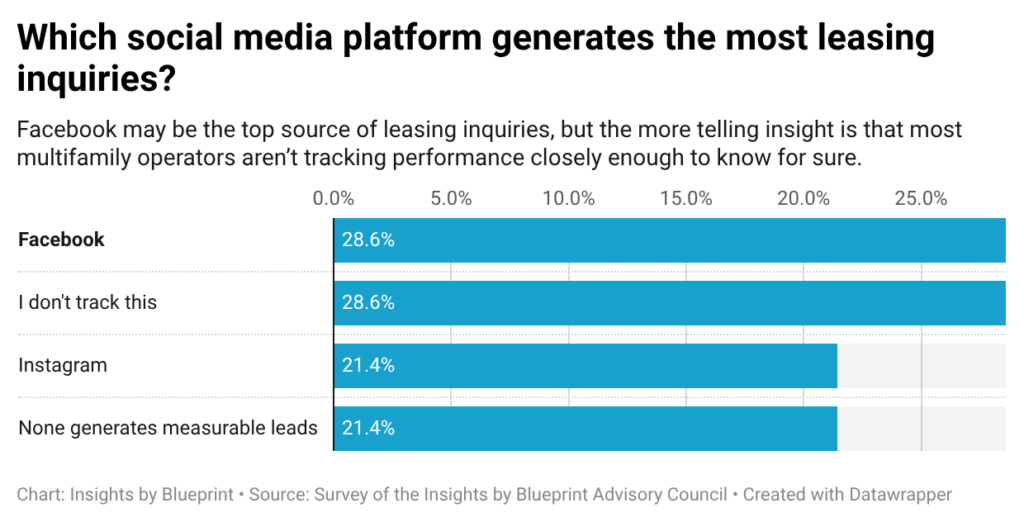
Facebook was the most commonly cited driver of leasing inquiries, with 28.6% of respondents naming it as their top-performing platform. But an equally large share (28.6%) said they don’t track which platforms generate leads at all. Instagram trails behind at 21.4%, while another 21.4% of respondents said none of their social media activity produces measurable leasing leads.
Half of the respondents (50%) said promotions and specials are the most effective type of social media content. Unit tours (42.9%) also perform strongly, while lifestyle content (21.4%) plays a secondary but still meaningful role. Other formats — including influencer partnerships (14.3%), resident testimonials (7.1%), and educational content (7.1%) — trail significantly.
While multifamily operators are actively using social media, it’s not emerging as a top investment priority. Half of respondents (50%) said they don’t plan to increase social media spend over the next 12 months, compared to just 21.4% who expect to invest more. About 29% remain undecided. That hesitation appears closely tied to the measurement gap. Without clear visibility into how social media translates into leasing outcomes, operators are understandably reluctant to allocate additional budget.
Automating the social feed
Some multifamily operators are using AI to streamline social media marketing and maintain a consistent posting cadence. Rather than replacing marketing teams, these tools are focused on reducing the manual effort required to keep channels active.
Survey responses suggest adoption is already well underway. About 28.6% of operators said they use AI tools extensively for social media content, while another 35.7% use them occasionally. Still, 35.7% reported not using AI for this purpose, indicating the market remains split between early adopters and those still evaluating its value.
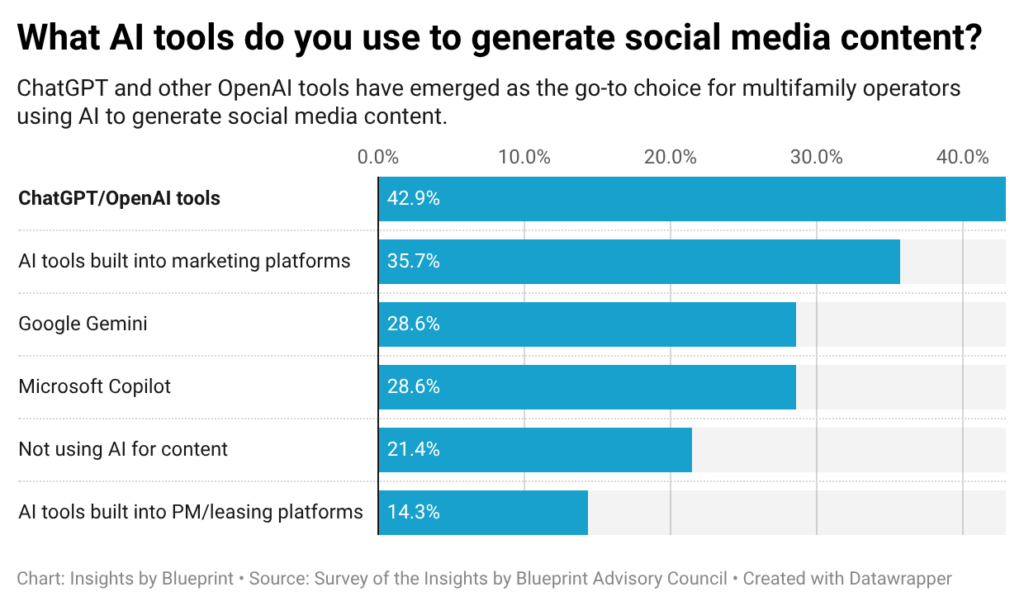
Among those using AI, general-purpose tools lead the way. ChatGPT and other OpenAI tools were the most widely used (42.9%), followed by AI features embedded within marketing platforms (35.7%). Roughly 29% reported using Google Gemini or Microsoft Copilot, while a smaller share (14.3%) relies on AI tools built directly into property management or leasing platforms. Just over one-fifth said they’re not using AI for social content at all, reinforcing that while adoption is growing, it’s far from universal.
Below, we highlight the leading and emerging social media marketing platforms gaining traction among multifamily operators:
Multifamily-specific platforms
Tech platforms designed specifically for multifamily now incorporate AI-driven social media capabilities. 365 Connect, for example, offers marketing automation tools that integrate with property management systems and generate content informed by real-time data such as unit availability, pricing, and specials.
SOCi, a multi-location marketing platform used across industries, including multifamily, allows apartment operators to manage social media, online reviews, and local search from a centralized system. Its AI tools generate localized, on-brand content and help maintain consistent messaging across large property portfolios.
General AI social media platforms
Many apartment marketing teams also rely on mainstream social media management platforms that incorporate AI content tools. Hootsuite offers an AI feature called OwlyWriter that generates social captions and hashtag suggestions, which can then be scheduled across multiple channels.
Buffer provides similar capabilities, including AI caption generation, scheduling tools with optimal timing recommendations, and analytics dashboards. Sprout Social, which larger organizations widely use, offers advanced features for social listening, brand monitoring, and AI-assisted content creation and publishing across multiple properties.
AI tools for content and design
Some AI platforms focus specifically on content creation and visual production. Canva offers AI-powered design tools that generate social graphics using branded templates, photos, and text overlays. Copywriting platforms such as Jasper and Copy.ai are also widely used to generate variations of marketing copy, including amenity descriptions, leasing announcements, and social captions.
AI-powered video tools are also becoming more common in multifamily marketing. Platforms like CapCut and Adobe Express provide templates and AI-assisted features that turn images and text into short-form video content suitable for TikTok, Instagram Reels, and YouTube Shorts. Other tools, such as Synthesia, focus on generating AI-driven videos with virtual presenters, offering a different approach to scalable video production.
Marketing the units that need leasing the most
One development in multifamily marketing is the growing ability to connect marketing content directly to property data. Instead of relying on staff to manually create posts, some platforms like 365 Connect automatically generate social media content based on real-time information such as pricing, availability, and leasing specials.
Kerry W. Kirby, founder and CEO of 365 Connect, said automation systems can integrate with multiple property data sources to determine what types of units should be promoted at any given time. These tools can anticipate future vacancies by monitoring units that are “on notice,” meaning residents have indicated they plan to move out at the end of their lease. While those units may not yet appear vacant in the leasing system, they represent upcoming inventory that operators may want to market in advance. “You might think you only have two units available,” Kirby said. “But if you have five on notice, that’s really seven units you’re about to have available. The system can recognize that and start marketing those units ahead of time.”
In addition to pricing and availability data, the system can also automatically promote leasing incentives and specials. According to Kirby, posts featuring pricing information or limited-time offers tend to generate the strongest engagement. However, relying solely on promotional content can make a social media feed feel overly sales-driven. To avoid that, many operators use a blended content strategy that combines leasing-focused posts with lifestyle content.
“We see specials and pricing perform very well,” Kirby said. “But you can’t just constantly publish that. So we mix in things like amenities — maybe a post about the pool or the dog park — so it’s not always just ‘rent an apartment.’”
From static posts to short-form video
Platforms like TikTok, Instagram Reels, Facebook Stories, and YouTube Shorts have created new expectations around visual content. Today, more than 60% of internet users watch short-form video, according to data from Ampere Analysis. Interestingly, Ampere’s data show that “short-form swiping” is more prevalent than watching TV in daily media consumption globally. Short-form video is now one of the most widely consumed formats online, with billions of views per day across major platforms.
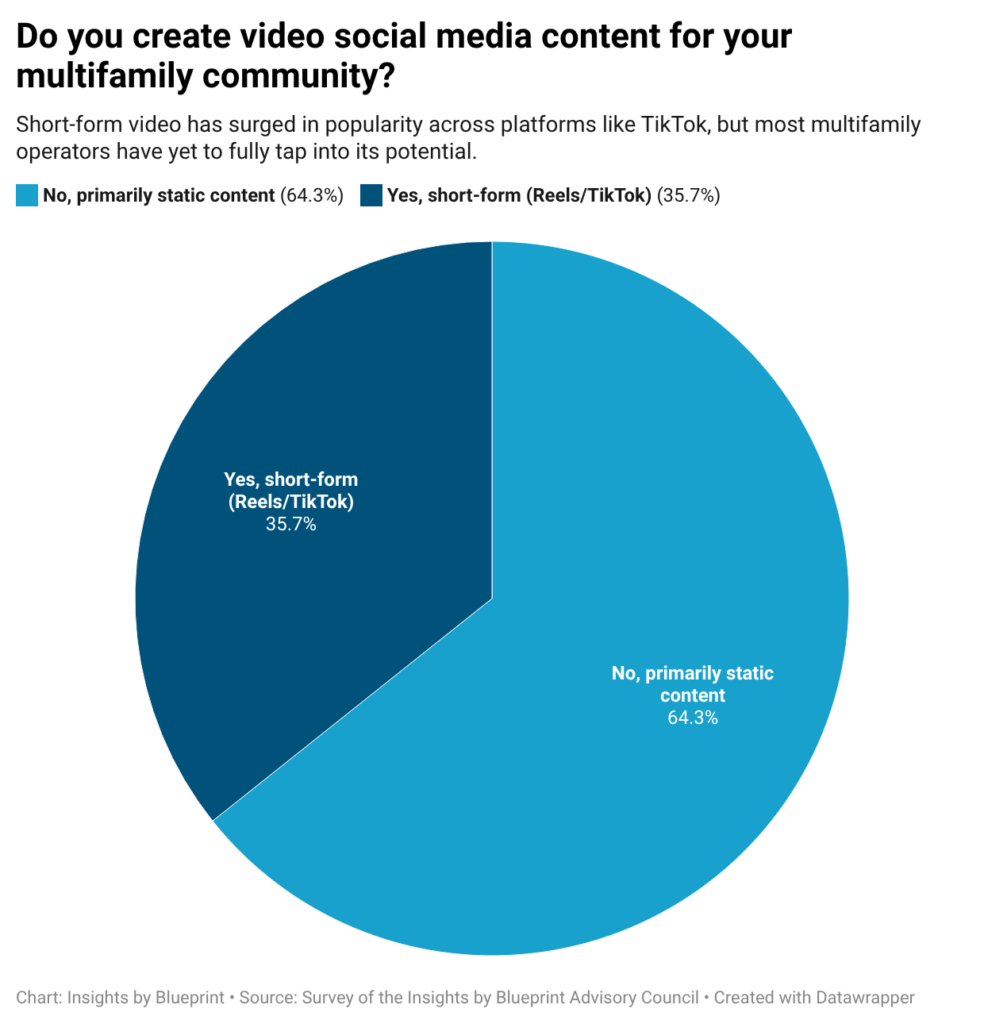
Our survey of the Insights by Blueprint Advisory Council suggests short-form video remains underutilized across the multifamily sector. Just 35.7% of operators said they regularly post video content on platforms like TikTok and Instagram Reels, while a clear majority (64.3%) still rely primarily on static posts.
Kirby has noticed a similar trend. Some multifamily communities are experimenting with short-form video, but adoption remains uneven. “We’re seeing some that can keep up with it use TikTok,” Kirby said. “But a lot of it is staff-driven content — people kind of auditioning for America’s Got Talent.” Producing regular video content requires time, staff participation, and editing skills that many leasing teams simply do not have. As a result, many multifamily communities post videos only occasionally rather than as part of a consistent marketing strategy.
To address that challenge, some tech providers are beginning to automate video creation using existing property images. Instead of filming new content, AI tools can animate still photos to create reel-style videos that showcase units, amenities, and community features. Kirby said his company is developing tools that do this.
These videos can then be distributed across multiple channels, including Instagram, Facebook, and TikTok. As short-form video becomes more central to social media algorithms, Kirby believes reels will play an increasingly important role in apartment marketing. “Reels are highly valuable,” he said. “A lot of people are doing them, but in multifamily it’s not consistent because they’re trying to produce them manually.”
TikTok, in particular, represents an opportunity many apartment communities have not yet fully explored. Kirby noted that the platform increasingly functions as a discovery engine, similar to e-commerce, where users browse visually engaging content and make purchasing decisions based on what they see. “There’s a real opportunity to showcase amenities, units, and what a property offers in a way that helps drive leasing,” he said.
Simplifying social media workflows
While automated video tools may become more common, human-generated content still has a role to play. Unit tours and real-time property events can create compelling content when staff capture them. Kirby said these types of videos can be effective, but only if properties have the time and resources to produce them. To make that process easier, some platforms are experimenting with tools that allow staff to quickly capture and distribute content from a smartphone without logging into multiple social accounts.
Kirby described a feature called “On Demand” in 365 Connect, which allows property staff to upload photos and short descriptions through a temporary web link. The system then automatically formats the post with branded templates, generates captions, and distributes it across social channels. For example, if a community hosts a food truck event or resident gathering, staff could take a photo and submit it through the link. The system automatically brands the image, generates a caption, and publishes it across platforms such as Instagram, Facebook, and TikTok.
The goal is to simplify the workflow while still allowing communities to share real-time updates. “So instead of logging into six different platforms and figuring out what to write, you just upload the photo and click post,” Kirby said. As social media platforms continue to prioritize video and dynamic content, such automation tools will make it easier for multifamily communities to engage in short-form video marketing without significantly increasing the workload for on-site teams.
The rise of automated social media
As renters increasingly use social media to evaluate properties, maintaining an active and engaging presence has become a more important priority for some multifamily operators. The challenge is finding the time and resources to keep up with the relentless pace of modern digital marketing.
Automation and AI are beginning to help. By generating content from existing property data and simplifying workflows for on-site teams, these tools allow operators to maintain consistent posting activity without adding too much operational burden. As the tech continues to evolve, automated social media marketing is likely to become a standard part of the multifamily marketing toolkit.
– Nick Pipitone
Got tips or feedback? Email Nick at [email protected]