

AI has quickly become embedded in the multifamily leasing process, promising faster response times, greater efficiency, and a more streamlined prospect experience. And in many ways, it has delivered, particularly at the top of the funnel.
Many operators are enthusiastically adopting AI-powered digital leasing agents, but some challenges still remain. The handoff between the digital agent and the human leasing agent has become one of the main challenges.
This report explores where AI leasing agents deliver value today, as well as a new generation of AI leasing tools that promise to improve human leasing agents’ performance. We also use exclusive survey results from the Insights by Blueprint Advisory Council to reveal how your peers are using AI in the leasing process, their biggest pain points, and advice on implementing these tools.
The leasing funnel is faster, but not necessarily better
Adoption of AI leasing tools in multifamily is already widespread. Our survey found that half of operators are using digital leasing assistants across multiple properties, with another 28.6 percent deploying them on a smaller scale. An additional 14.3 percent are currently piloting these tools, leaving just 7.1 percent with no plans to adopt AI leasing agents.
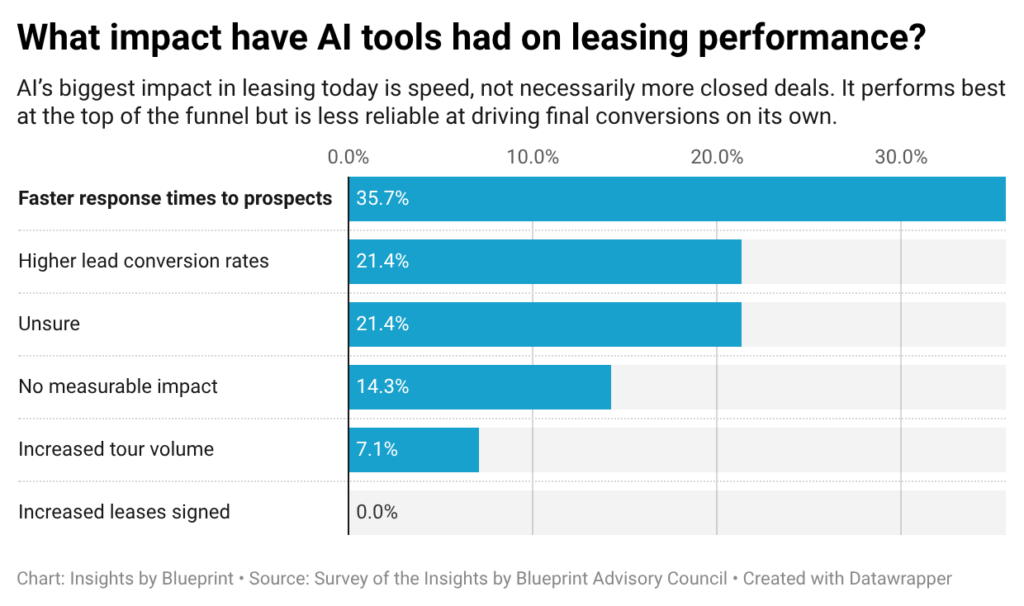
When it comes to leasing performance, the impact is more mixed. The largest share of respondents (35.7%) said AI leasing agents have improved response times to prospects, while 21.4% reported higher conversion rates. However, another 21.4% said they were unsure of the impact, and 14.3% reported no measurable change.
When asked for advice on implementing AI leasing tools, respondents consistently emphasized the importance of using AI to support — not replace — human leasing teams. Many noted that AI performs best as a first-touch layer, delivering speed and consistency in early interactions, rather than serving as a full substitute for on-site staff.
A strong data foundation also emerged as critical. Respondents stressed the need for clean, accessible information, including accurate pricing, office hours, amenity details, and clearly defined escalation rules to ensure the AI delivers reliable responses.
Several participants cautioned operators to measure the right outcomes. Rather than relying solely on platform dashboards, they recommended focusing on tangible leasing results, such as conversion rates and prospect satisfaction.
Finally, there was broad agreement that human escalation remains essential. While AI can accelerate response times and streamline communication, respondents underscored the need for a clear handoff to human agents for more complex or high-intent interactions.
The handoff problem
As our survey indicates, AI is rapidly transforming the top of the leasing funnel, with lead nurturing emerging as one of the most widely adopted use cases. Digital leasing agents, led by platforms like EliseAI, now handle much of the initial prospect interaction across the multifamily industry. Unlike traditional chatbots, these systems function as full-service AI agents, responding across channels, managing conversations in real time, and guiding prospects through early-stage engagement.
The impact has been significant. Historically, only about half of inbound calls were answered, creating a major bottleneck, according to Jamie Gorski, a Proptech Advisor and Multifamily Consultant at Catchpoint Collective. AI leasing agents have largely eliminated that issue, enabling near-instant responses and turning lead nurturing into a scalable, always-on process.
Julia Lambert, Vice President at RET Ventures, told us that industry estimates suggest that “roughly 80% of inbound prospect needs” during the leasing process fall into a finite set of scenarios that AI can handle reliably, making a significant portion of the funnel suitable for automation without compromising quality or compliance.
“Two years ago, the industry was embracing chatbots and virtual leasing assistants, and light solutions with a clear, immediate ROI story moved quickly,” Lambert says. “Now we’re seeing a new category emerge: genuinely agentic workflows that don’t just respond to prospects but execute tasks within your systems.”
She added that these agentic workflows are “operationally different” from a chatbot, and owners and operators know it. However, performance gains depend less on full automation and more on execution. The critical factor is a seamless transition between systems and staff, with “AI to human when needed, and back to AI once it’s resolved.” Operators that successfully manage this handoff are beginning to see measurable improvements in efficiency, response times, and leasing outcomes.
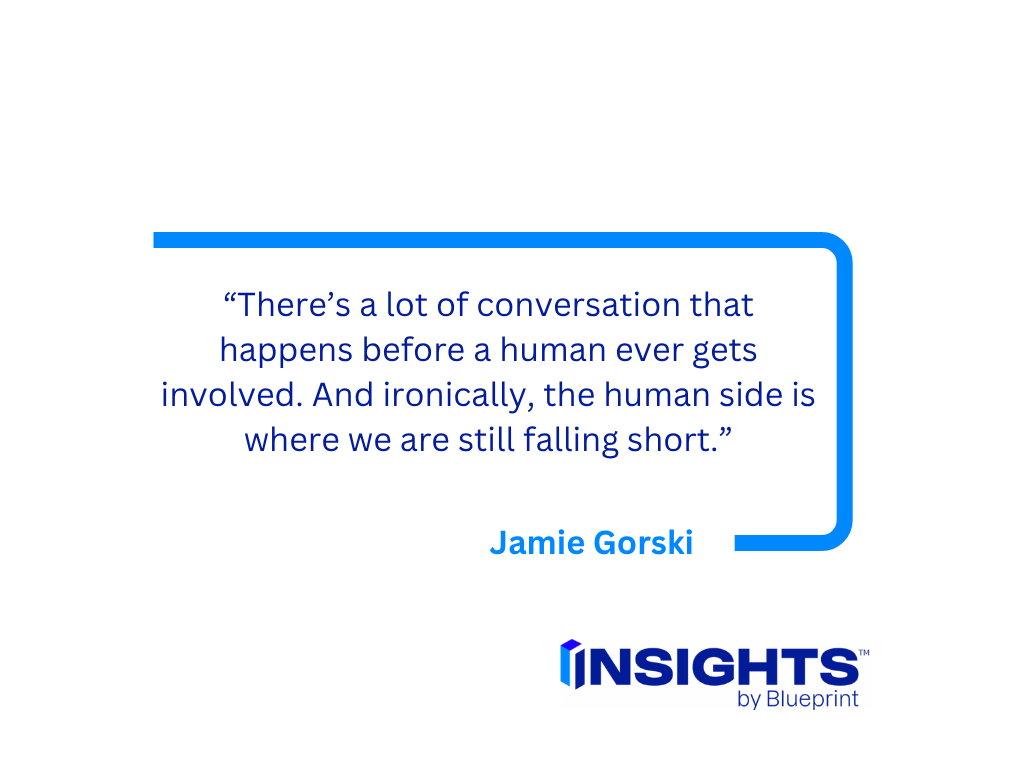
In many cases, AI agents manage extended conversations with prospects before scheduling a tour, but that transition to a human leasing agent can be disjointed. “There’s a lot of conversation that happens before a human ever gets involved,” Gorski noted. “And ironically, the human side is where we’re still falling short.” Accuracy is another concern. While AI leasing agents are generally effective at handling routine inquiries, they can occasionally provide incorrect or outdated information — such as pricing — highlighting the continued need for human oversight.
Even leading platforms have trade-offs. Gorski noted that tools like EliseAI can feel overly transactional, tending to push prospects toward scheduling a tour regardless of context. While this may improve tour volume, it does not always translate into a better prospect experience. These challenges point to a broader conclusion: while AI has improved the speed and scale of leasing operations, the human layer remains a critical and still under-optimized part of the process.
The human edge becomes measurable
A new category of tech is emerging to address this gap. Unlike digital leasing agents, which focus on automation, platforms like Grotto AI are designed to enhance human performance rather than replace it. GrottoAI’s approach is rooted in behavioral analysis. By analyzing thousands of leasing calls and tours, the platform identifies which specific actions and conversational patterns correlate with higher conversion rates.
It then applies those insights in real time. During calls, leasing agents receive live guidance: subtle prompts that encourage behaviors proven to improve outcomes, such as asking open-ended questions or exploring a prospect’s preferences more deeply. For tours, agents receive pre-tour briefings based on prospect data and immediate post-tour performance feedback. The goal is not to script interactions, but to improve them.
A common promise across AI leasing platforms is straightforward: automate the “grunt work” so on-site teams can focus on higher-value interactions. As Nick Deveau, Co-Founder and CEO of GrottoAI, put it, the prevailing pitch to operators is, “We’re going to automate away the grunt work so your teams have time back for what matters most.” But as adoption has grown, a gap has emerged.
Many of these solutions have successfully streamlined administrative tasks and initial prospect engagement, yet they have done little to support the moments that actually drive leasing outcomes. “That completely leaves the moments that matter most abandoned,” Deveau said. “And we need to support those.”
Recent analysis of leasing conversations underscores just how important those moments are. The most predictive factor for conversion, according to the data, is whether the leasing agent can build a genuine rapport, starting with something as simple as making the prospect laugh.
Close behind are behaviors such as asking open-ended questions and demonstrating curiosity, followed by more traditional actions, such as inviting the prospect to tour. These findings point to a broader truth: leasing performance is driven less by scripted sales tactics and more by authentic human interaction. “More than anything, it’s relationship building,” Deveau said. “The human edge matters.”
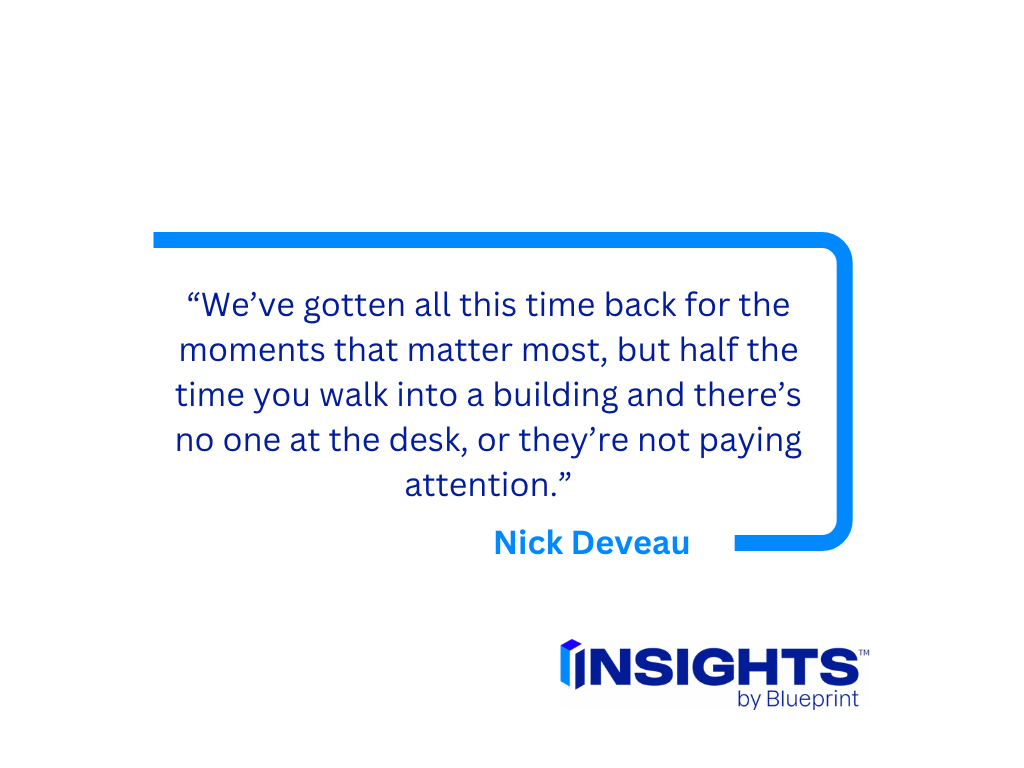
This has important implications for how operators think about AI. While automation can create efficiency and free up time, it does not guarantee better outcomes on its own. In some cases, the opposite is true: operators may gain time but fail to reinvest it effectively. “We’ve gotten all this time back for the moments that matter most,” Deveau noted, “but half the time you walk into a building and there’s no one at the desk, or they’re not paying attention.”
The next phase of innovation, then, is not just about automating more of the leasing process. It’s about ensuring teams are better equipped to perform in the moments when data shows they matter most. In this model, AI doesn’t replace human interaction but builds on top of it, enhancing the quality and consistency of those critical touchpoints.
The Gong playbook arrives in multifamily
Gorski and others in multifamily real estate are enthusiastic about Grotto AI’s approach to training leasing staff, but the underlying concept is not entirely new. Gong, founded in 2015, was an early leader in applying AI to sales by capturing and analyzing customer interactions and converting them into structured insights. Using machine learning and natural language processing, Gong identifies patterns, detects buying signals and risks, and helps forecast deal outcomes. It has been used widely across the tech sector by companies such as LinkedIn, GitHub, Autodesk, Mailchimp, and Zendesk, among thousands of others, and operates in a large, competitive market of AI-driven sales platforms. That market includes competitors such as Clari, Salesloft, Outreach, and Revenue Grid, which similarly analyze sales activity to improve performance, while differentiating through strengths such as forecasting, automation, or coaching.
A parallel ecosystem has been emerging in multifamily real estate. The market for companies similar to EliseAI and Grotto AI is coalescing around a relatively defined set of competitors and adjacent platforms, all aiming to automate or augment the leasing process through AI-driven communication and workflow tools. At the center of this landscape are companies such as Funnel Leasing, Conduit, Leasey.ai, Alven AI, and Fenix AI, which offer conversational leasing agents, lead nurturing, and tour scheduling capabilities. These platforms are largely differentiated by how they balance automation with human oversight: some emphasize centralized leasing models that integrate human agents into the workflow, while others push toward more fully autonomous “AI employee” concepts.
Within this landscape, Grotto AI stands out for its emphasis on real-time coaching of human leasing agents rather than pure automation or analytics. However, it fits within a rapidly growing category of AI-powered tools designed to improve leasing performance, increase occupancy, and maximize revenue in multifamily housing.
Lambert of RET Ventures says that the current generation of AI leasing tools is still maturing in two important dimensions. “The bigger open question is what the leasing process will look like in three to five years: how much of the funnel is fully automated end-to-end, and where human touchpoints persist because they genuinely drive better outcomes,” Lambert said.
Right now, the biggest gaps are configurability and transparency. Operators have specific workflows, and the tools that win in the long term will let operators build those rather than asking them to conform to a one-size-fits-all system. The “black box” problem is also real. “Operators need to see what their AI is actually doing, where it resolved independently, where it is handed off, and why,” Lambert told us. “Better audit capability isn’t a nice-to-have — it’s what allows operators to quantify ROI and justify renewal. The vendors who prioritize that visibility will earn the long-term contracts.”
From mystery shops to real-time feedback
When it comes to in-person tours, the application of AI looks different from real-time call guidance. Rather than prompting agents during the interaction itself, current approaches are focused on immediate post-tour coaching, delivering feedback while the experience is still fresh. After each tour, agents receive a push notification highlighting key takeaways, typically framed as one strength and one area for improvement. More detailed insights are available through a dashboard, allowing agents and managers to review performance in greater depth.
This has introduced a new level of visibility into a part of the leasing process that has historically been difficult to measure. It has also changed how teams interact with performance data. At some properties, leasing staff review each other’s tours collaboratively, creating a continuous, peer-driven feedback loop. “They’ll go and look at each other’s tours and say, ‘Here’s what you did really well, and here’s how I can be better,’” Deveau said.
That dynamic has, in some cases, turned performance tracking into a more engaging, even gamified experience. More importantly, it addresses long-standing frustrations with traditional evaluation methods. Leasing teams have historically relied on periodic mystery shops, which many view as inconsistent and subjective.
“We’re so sick of being evaluated by mystery shops once a quarter,” Deveau said one leasing agent told the company. “It’s biased. What if the shopper doesn’t like me? What if I haven’t had my coffee?” By contrast, AI-driven tour analysis offers a more continuous and objective alternative.
Early feedback suggests strong adoption at the property level, driven in part by the tangible benefits for leasing staff. In addition to improving performance, these tools can contribute to higher commissions and faster career progression, further reinforcing engagement. Instead of relying on occasional, subjective snapshots, operators are beginning to adopt systems that provide ongoing, data-driven insights into one of the most critical stages of the leasing journey.
Boosting performance – and expectations
The impact of AI-driven coaching may be even more pronounced for onboarding and training new leasing staff. Early data from Grotto AI suggests that these tools can dramatically accelerate the ramp-up period for new hires. In one case, a leasing agent improved from an average tour performance score of roughly 30% to 80% in just a week and a half, becoming one of the top performers at their property.
This has significant implications in a labor market where operators continue to face staffing shortages and high turnover. Rather than relying solely on experienced leasing professionals, companies may be able to recruit talent from adjacent industries, such as hospitality, retail, or food service, and train them more efficiently. By compressing training timelines and standardizing performance expectations, AI-enabled coaching platforms may not only improve individual outcomes but also expand the talent pool available to multifamily operators.
AI systems may boost the performance of human leasing agents, but they will also raise expectations, according to Lambert. “AI will elevate the importance of high-touch moments — and raise the accountability for them,” she told us. “When the administrative work is handled, the question becomes: Did you talk to that prospect? Did you send a personal follow-up? Did you build a real relationship with that resident? The human interactions that remain will matter more, not less.”
Lambert said the bigger structural shift is specialization. Smarter operators are centralizing leasing while deploying AI, which means people cover more properties and go deep in one part of the journey rather than being generalists across all of it, such as renewals specialists, touring specialists, and collections specialists. “That’s actually better for the employee,” she said. “The data bears it out: personnel turnover on centralized leasing teams drops dramatically once the right technology is in place. People get to do the parts of the job they got into this industry for.”
The next phase of leasing: a hybrid model
These trends point toward a hybrid future for multifamily leasing. AI handles the front end while human agents focus on high-value interactions, including tours, relationship-building, and closing. AI also supports the human layer through coaching, performance insights, and personalization.
Rather than replacing human leasing agents, AI becomes an embedded layer that enhances their effectiveness. The result is a more balanced system that combines the speed and scalability of automation with the nuance and trust of human interaction.
– Nick Pipitone
Got tips or feedback? Email Nick at [email protected]