

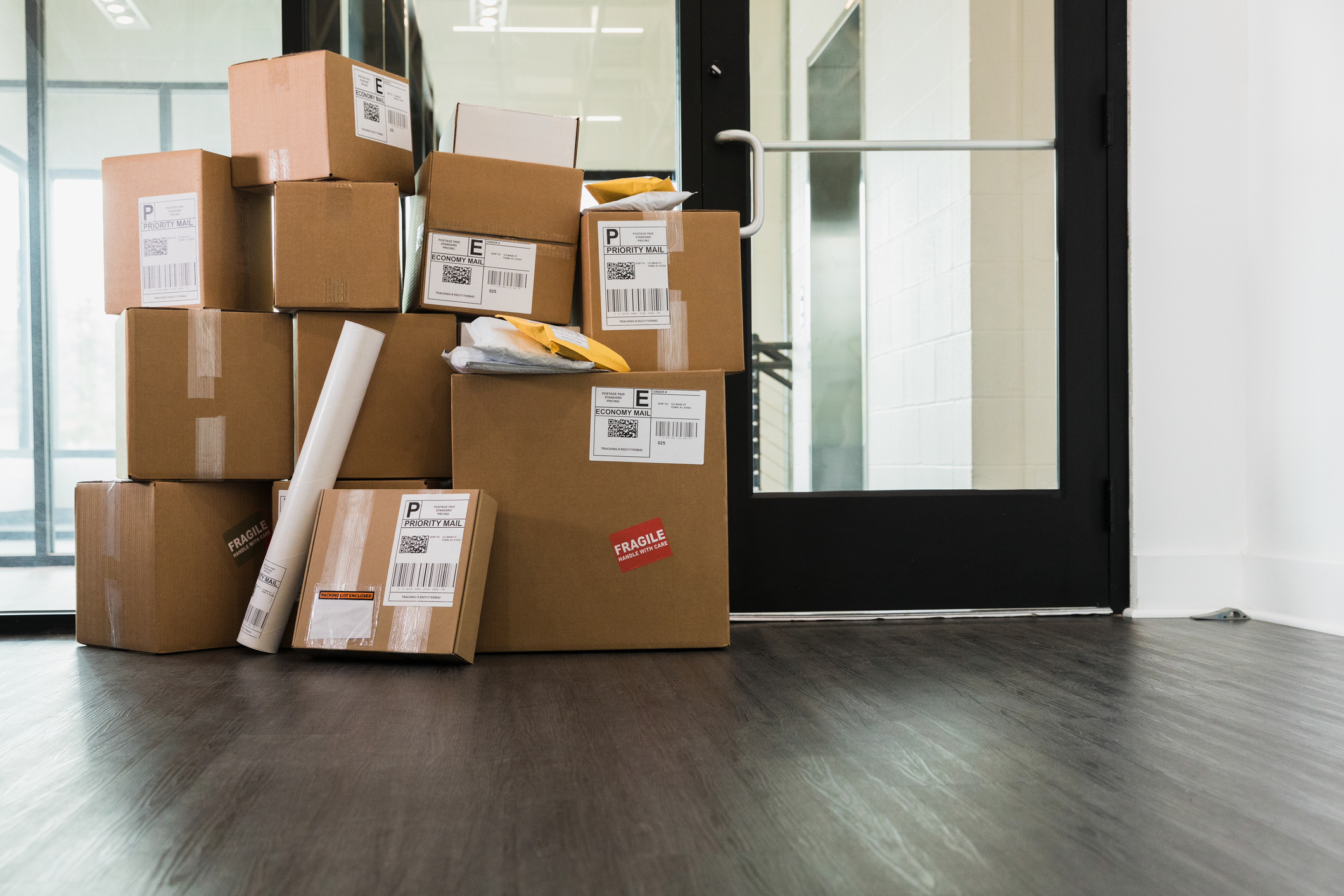
On a typical day at a 400-unit urban apartment building in New York City, 187 packages arrive. At Stuyvesant Town, America’s largest apartment community, with more than 11,200 units, residents once waited up to 30 minutes to retrieve their packages while a team of more than 12 staff members managed daily deliveries. These are not edge cases. They represent the structural reality of multifamily operations in an era of permanent e-commerce expansion, and they are arriving at properties that were not designed, staffed, or budgeted to handle them.
The operational consequences are well understood at the property level: staff interruptions, cluttered lobbies, carrier compliance failures, and resident complaints that cumulatively create lease-renewal friction. What is less well understood at the portfolio level is that package management has fragmented into a landscape of competing models, with no industry consensus on which approach performs best across asset types, and the right answer varies by building size, market density, staffing configuration, and capital constraints.
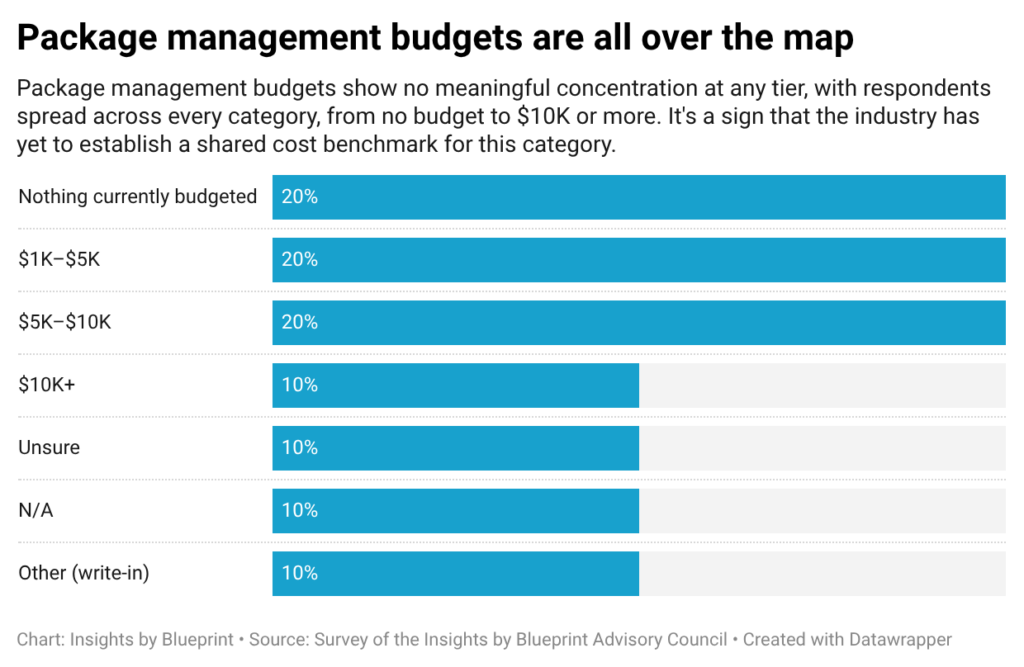
Insights by Blueprint Advisory Council survey data reinforce this picture. Seventy percent of operator respondents rely on more than one intake method. The average respondent deploys 2.4 methods across their properties, and no respondent has standardized on a single solution.
This report examines the forces driving the current fragmentation, maps the tradeoffs across the four dominant solution models, and presents a framework for how multifamily operators can move from reactive, property-by-property package decisions toward a portfolio-level strategy built on solution-to-property matching, vendor accountability for carrier compliance, and operational data that supports consistent execution at scale.
Package management has no consensus solution
The Insights by Blueprint Advisory Council survey on package management reveals a landscape defined by fragmentation, improvisation, and a near-universal pain point that neither hardware nor software has fully resolved: carrier non-compliance. Across operator respondents, the dominant setup combines unmanaged package rooms with smart locker systems. Seventy percent of respondents use at least one of these two approaches. No respondent relies exclusively on a single method. The average respondent selected 2.4 intake methods, with the most complex operators, including those using third-party services, selecting five or more simultaneously, suggesting that layering solutions on top of existing infrastructure is more common than replacing it.
Some respondents rely primarily on packages left at unit doors, and some skipped the frustrations and improvement questions by selecting N/A, indicating a posture of disengagement from the package management problem rather than active investment in solving it. The respondents using third-party services run the most operationally complex setups in the sample. This aligns with market reporting suggesting that offsite and managed services are adopted as supplements to, not substitutes for, existing infrastructure, at least in the near term.
The human variable that tech hasn’t fixed yet
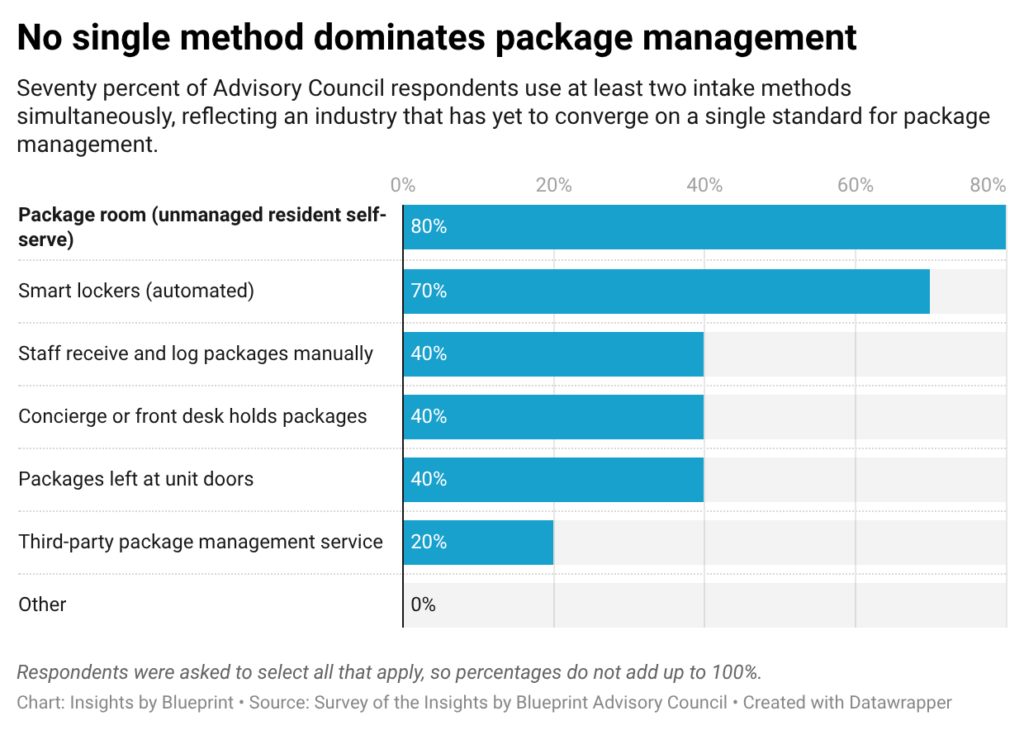
Carrier non-compliance was selected by 70% of respondents as one of their top frustrations, making it the most widely shared pain point in the sample. This finding is consistent with practitioner reporting in the trade press, where carrier compliance is routinely cited as the failure mode that undermines otherwise well-designed package systems. Staff time consumed by package handling was selected by 50% of respondents, resident complaints about missed or lost packages by 50%, and overflow or insufficient storage space by 40%.
Better carrier compliance was the most selected improvement across the sample, chosen by 60% of respondents, directly mirroring its position as the top frustration. Reduced staff burden was selected by 50% of respondents, and lower-cost solutions by 40%. Only 30% of respondents selected “more locker capacity,” a notably low figure given how frequently hardware expansion is the default response when package problems escalate. Dedicated package room buildout was selected by 30% of respondents, and automated resident notifications by 20%. Integration with property management software was selected by 20% of respondents, suggesting that while PMS integration is a consideration, it ranks lower than operational pain points in current operator priorities.
The gap between the frequency of locker-related frustrations (overflow, capacity) and the relatively low selection of more locker capacity as a desired improvement suggests that at least some operators have already internalized the argument that adding hardware is a temporary fix rather than a durable solution. The concentration of demand on carrier compliance, staff-burden reduction, and cost efficiency points to a market preference for solutions that restructure the intake workflow rather than simply expand storage.
Budgets are all over the map
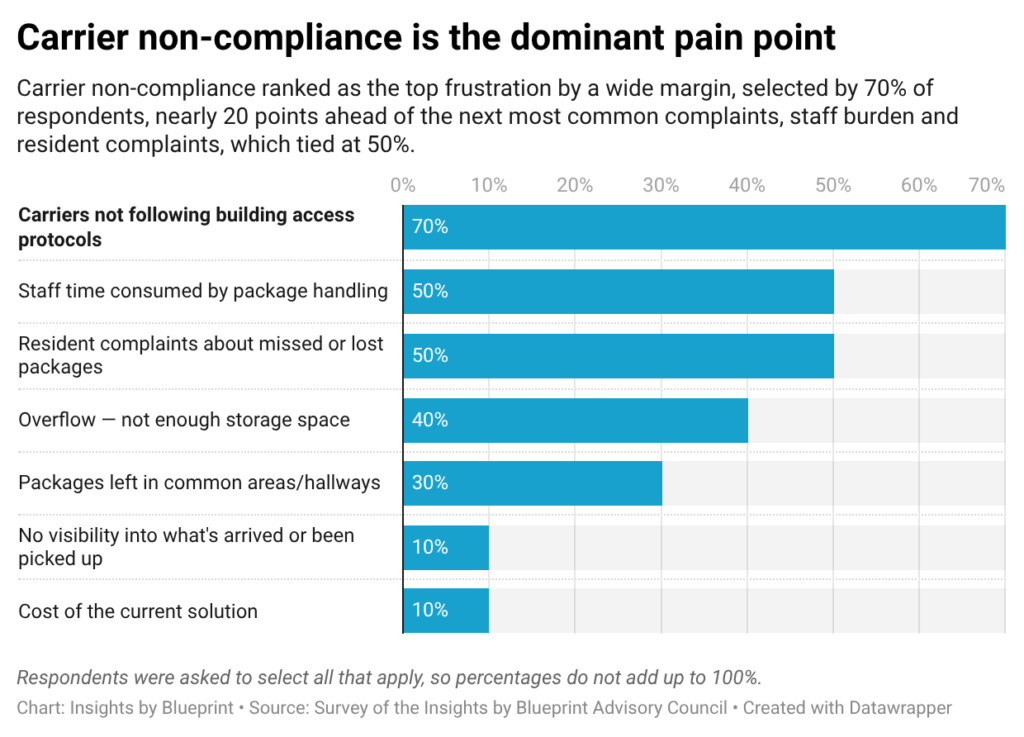
Package management budgets across the survey show no meaningful concentration at any tier, indicating that the industry has not yet established a cost-per-unit benchmark for this category. Twenty percent of respondents report nothing currently budgeted; 20% are in the $1K–$5K range per asset annually; 20% are in the $5K–$10K range; and 10% is at $10K or above. One respondent declined to categorize their budget, instead offering a write-in that accurately frames the variable: package rooms are very low-cost, while managed vendor services run approximately $2–$4 per unit per month. At 300 units, that vendor range translates to roughly $7,200–$14,400 annually, which aligns with the $5K–$10K budget tier for mid-market vendor deployments.
The absence of budget consolidation has practical consequences for vendor selection and the quality of ROI conversations. Without a shared cost benchmark, operators evaluate proposals without a consistent baseline for comparison, and vendors set prices in a market where buyers lack reference points. The write-in response noting that costs depend heavily on property setup and vendor is likely more representative of actual operator experience than any single budget tier in the structured options.
A multi-vendor pattern
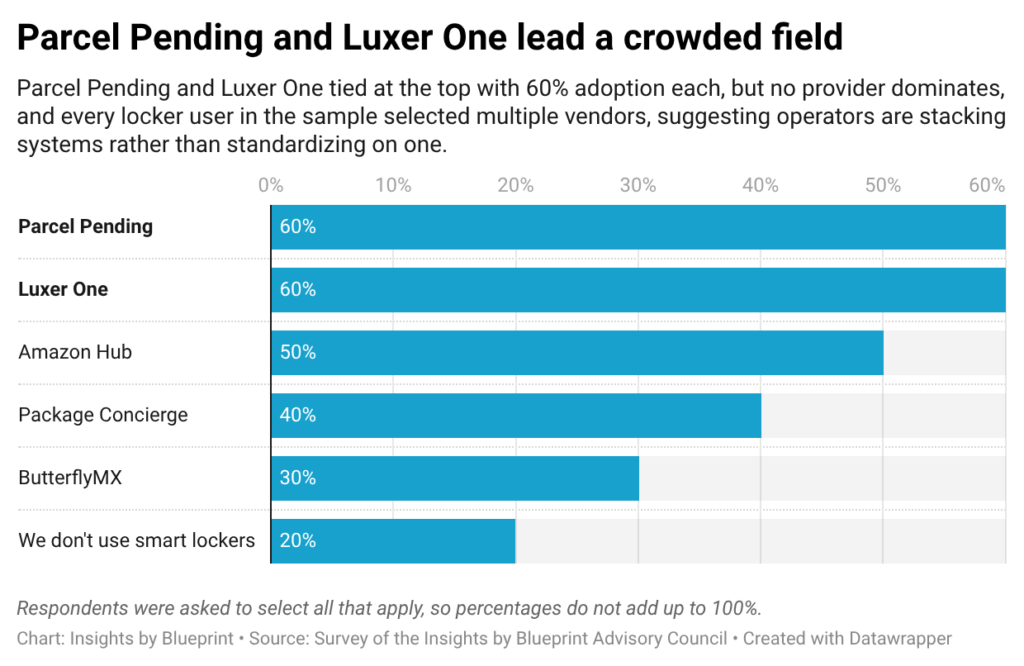
Among respondents using smart lockers, Parcel Pending and Luxer One were each selected by 60% of respondents, making them the most widely used providers in the sample. Amazon Hub appeared in 50% of responses, Package Concierge in 40%, and ButterflyMX in 30%. ButterflyMX is primarily an access control platform, suggesting those respondents are using it as part of a controlled-access package room configuration rather than a pure locker deployment. No respondent selected a single locker vendor exclusively. Every locker user in the sample selected multiple providers, indicating either portfolio-level variation across properties or a deliberate multi-vendor strategy within individual assets.
The multi-vendor pattern is consistent with Advisory Council observations about the practical limits of any single locker system: capacity gaps, oversized package incompatibility, and carrier compliance failures tend to push operators toward supplementary systems over time. The result is a portfolio landscape where two or three locker vendors operate in parallel. It’s a configuration that creates operational complexity and complicates performance measurement across properties.
The compliance gap and the size problem
Every package management solution depends on carrier compliance at the point of intake. When a driver scans one package into the locker system and leaves the remaining deliveries unlogged in the package room, the system’s data integrity breaks down regardless of how well the technology is designed. Advisory Council conversations with multifamily operators confirm this is a recurring pattern — not an edge case — and that the problem intensifies when routes change hands or contract drivers substitute for regular routes, since institutional knowledge of a property’s intake workflow does not reliably transfer with the assignment.
This carrier variable receives insufficient weight in vendor selection conversations relative to its actual impact on system performance. The decision framework for package management solutions tends to emphasize hardware specifications, locker capacity ratios, and software integrations — all of which matter — but the question of how consistently a given carrier’s drivers will execute the intended intake workflow is rarely stress-tested during evaluation. A system that performs as designed only when the same driver is on route is not a system that scales reliably across a portfolio.
The mix of items arriving at multifamily properties has also shifted. Millennials and Gen Z now drive a disproportionate share of furniture and home goods purchasing. Research consistently shows these cohorts account for roughly 70% of home furnishings transactions, despite representing less than half the population, and a growing portion of those purchases arrive via direct-to-consumer delivery rather than in-store pickup. Meal kit services follow a similar demographic pattern, with Gen Z and millennials comprising the majority of subscribers. The operational consequence for multifamily operators is that a meaningful and growing share of daily deliveries involves items that standard locker compartments were not designed to accommodate: boxed mattresses, flat-pack furniture, insulated meal kit packaging, and larger fitness and home goods items that exceed typical compartment dimensions.
The 4 primary package management models
The multifamily package management landscape has converged around four distinct operational models. Each represents a different theory about where accountability should sit, how space should be used, and how staff should be involved. Operators evaluating their portfolio strategy need a clear-eyed view of the structural tradeoffs in each model before defaulting to any single approach.
Model 1: Smart lockers. The incumbent solution in most markets, smart lockers deliver automated resident notification via secure access codes, 24/7 pickup availability, and no staff handling requirement under normal conditions. The principal limitations are dimensional rigidity and scalability during surge periods. Each compartment holds exactly one delivery, meaning a small package occupies the same space as a large one, and a box that does not fit generates immediate overflow. Locker banks are fixed infrastructure, expensive to expand, and require the permanent dedication of square footage, which becomes harder to justify as the share of oversized packages in total volume increases. Vendors like Parcel Pending, Luxer One, and Package Concierge compete in this segment, with installations ranging from $6,000 to $20,000 for entry-level systems, excluding ongoing software fees and maintenance. Carrier compliance remains a critical dependency. When drivers bypass the locker logging process, the system’s automated notification chain breaks entirely.
Model 2: AI-powered smart package rooms. The emerging alternative to locker-based systems, smart package rooms replace fixed compartments with open shelving and rely on computer vision, optical character recognition, and precision positioning tech to automate intake tracking and resident guidance. Position Imaging’s Smart Package Room is the most deployed example in this category, used at Stuyvesant Town and across hundreds of other multifamily and student housing sites. At Stuyvesant Town, the system reduced resident wait times from 30 minutes to seconds, and allowed the property to reduce package-dedicated staff from 12 to two. The core advantage over lockers is spatial efficiency. Packages can be placed adjacent on shelves regardless of size, effectively tripling the storage capacity within a given footprint and eliminating overflow for most delivery types. The tradeoff is greater dependence on driver adoption of the intake workflow, since packages must be correctly positioned and scanned upon arrival for the tracking system to function.
Model 3: Offsite third-party delivery. The model championed by Fetch routes all resident packages to a centralized off-site warehouse before coordinating scheduled deliveries directly to residents’ doors. This removes the package problem from the building entirely, rather than improving how it is managed within the building. Fetch now operates across more than 25 U.S. markets, supporting over 400,000 apartment homes in more than 1,100 communities. The operational implications are distinct from onsite alternatives. Space requirements at the property level are eliminated, on-site staff exits the package-handling chain entirely, and carrier compliance dependencies in common areas cease to exist because no packages arrive at the building in the first place. Liability for lost, stolen, or misdirected packages transfers to the service provider.
The model also addresses resident preferences more directly than lockers or smart rooms do. Advisory Council discussions consistently surface door delivery as residents’ first-choice outcome, particularly for large or heavy items where the last-100-feet problem — moving furniture or an appliance from a package room to a unit — creates friction that onsite solutions cannot resolve. Myka Staryk, regional vice president at ZRS Management, a long-tenured Fetch operator, has noted that residents increasingly hold property management accountable for end-to-end delivery, an expectation shaped by real-time tracking and doorstep delivery standards set by Amazon and major retailers. ZRS has cited liability reduction and staff time recovery as the primary operational rationale for the relationship.
Model 4: Repurposed space and hybrid staff models. A smaller but significant segment of operators has shifted away from dedicated technology deployments toward converting underutilized amenity space into staffed or access-controlled package centers. The underlying logic is consistent across configurations surfaced in Advisory Council conversations: identify space that is underperforming on its original use case, secure the entry point with a smart access panel — vendors like ButterflyMX are frequently cited — to give carriers controlled drop-off access without requiring staff presence for every delivery, and layer in a part-time attendant whose role covers multiple functions to distribute the labor cost across operational line items rather than treating package management as a standalone expense. Some operators structure these arrangements to generate package fee revenue from residents, partially offsetting incremental labor costs. The economics compare favorably with third-party offsite services in communities where space-conversion costs are low, and the operator has flexibility in amenity programming. The model’s principal limitation is that it depends on specific physical conditions — available square footage, favorable building layout, manageable package volumes — that do not generalize across a portfolio, making it a site-specific path rather than a scalable portfolio strategy.
Moving from a reactive to a deliberate strategy
Moving from reactive, property-level package solutions to a deliberate portfolio-level strategy requires building the operational infrastructure, such as data, segmentation, vendor accountability, and reporting cadence, that makes consistent execution possible across a diverse asset base. The following three steps provide a structured path for operators ready to make that shift:
Matching solution type to property type. Operators should establish explicit criteria for matching solution type to property type, rather than defaulting to whichever vendor relationship is most prominent in the market. Relevant segmentation includes unit count, current daily package volume, available dedicated package space, staffing model, resident demographic, and market positioning. A tiered framework might direct AI-powered smart package rooms to high-volume urban properties with more than 300 units, smart locker systems to mid-size suburban communities with existing locker infrastructure, off-site third-party delivery to premium communities where residents will accept a service fee, and hybrid staff models to smaller properties with underutilized amenity space. The point is explicitness and a documented rationale for each tier that regional teams can apply consistently.
Evaluating carrier non-compliance. Given that carrier non-compliance is the most common cause of package system failures, operators should make it a primary evaluation criterion rather than an afterthought. Request specific answers from each vendor on how their system detects and responds to driver non-participation, what the workflow is when drivers bypass the intake process, whether any active driver management or compliance enforcement tooling is included in the solution, and what onsite labor support is available when the system encounters compliance failures. Vendors who cannot answer these questions with specificity have likely not addressed the problem systematically.
Standardized carrier communication. Operators who have worked through package system failures consistently identify the same retrospective lesson: carrier training and post-delivery instructions should be established at the outset of a deployment, not introduced reactively after problems surface. The investment is modest, such as a single-page pictorial SOP covering where to stage deliveries, how to log packages into the system, where oversized items go, and where to place perishables. But the operational return during peak periods is substantial, particularly at properties with high daily volume where a single non-compliant driver can create cascading resident complaints. Some operators issue QR or PIN codes to regular-route drivers, creating both a compliance audit trail and a faster access experience, which gives high-frequency carriers an incentive to use the intake workflow correctly. For operators deploying across multiple properties simultaneously, developing a standardized carrier communication package centrally and distributing it to on-site teams reduces the likelihood of uneven implementation, which is a common failure mode when individual site managers develop their own carrier protocols.
Building a better package process
Package management has crossed the threshold from a property-level inconvenience into a portfolio-level strategic decision. Operators who continue treating it as a site-level problem will find themselves in a permanent cycle of inadequate solutions, replacing hardware and switching vendors without addressing the process and governance gaps that produce failures in the first place.
Advisory Council conversations point consistently to the same diagnosis: the market’s most common response to package volume growth — expanding hardware — addresses the symptom rather than the underlying operational condition. The path forward runs through process: carrier compliance protocols, solution-to-property matching, and implementation standards that regional teams can apply consistently across a portfolio. Operators who build those processes now will enter the next leasing cycle with package management that functions as a competitive differentiator rather than a recurring source of resident friction.
– Nick Pipitone