
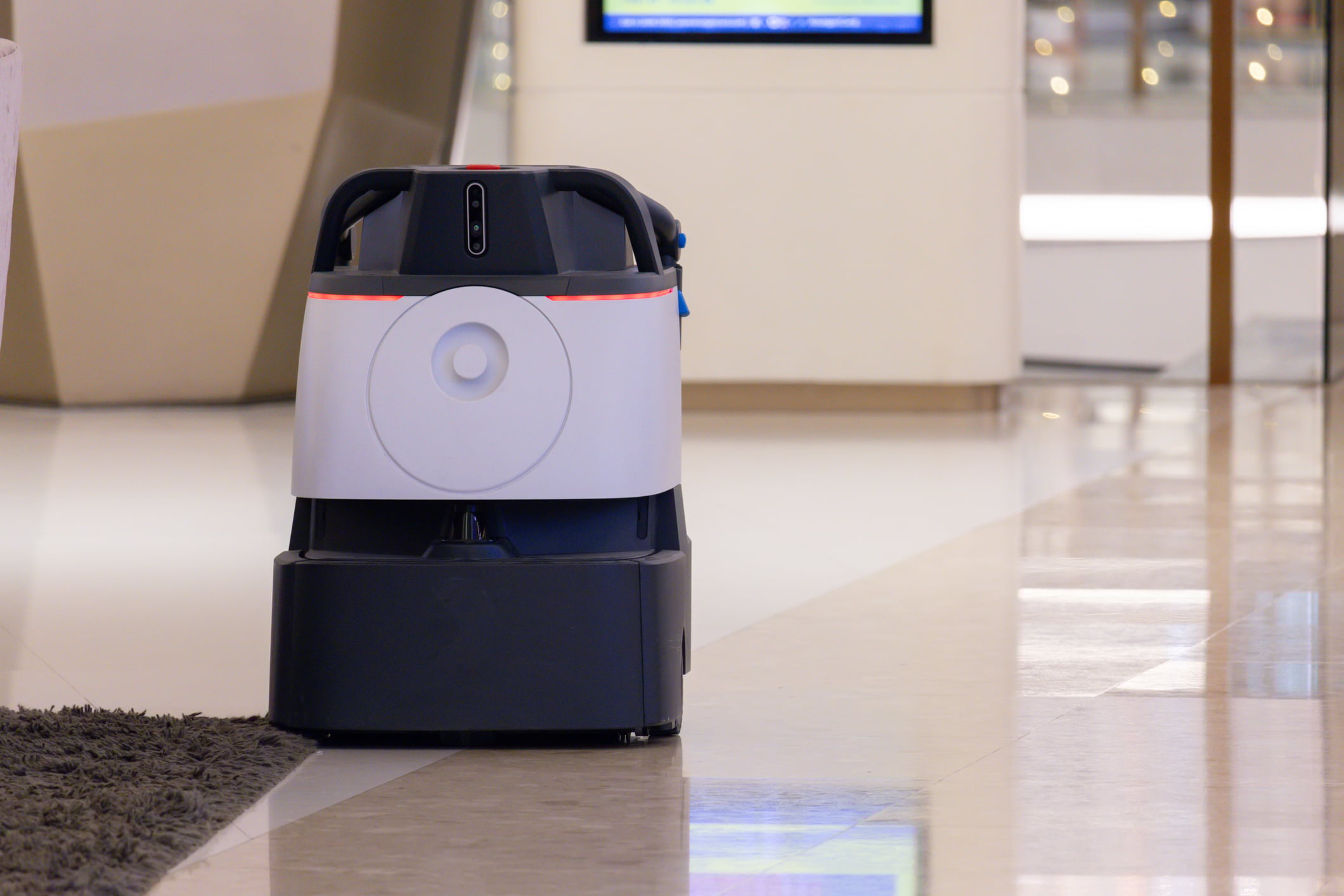
At the Blueprint Vegas conference last fall, there were a handful of demos on the expo floor featuring robots that could perform various tasks in a real estate context. While the use cases were basic, one could imagine a robot replacing a concierge, grabbing packages from the package room and delivering them a resident’s door. Or maybe a Roomba-like device cleaning a hallway.
These use cases have already been deployed in hospitality properties, and it makes sense that they should also be on the minds of multifamily owners seeking to streamline operations, reduce overhead, and maximize NOI. The motivation is straightforward: staffing shortages, rising labor costs, and operational complexity have pushed many operators to ask whether the more repetitive tasks in building management can be automated — and at what cost.
But according to a recent Insights by Blueprint survey of multifamily operators on our advisory board, the industry appears to still be firmly in the experimentation phase when it comes to robots. In this report, we delve into how multifamily operators are piloting robotics, the barriers to broader adoption, the vendors currently offering solutions, and where robotics can actually help in apartment operations today.
Early experiments, not wide adoption
Among the survey’s respondents, only a handful of operators reported active robotic deployments. Most of the firms fall into a more tentative category, where they reported monitoring vendors, exploring potential applications, or evaluating whether robotics might make sense in the future.
In many ways, this mirrors the broader proptech adoption cycle seen across the industry over the past decade. Operators are comfortable experimenting with new tools, but large-scale rollouts tend to follow only after clear operational (and financial) benefits emerge. According to the survey, the proof point for robotics hasn’t fully arrived yet.
Across the survey, one answer appeared repeatedly when respondents were asked what prevents wider robotic deployment: expense and implementation complexity. Operators cited a range of concerns, including high upfront equipment costs, ongoing maintenance and servicing, training staff to manage robotic systems, uncertain payback periods, and difficulty integrating robotics into existing operations.
In many cases, the tech simply hasn’t demonstrated a compelling return on investment. One owner put it bluntly: the industry may be interested in robotics, but “it doesn’t feel like we’re there yet.” That hesitation is particularly pronounced among operators of garden-style communities, where the economics of automation differ dramatically from dense urban high-rises. Some respondents noted that many robotics vendors appear to be designing solutions primarily for structured, indoor environments typical of mid-rise or high-rise buildings. For sprawling suburban portfolios, the technology may need to evolve before adoption becomes practical.
Start with the mop, not the moonshot
Despite the caution, operators in our survey were surprisingly aligned about where robotics could add value if the technology matures. The most promising applications tend to involve repetitive, labor-intensive tasks.
Cleaning and unit preparation represent the most mature and deployment-ready category. Vendors such as SoftBank Robotics, Avidbots, and Tailos have introduced autonomous systems designed to handle routine custodial tasks in common areas and vacant units. Many of these solutions are already deployed in adjacent sectors, including hospitality, healthcare, and commercial real estate.
Cleaning and unit turns are highly repetitive, labor-intensive workflows with clear performance benchmarks, making them well-suited for automation. Cleaning is one of the few areas where robotics delivers measurable efficiency gains and a clearer path to ROI compared with more complex use cases. This aligns closely with survey findings, which identified unit turns and cleaning as the most promising near-term applications.
Security robotics represents a second, emerging category with growing adoption. Companies such as Knightscope and Robotic Assistance Devices (RAD) have developed autonomous patrol systems capable of monitoring parking areas, building perimeters, and other high-traffic zones. These systems typically incorporate features such as real-time alerts, license plate recognition, and incident detection.
Despite these capabilities, adoption remains selective. Operators tend to view security robots as a supplement to human staff rather than a replacement, deploying them in specific environments where additional coverage or visibility is needed.
Robotics solutions focused on delivery and service functions, including package handling and internal transport, remain in an earlier stage of development. Vendors such as Pudu Robotics have demonstrated success in hospitality environments, where robots are used to transport food, linens, and other items. While these applications are conceptually relevant to multifamily, particularly given rising package volumes, they have not yet achieved meaningful penetration in residential portfolios.
It’s worth noting that delivery bots have recently entered the mainstream outside multifamily contexts. In cities from Los Angeles to Miami, bots are delivering food, sometimes via apps like Uber Eats, as well as small parcels. They operate on sidewalks and typically travel short distances of about one to three miles. Delivery bots are also used on corporate campuses, in hospitals, and in industrial parks for internal logistics, such as delivering supplies, meals, and equipment. In cities, the public’s reaction to delivery bots has sometimes been harsh, with reports of vandalism. And while delivery bots may not be ready for multifamily yet, the tech is advancing enough to handle hyperlocal logistics and specific environments.
Exterior maintenance, including lawn care, snow removal, and property inspections, was frequently cited by operators as a high-potential area for robotics. However, the vendor landscape in this category remains underdeveloped. While tech such as autonomous mowers and drone-based inspections are advancing, they have yet to achieve the reliability and scalability required for widespread deployment in multifamily settings. This gap is particularly significant given the operational challenges associated with maintaining large, dispersed portfolios.
You can automate workflows, but not empathy
If there was one area where operators were nearly unanimous, it was this: the core of multifamily operations still requires people. Respondents consistently pointed to several areas where robots simply cannot replicate human judgment or empathy.
Resident relations topped the list. Handling complaints, responding to emergencies, and helping residents through stressful life events all require emotional intelligence and nuance. Leasing and renewals were another area where human interaction remains essential. Even in an era of digital leasing platforms and self-guided tours, operators say prospective renters still often want to speak with someone when making a major housing decision.
Community-building activities — events, programming, and social engagement — were also widely viewed as human-driven functions that robotics is unlikely to replace anytime soon. One respondent summarized the dynamic succinctly: robots may eventually handle repetitive tasks, but humans still handle relationships.
Support, not substitution, is the real value
For many operators, the robotics conversation is closely tied to the ongoing challenge of staffing. Maintenance hiring has become increasingly difficult across many markets, and turnover among service staff creates operational strain.
Rather than viewing robots purely as replacements for human workers, survey respondents framed automation as a way to stabilize operations when staffing gaps arise. Robotics could potentially handle the most repetitive or physically demanding tasks, allowing human employees to focus on higher-value activities. In this view, automation becomes less about replacing workers and more about supporting them.
Automation has become common in other multifamily operations, such as digital leasing agents, which can augment human leasing staff. The difference, though, is that AI leasing agents are lower cost, software-based, and provide a faster ROI. For now, many robotics solutions that could augment human staff in apartment operations may be too hardware-heavy and operationally complex.
Promising, but not yet essential
The survey suggests that robotics in multifamily is not a passing curiosity. Operators are clearly paying attention. But widespread deployment will likely require several developments, including lower equipment costs, greater reliability in real-world environments, clear ROI, and solutions tailored to a broader range of building types. Until then, most multifamily portfolios will continue to treat robotics as a technology worth watching, but not yet essential.
– David Hirschman and Nick Pipitone
Got tips or feedback? Email Nick at [email protected]