
Over the past decade, the multifamily proptech market has gone from a niche curiosity to a sprawling vendor ecosystem spanning leasing, operations, resident experience, asset management, and every adjacency in between. The typical owner-operator now runs more software than most professional services firms ran a decade ago, and spends a meaningful share of revenue on a stack of tools that did not exist a few years back.
That growth has produced real innovation alongside significant fatigue. Operators are no longer asking which categories of proptech exist or which pitch decks look the most polished. Advisory Council conversations have shifted to a harder benchmark: which specific tools are actually producing measurable lift at the property level, and how much.
In response, Blueprint is launching a new track at this year’s conference: the NOI Stage. The format is deliberately simple. Owner-operators present 10-minute case studies on the specific technologies and operational changes that have driven measurable NOI in their portfolios — no keynotes, no abstract panels, no pitches. Confirmed presenters include Amanda Cox of Bellaire Partners, Mike Taravella of Niche Holdings, Anne Baum of Towne Properties, Teddy Abdelmalek of HH Red Stone, Kelley Brine of Rose Valley Management, Art McCann of Bell Partners, and Saharsh Chorida of Cortland, with additional names and topics to be announced in the coming weeks.
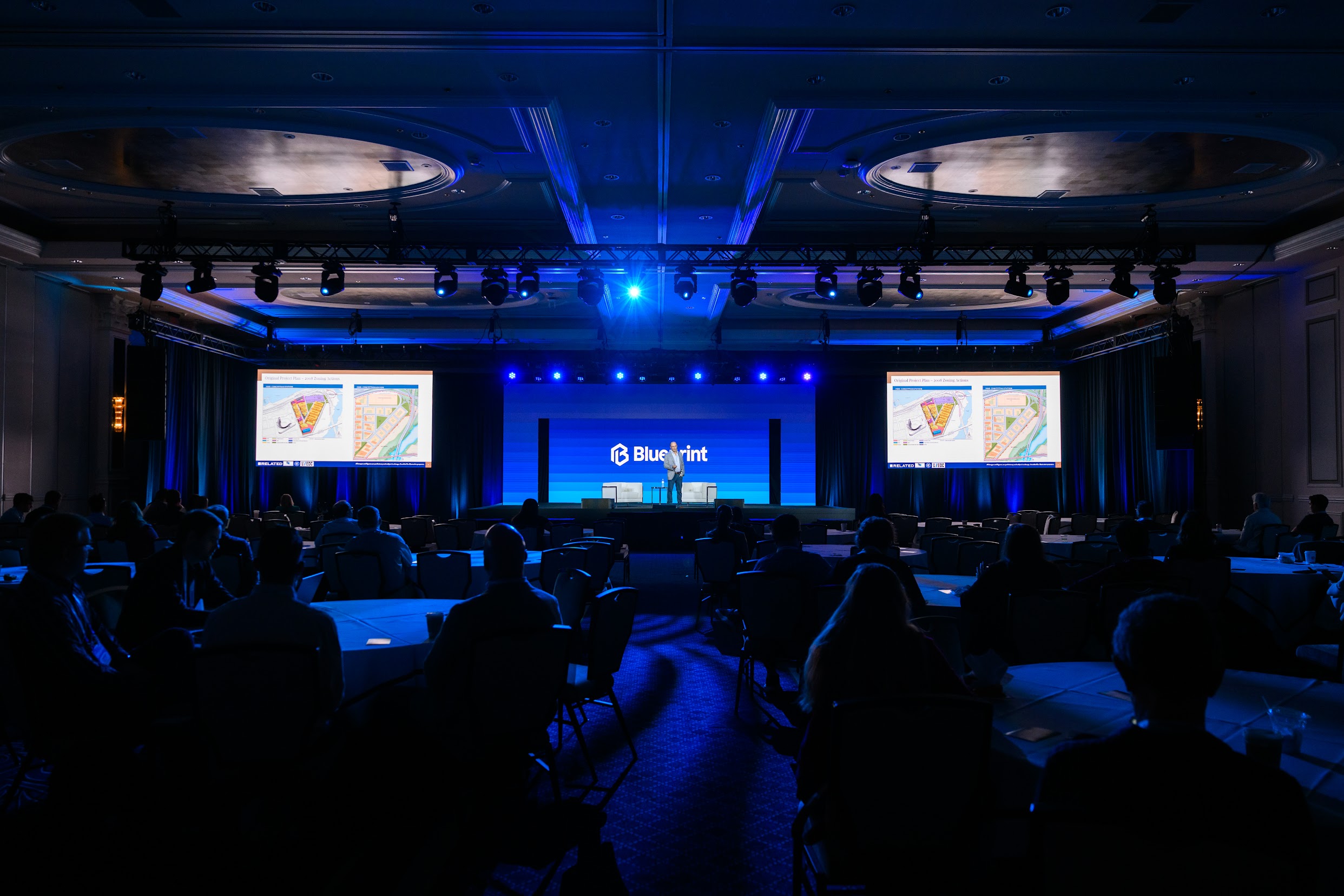
Blueprint 2026 takes place September 22-24, and the NOI Stage will run as a dedicated track alongside the main programming throughout the conference. In today’s report, we share six technologies surfaced through Advisory Council conversations that are actually moving the NOI needle in portfolios today. At Blueprint, operators will share detailed rundowns of how these technologies – and others – drove NOI results.
Previewing Tech That Moves the Needle
AI-driven leasing training and quality assurance. Leasing performance is one of the largest variable inputs into NOI and one of the hardest to manage at scale. Traditional secret shopping programs evaluate a handful of leasing interactions per property per month — a vanishingly small sample of the actual conversations a portfolio produces.
A new generation of AI tools, including companies like Grotto AI, captures and analyzes every leasing interaction across phone, email, SMS, and in-person, then surfaces specific coaching opportunities for individual leasing professionals. The NOI lift comes from two sources: meaningful improvement in conversion rates across the leasing funnel, and reduced reliance on expensive legacy training programs. Operators piloting these tools have reported that the most measurable gains come from compressing the gap between top-quartile and bottom-quartile leasing performers within the same portfolio.
Renewals optimization systems. Lease renewals are the single highest-leverage NOI lever in a stabilized portfolio. A three-percentage-point improvement in retention typically translates to materially higher NOI than a similar improvement in lease-up velocity, because turn costs, vacancy loss, and concessions are all avoided simultaneously.
Until recently, most operators ran renewals on a relatively static playbook: a system-generated offer, a notice window, and a leasing team chasing signatures. Newer renewals systems use resident behavior data, payment history, market comp data, and intent signals to generate differentiated offers per resident — and to surface the residents most likely to leave so site teams can intervene early. Mike Taravella of Niche Holdings will present on the renewals system his portfolio has built around this approach.
AI for delinquency and collections. Delinquency has been a stubborn drag on NOI for the past several years, particularly in markets affected by extended eviction backlogs and rising application fraud.
The traditional collections workflow is highly manual, relies on inconsistent communication between site teams and centralized accounting, and tends to escalate too late in the cycle. AI-driven collections tools automate resident outreach across multiple channels, segment delinquent residents based on probability of payment, and flag accounts that require human escalation before they age into legal proceedings. Operators in the Advisory Council have reported meaningful reductions in 30-plus day delinquency without adding centralized headcount, a direct line to NOI in markets where every basis point of recovered delinquency translates straight to the bottom line.
Application fraud detection. Multifamily application fraud has moved from a marginal concern to a structural NOI issue. Fraudulent applications using synthetic identities, altered pay stubs, and AI-generated documentation now represent a meaningful share of applicant flow in many markets, particularly in workforce and lower-mid submarkets. The downstream costs — eviction proceedings, unpaid rent, legal fees, accelerated turnover — are all direct hits to property-level NOI.
A category of dedicated fraud-detection tools has emerged to verify identity, income, and employment in ways that go beyond what traditional screening providers offer, often integrating directly into the application workflow without adding friction for legitimate applicants. Operators presenting on the NOI Stage will share specific deployment data, including the fraud rates they detected post-implementation and the resulting impact on bad-debt expense.
Centralized maintenance dispatch and on-demand technician networks. Maintenance is one of the largest controllable line items in the operating budget, and one where labor costs, contractor markups, and inefficient routing have historically eroded NOI.
The traditional model — one or two technicians per property handling everything from minor service tickets to turn punch lists — leaves margin on the table in both directions, with technicians sitting idle at one property while neighboring properties fall behind on turn cycles. A new category of centralized maintenance platforms and on-demand technician networks pools labor across portfolios, routes work based on skill match and proximity, and benchmarks cost-per-work-order in ways that surface underperforming properties and contractors. Operators in the Advisory Council have reported meaningful reductions in maintenance spend and turn-time without compromising resident response.
Resident communication and work-order standardization. Operating cost leakage from inefficient maintenance and inconsistent resident communication is harder to quantify than delinquency or fraud, but the cumulative NOI impact across a large portfolio is substantial. Disjointed communication produces duplicate work orders, missed escalations, and a resident experience that ultimately surfaces as elevated turnover and concession pressure at renewal.
Fortunately, a new generation of communication and work-order platforms has emerged to standardize the resident-facing experience across properties — particularly valuable for portfolios that have grown through acquisition and inherited multiple PMS configurations and communication patterns. Anne Baum of Towne Properties will present on her firm’s deployment of one such platform across its 115,000-unit HOA and condominium management portfolio, an operating context that places unusual demands on standardization at scale.
What’s Next at the NOI Stage
The NOI Stage represents a deliberate move away from the kind of programming that has dominated proptech conferences for the past several years — keynotes about transformation, panels about the future of work, and vendor showcases that rarely connect back to portfolio-level financial outcomes. The format pushes presenters to show specific tools, specific deployments, and specific NOI impact, rather than speaking in the abstract about where the industry is headed.
Topics for several presenters remain in development, and additional NOI Stage sessions will be announced in the coming weeks. A small number of slots have been reserved for extended 20-minute sessions pairing an owner-operator with the executive of the technology provider that helped achieve the NOI lift in question. The first of those is a fireside chat featuring Nick Deveau, co-founder and CEO of Grotto AI, paired with one of the firm’s owner-operator clients on the topic of AI-driven leasing training.
For multifamily executives evaluating where to spend technology dollars and operational attention over the next twelve months, the NOI Stage is intended to deliver something the industry has not consistently produced at conference scale: a concentrated set of operator-led case studies grounded in measurable financial outcomes. Operators attending Blueprint 2026 should expect to leave with a clearer view of which categories of technology are producing real lift in their peers’ portfolios, which are still in pilot, and where the highest-leverage opportunities for the year ahead are most likely to emerge.
-Brad Hargreaves