

The self-guided tour has become standard in multifamily leasing, and operators have largely stopped debating whether to offer it. But the question of whether it converts better than agent-led tours has no clean answer, in part because the industry is measuring an incomplete deployment. In a recent Insights by Blueprint Advisory Council survey, no respondent said self-guided tours convert better than traditional agent-led ones. That finding is striking, but it may say more about implementation than the self-guided tour itself.
The access layer of identity verification and smart locks is largely solved. What remains underdeveloped is the half of the tech stack that actually moves a prospect toward a decision: wayfinding and navigation, behavioral data capture, and real-time engagement. Operators who have built out the front of the tech stack and stalled at the back are drawing conclusions about self-guided touring from evidence that doesn’t fully reflect it.
This report maps the full tech stack, locates the largest gaps, and proposes a segment-specific deployment model for operators running diverse portfolios. It also takes on the measurement problem directly: The industry cannot make a credible case for self-guided touring in either direction without defining what a fair comparison looks like. The technology is no longer the biggest challenge, but major differences in implementation remain.
What changed
Multifamily operators have heard the self-guided touring pitch for years. What’s changed is the underlying reality of leaner property site teams, a younger renter cohort that prefers on-demand scheduling by default, and AI-layered platforms that have quietly resolved the core objection that removing the agent means removing the sale.
The staffing efficiency imperative. A conventional agent-led tour consumes 45 minutes of leasing staff time, more when scheduling coordination and follow-up are included, and a significant share of those tours produce no lease. For operators running lean site teams, the volume of tours a leasing agent must personally conduct each week is a drag on every other revenue-generating activity. Advisory Council operators have noted that middle-market communities without a dedicated leasing function, in which a single on-site manager is responsible for tours alongside maintenance coordination, renewals, and resident relations, are most acutely affected. Self-guided tours do not merely reduce costs at these properties; they create capacity that would otherwise not exist.
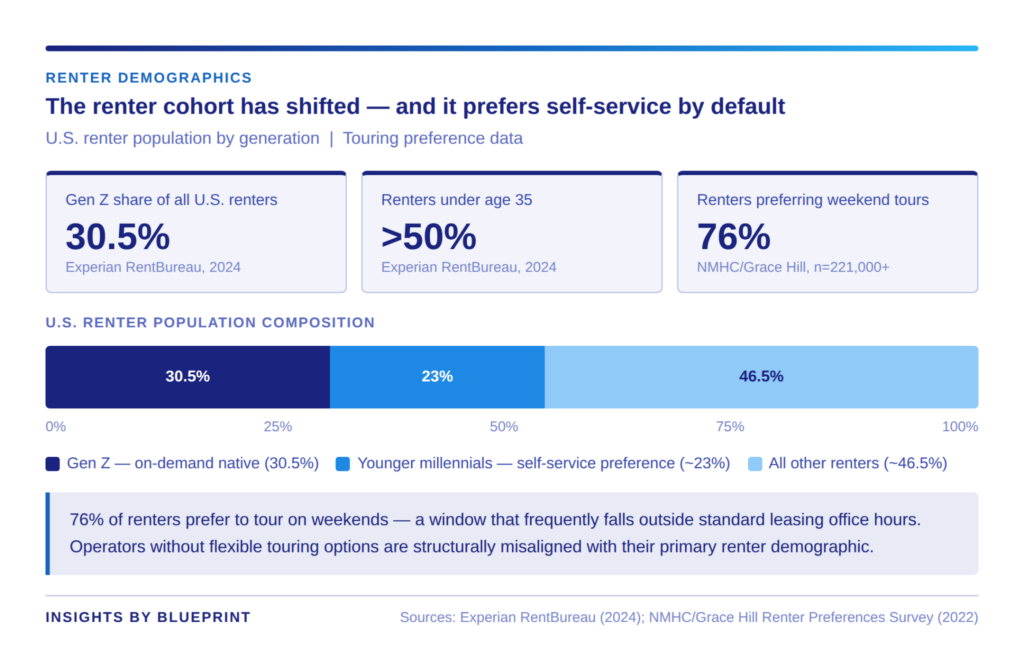
The renter demographic shift. Gen Z and younger millennials (adults under 35) represent more than half of the U.S. rental population, according to Experian’s 2024 analysis of RentBureau tenant data. Gen Z alone accounts for 30.5% of all renters. This cohort demonstrates a consistent preference for on-demand scheduling and self-service interactions throughout the leasing funnel. The NMHC/Grace Hill 2022 Renter Preferences Survey, which drew on responses from more than 221,000 renters, found that 76% of renters prefer the weekend to tour a property, a window that may fall outside standard leasing office hours. Operators who fail to offer flexible touring options are misaligned with the expectations of their primary renter demographic.
Technology maturation from single-family rental. Self-guided touring originated at institutional SFR scale, where operators like Invitation Homes and Progress Residential needed to manage tens of thousands of geographically dispersed units without site-level staff at each property. The operational requirements of that environment forced the rapid maturation of the underlying technology, which has since migrated into multifamily with greater reliability and lower implementation costs than were available during the pandemic-era rush to deploy.
AI integration changing the conversion calculus. The most significant recent development in the self-guided tour category is the layering of conversational AI into the tour experience itself. Platforms including Tour24 have built in-tour AI assistants that answer prospect questions in real time, capture stated preferences and objections, and feed structured data back into the CRM for follow-up personalization. This addresses the primary argument against self-guided tours — that removing a leasing agent eliminates the sales function — by repositioning the AI as a qualification and information-gathering layer and the agent as a follow-up resource for prospects who have already demonstrated serious intent.
Beyond access control
Most operators think about self-guided tours as an access problem — get the prospect into the unit safely and efficiently. The technology stack required to do that well is considerably more complex, and the layers that receive the least investment tend to have the greatest impact on conversion.
Layer 1: Access control. The foundation of any self-guided tour deployment. Smart locks that issue time-limited PIN codes or Bluetooth mobile credentials are the dominant approach at scale, while key lockboxes remain a lower-cost fallback for smaller or older properties. Enterprise operators running Class A communities have largely migrated to integrated access platforms such as Latch (now Door.com), ButterflyMX, or SALTO, which provide amenity-level access beyond the unit door and integrate with broader resident experience platforms. The access layer is the most mature component of the stack and the area where operator investment is most consistent.
Layer 2: Identity and fraud verification. Identity verification — government-issued ID scan combined with a liveness check or selfie match — has become a near-universal requirement for self-guided tour deployment, and Advisory Council survey data confirms its broad adoption. Vendors including Persona, Jumio, and Checkpoint ID provide standalone verification services, while most major self-guided tour platforms have integrated ID verification into their scheduling flow. Geo-fencing, which restricts access code delivery until a prospect is physically within a defined radius of the property, represents a more recent fraud-mitigation layer still being adopted across the industry.
Layer 3: Scheduling and PMS integration. Calendar integrations with property management software platforms enable real-time availability display and prevent double-booking against agent-led tour inventory. Automated confirmation and reminder flows via SMS and email are standard in this layer. The scheduling layer is widely deployed but varies in integration depth. Operators whose self-guided tour scheduling system is not natively connected to their PMS typically incur manual reconciliation overhead, which offsets part of the efficiency gains.
Layer 4: Navigation and experience. This is the most underdeveloped layer in terms of its impact on tour completion. Most SGT deployments in the market today function as self-access tours rather than true self-guided experiences — the prospect receives a lockbox code and, at best, a static PDF map. Wayfinding technology, which provides GPS-style turn-by-turn navigation from parking to unit to amenity points of interest, directly addresses the scenario described in this report’s opening.
Rently’s Wayfinding product, built into its self-guided tour platform, reports a 15% increase in tour-to-lease conversion rates and a 20% improvement in community ratings at communities where it is deployed, according to the company’s internal platform analytics. Beyond navigation, in-app guided content — curated descriptions of unit features, amenity callouts, and neighborhood context — allows operators to direct the tour narrative as a skilled leasing agent would, without requiring an agent to be present.
Layer 5: Data capture and follow-up automation. This layer is where the self-guided tour stack has the greatest unrealized potential, and where operator investment is most clearly lagging. Advisory Council survey data shows that lead scoring tied to tour behavior — which rooms the prospect viewed, how long they spent in each space, which features they flagged or questioned — is present in roughly 7% of current stacks.
The data exists within the platforms, but it is simply not being activated. Operators who feed tour behavior analytics back into CRM scoring and follow-up sequencing can personalize outreach in ways that are demonstrably more effective than generic post-tour email campaigns. Conversational AI layered into the tour experience further enriches this data by capturing stated prospect preferences and objections that a traditional self-guided tour system would not surface.
Deployment by segment
Self-guided tours are not a single product decision applied uniformly across a portfolio. The appropriate model and the appropriate depth of investment in each stack layer vary substantially by property segment. Advisory Council data show that the most common current approach — roughly 20% of respondents — is to operate different models across properties. That heterogeneity is appropriate. The risk is that it reflects ad hoc vendor decisions rather than a deliberate segmentation framework.
Lease-up and Class A communities. At premium properties with dedicated leasing teams and service-oriented positioning, agent-led tours remain the primary conversion vehicle. Self-guided tours in this segment serve as a supplement to off-hours access rather than a replacement for the agent relationship. Investment should be concentrated in Layers 1 through 3, with experience quality — a polished wayfinding and in-app content experience — prioritized over data capture infrastructure.
Stabilized mid-market communities with dedicated leasing teams. This is the segment where a hybrid model is most appropriate and most common. Self-guided tours handle off-hours and initial qualification, while agent intervention is reserved for prospects who have toured and expressed specific interest. Full-stack deployment is justified in this segment — including Layer 4 navigation and Layer 5 data capture — because the volume of self-guided tour interactions is high enough to generate actionable analytics, and the leasing team is positioned to act on them in follow-up.
Value-add and smaller communities without dedicated leasing staff. Self-guided tours at this segment are load-bearing infrastructure rather than a supplemental option. The sole on-site manager, who would otherwise conduct every tour, is also responsible for maintenance coordination, renewals, and resident relations. Removing tour escort time creates capacity that directly translates to other revenue-generating activity. The failure mode in this segment is underinvestment in Layers 4 and 5. The efficiency gain from removing the agent from the tour is realized only if the time is redirected to high-quality follow-up, and that follow-up quality depends on the data the self-guided tour system captures during the tour.
Large diversified portfolios. Operators managing portfolios that span multiple property types and markets face a governance challenge that the segmentation framework addresses directly. Running different models across different properties is operationally appropriate. Running them without a defined standard for each segment creates inconsistent prospect experiences and makes portfolio-level measurement of self-guided tour performance nearly impossible. The priority at scale is to establish segment-specific deployment standards and ensure that data from all self-guided tour interactions flows into a unified CRM and analytics environment.
The question operators can’t (yet) answer
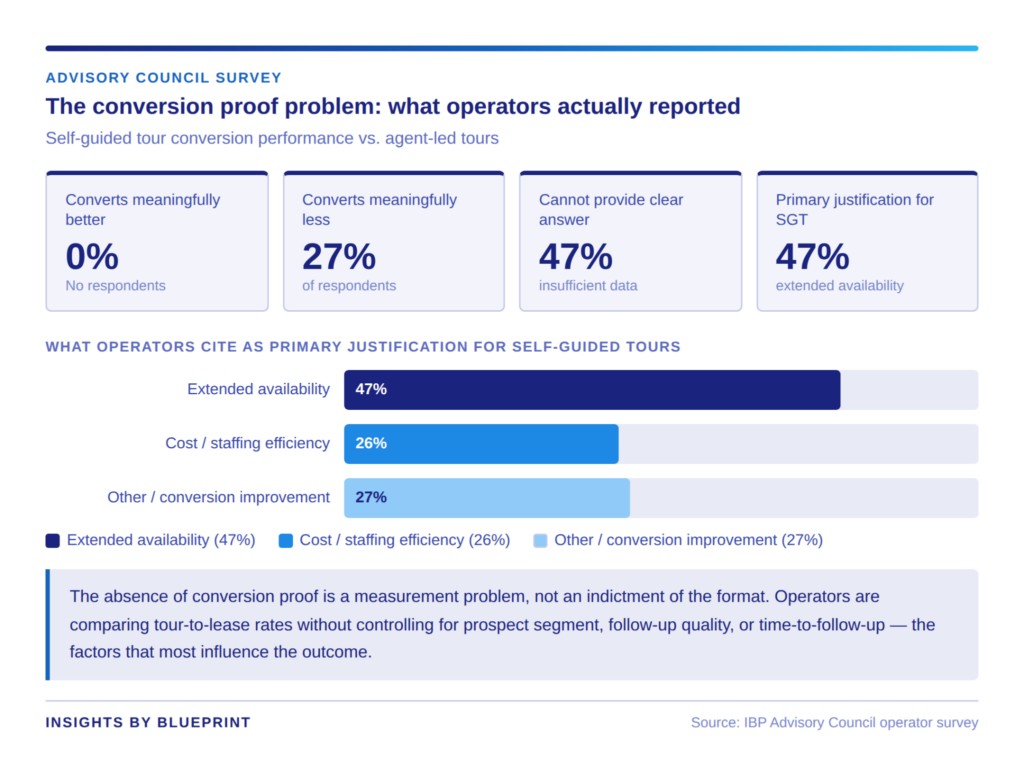
The most significant finding from Advisory Council survey data is the absence of conversion proof. Zero percent of respondents reported that self-guided tours convert meaningfully better than agent-led tours. 27% said self-guided tours convert meaningfully less. Nearly half — 47% — could not provide a clear answer, citing insufficient data or too much variation by property type to generalize. The dominant justification for investing in self-guided tours, cited by 47% of operators, is extended tour availability rather than conversion performance.
This data should not be read as an indictment of self-guided touring. It should be read as a measurement problem. The industry is comparing tour-to-lease conversion rates between two very different experiences without controlling for factors such as property type, prospect segment, staff follow-up quality, and time-to-follow-up that most influence the outcome. A self-guided tour deployment with a weak Layer 5 will underperform an agent-led tour with strong follow-up, not because the self-guided format is inferior, but because the data and automation required to match the quality of agent follow-up has not been built.
Aigentless CEO Bella Campise has articulated this argument directly. “Tours drive conversions, but not because a leasing agent is present,” Campise told Propmodo. “The important factor is that prospects get the information they need to make a decision.” The follow-up, she argues, is where the conversion actually happens, and it needs to be calibrated to what the prospect actually cares about. “Our clients can spend more time on personalized follow-ups,” she said. AI-assisted self-guided touring systems that capture prospect behavior and stated preferences during the tour, and route that data to agents for structured follow-up, are designed precisely to address that conversion gap, but they require the full five-layer stack to function as intended.
Constraints and considerations
The strategic case for self-guided touring is well-established. The operational case requires working through four constraints that most deployment frameworks underweight.
Centralization strategy creates stack dependencies. Operators who are moving toward centralized leasing models — where a remote team handles follow-up and closing for multiple properties simultaneously — have a stronger structural case for a full Layer 5 investment because the data captured by the self-guided touring system is the primary input the centralized team uses to personalize outreach. Operators who retain site-level leasing staff, by contrast, may find that existing agent relationships and local knowledge substitute for some of what the data layer would otherwise provide. The framework should be applied with the organization’s centralization direction in mind.
Fair housing compliance introduces deployment constraints. Operators must offer self-guided tours equitably across prospect segments and cannot use self-guided touring availability as a steering mechanism. The identity verification and access control layers, which involve government ID collection and biometric liveness checks, require careful review for compliance with fair housing obligations and applicable state privacy laws. Operators in states with stricter biometric data regulations — notably Illinois and Texas — face additional compliance requirements that should be addressed before Layer 2 is deployed at scale.
Hardware reliability is an operational risk that scales with deployment. Smart lock battery failures, connectivity outages, and lock mechanism errors are low-probability events at the unit level but near certainties at the portfolio scale. An operator running self-guided tours across 10,000 units should expect daily hardware failures. The operational protocols for responding to lock failures — how quickly the issue is detected, how the prospect is notified, how the tour is rescheduled — are as important as the technology itself, and are frequently underdeveloped relative to the attention paid to initial deployment.
Vendor consolidation is reshaping the competitive landscape. The standalone self-guided touring vendor category has faced significant M&A pressure as PMS platforms and access hardware companies absorb functionality into broader resident lifecycle platforms. Operators evaluating point solutions should assess vendor stability and roadmap trajectory alongside current feature sets. Self-guided tour functionality native to an operator’s existing PMS or resident experience platform may offer lower integration costs and better data continuity than a best-of-breed standalone product, even if the standalone product has richer current features.
The implementation sequence
The five-layer framework is only useful if it produces action. The recommendations below are sequenced to address the most common deployment gaps first, starting with the data integrations that most operators already have the infrastructure to fix.
1. Audit the current stack against all five layers. Most operators have Layers 1 and 2 deployed but lack meaningful capabilities in Layers 4 and 5. The audit should document, for each property segment, which layers are present, which vendor provides each layer, and whether the layers are integrated with each other and with the PMS. Properties where self-guided tour scheduling data does not flow into the CRM have a data gap that is costing follow-up quality regardless of how well the access and verification layers function.
2. Segment the portfolio before expanding self-guided touring footprint. 33% of Advisory Council respondents plan to selectively expand self-guided tours over the next 12 to 18 months. That selectivity is appropriate, but it should be driven by the segment framework described in this report rather than by individual property manager preference or vendor sales relationships. Each segment should have a defined standard deployment model applied consistently across properties in that segment.
3. Define a conversion measurement framework before measuring. Comparing self-guided tour-to-lease conversion directly against agent-led tour conversion, without controlling for follow-up quality and speed, will produce misleading results. The appropriate measurement framework tracks tour completion rate, time-to-follow-up, follow-up personalization score (which requires Layer 5 data), and application rate. Track separately for self-guided and agent-led tours, within the same property segment, over a period long enough to produce statistically meaningful results.
4. Activate the data layer in existing deployments. Operators who already have smart locks and scheduling systems in place, but are not capturing tour behavior data or feeding it into CRM follow-up sequences, can close the most impactful stack gap without additional hardware. The priority is to confirm that tour behavior data from the self-guided tour platform flows into the CRM in a structured format, that agents have a standardized protocol for using that data in follow-up outreach, and that post-tour communication is triggered automatically rather than relying on agent-initiated action.
5. Establish a wayfinding and experience standard for unstaffed communities. Properties without on-site leasing staff during tour hours are most exposed to the navigation gap described in the opening scenario of this report. Deploying wayfinding technology at these properties — either through a platform with native wayfinding capability or through in-app tour content that provides step-by-step guidance — should be treated as a baseline requirement rather than an enhancement. The first impression a prospect forms of a community occurs during the tour, and a frictionless navigation experience directly shapes that impression.
From access to advantage
The self-guided tour stack is not a single technology decision. It is a layered architecture in which access and verification are necessary but not sufficient for the conversion outcomes the tech is capable of delivering. The gap between the current industry stack and what a full deployment enables is the difference between a self-access program and a genuine leasing advantage.
The NOI implications are direct. Faster time-to-tour reduces vacancy duration. Higher tour completion rates — driven by navigation quality — increase the pool of prospects who reach the application stage. Better data capture enables follow-up personalization that improves conversion rates at the close. Staff time recovered from tour escort duties, when systematically redirected to follow-up and renewal activity, compounds across the portfolio. None of these outcomes require new technology that does not yet exist. They require closing the deployment gap in the back half of a stack that most operators have already partially built.
Operators who apply the segment framework, audit their current stack against all five layers, and invest in closing the gaps will be well positioned to accurately measure self-guided tour performance for the first time. They will also be able to demonstrate the conversion case that the industry has, to date, been unable to make with confidence. The technology has matured past the point where the access problem is the hard problem. The competitive question now is which operators solve the conversion problem first.
– Nick Pipitone