
Centralized maintenance dispatch has become one of the most-discussed operational shifts in multifamily property management. But the conversation around it has largely missed what’s actually driving its adoption. The prevailing narrative treats centralization as a response to labor shortages and a way to do more with fewer technicians in a tight hiring market.
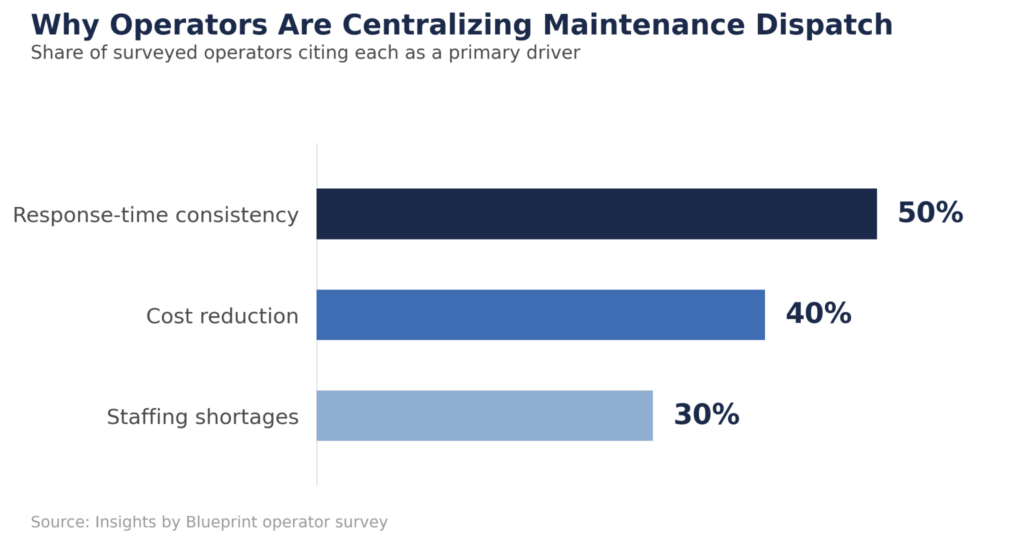
New Advisory Council survey data from Blueprint offers a slightly different angle. Response-time consistency, not cost reduction or staffing scarcity, is the reason operators most often cite for centralizing dispatch. That distinction matters because it changes the internal pitch an operations leader has to make, shifts the metrics used to judge success, and suggests the case for centralization holds even in markets where hiring isn’t the acute problem it is elsewhere.
But adoption on paper doesn’t mean adoption in practice. A meaningful share of operators who describe their maintenance function as “centralized” are still coordinating dispatch through spreadsheets, email threads, and phone calls. It is proof that centralizing a process and centralizing the systems underneath it are two different projects, frequently conflated and rarely executed in tandem.
This report treats that gap as the problem to be diagnosed. Rather than plotting operators along a single spectrum from decentralized to centralized, we introduce a framework that separates process centralization (who holds decision authority over triage and dispatch) from systems centralization (whether the underlying tools actually generate portfolio-level data and coordination). The result is four distinct operational postures, each with its own strengths, blind spots, and next move.
Why operators centralize dispatch
Trade press coverage of maintenance centralization over the past several years has largely framed it as a response to staffing shortages. New Blueprint survey data suggests that framing is incomplete and possibly backward for a meaningful share of the market. Response-time consistency is the leading catalyst, not cost. Fifty percent of surveyed operators cited response-time consistency as a primary reason for centralizing maintenance dispatch, ahead of cost reduction at 40 percent and staffing shortages at 30 percent. This changes the internal case an operations leader has to make. A pitch built primarily on labor savings invites headcount anxiety and can stall with a skeptical CFO. A pitch built on service-delivery consistency is a harder argument to dismiss and does not require betting the business case on staff reductions that may not materialize.
Staffing shortages are a secondary driver, which has implications for markets where hiring is not acutely broken. If staffing pressure were the dominant driver, the case for centralization would weaken automatically in any market where an operator is fully staffed. Blueprint survey data suggests the case is being made on operational grounds that hold regardless of local labor conditions: triage quality, technician utilization, and consistency of execution across a heterogeneous portfolio.
System fragmentation persists even where process centralization has occurred. Native property management system maintenance modules power roughly half of centralized dispatch operations. But a fifth of respondents who report having some form of centralized function are still running it through spreadsheets, email, or manual coordination. Centralizing a process, such as creating a triage team, a regional coordinator role, or a maintenance pod, does not automatically centralize the systems underneath it, and operators frequently conflate the two.
Geography imposes a hard constraint that other centralized functions do not face. Leasing and back-office administration can be centralized almost anywhere because the skills transfer cleanly from one property to another regardless of location. Maintenance cannot, because a technician must still be physically present at the unit. This is a reason maintenance centralization has lagged leasing centralization in multifamily. A portfolio spread across distant metro areas gets little benefit from a shared maintenance model, since there’s no way to pool technician capacity across communities outside a practical driving radius. Operators who have successfully built maintenance pods tend to keep those pods geographically tight, clustering a handful of nearby properties rather than spanning an entire regional or national portfolio.
Where does your maintenance operation sit?
The gap between survey respondents’ self-reported centralization status and their underlying systems suggests that centralization should be evaluated along two separate axes rather than treated as a single spectrum from decentralized to centralized. The first axis is process centralization: whether decision rights over triage, dispatch, and technician assignment sit with the site or with a regional or portfolio-level function. The second axis is systems centralization: whether the tools underlying that process are unified, integrated, and generating portfolio-level data. Or whether they remain fragmented across spreadsheets, phone calls, and disconnected software. Plotting an operation on both axes yields four distinct positions, each with a different operational profile and next step:
Site-Autonomous (low process, low system). Maintenance requests are called in to the property office, triaged by whoever answers the phone, and informally assigned to the available technician. This describes roughly a fifth of surveyed operators and is closest to the traditional one-technician-per-100-units staffing model that has defined multifamily maintenance for decades. The strength of this model lies in its simplicity and proximity. The weakness is that service quality depends entirely on the individual site team, and the organization lacks a portfolio-level view of technician efficiency, response times, or recurring issues.
Coordinated-but-Manual (high process, low system). A regional lead or centralized triage function has decision authority over dispatch, but the underlying tooling is still spreadsheets, email, and phone calls. This profile is common among operators taking early steps toward regional maintenance coordination. Work orders are still processed at the property level, but a regional lead — not the property manager — coordinates assignments and can redeploy technicians as unit-turn timelines shift. Operators who have piloted this model report that the financial benefit tends to come primarily from better decisions about work allocation rather than from headcount reduction. For instance, consolidating a repair category that had generated numerous separate external vendor calls under a single in-house technician once a regional lead gained visibility across properties. This quadrant captures real gains through better decision rights even before any system investment, but the gains are capped by the absence of portfolio-level data.
Tooled-but-Fragmented (low process, high system). A native property management system maintenance module or a dedicated dispatch platform is in place, but decision authority still sits at the site. The tool functions as a work order log rather than a coordination layer. This is a common landing point for operators who purchased software to solve centralization without first deciding who has authority to make dispatch decisions across properties. The tool generates data, but nobody at the portfolio level is using it to reallocate technician capacity or standardize response times. So the operational behavior is identical to that of the Site-Autonomous quadrant, despite the software investment.
Fully Centralized (high process, high system). A dedicated, centralized team or third-party call center has authority over triage and dispatch. That authority is exercised through unified software that captures response times, technician performance, and supplier ratings at the portfolio level. Blueprint survey data suggests this level of centralization remains the exception rather than the rule. Only about one in ten operators currently sit fully in this quadrant. That’s consistent with a 24-month outlook in which half expect modest further expansion and only one in ten expect significant expansion. The market is advancing toward this quadrant incrementally rather than converging on it quickly.
The diagnostic value of the framework is in forcing an honest placement. An operator that has hired a regional maintenance coordinator but is still tracking work orders in a shared spreadsheet has made real process progress and no system progress. An operator that rolled out a maintenance module across every property but left dispatch authority at the site has made system progress without corresponding process changes. Both operators may describe themselves as centralizing, but they face different next steps and should not benchmark themselves against each other.
The framework’s limitations
Portfolio diversity undermines pooled maintenance pods. Third-party managers face a specific version of this problem. Asset owners with newer properties are frequently reluctant to be pooled with older assets in the same maintenance pod, on the theory that their property will subsidize a disproportionate share of repairs on a building with different maintenance needs. Ian Bingham, senior vice president of business development at Daniel Management Group (and formerly in the same role at Buckingham Companies), has pointed to property vintage as a key variable here. A 1990s-built property with more frequent HVAC failures requires meaningfully more maintenance labor than a 2016-built property, a gap that complicates any pooling arrangement that treats properties as interchangeable. That dynamic is exactly what makes asset managers overseeing large, mixed-vintage portfolios cautious about pod structures without a clear allocation methodology.
Work order types do not centralize at the same rate. Maintenance activity splits into at least three categories with different cadences: routine business-as-usual work orders best handled by technicians close to the property, proactive maintenance that can be scheduled during low-demand periods, and unit turns, which spike sharply during leasing season and around monthly move-in and move-out cycles. Turn maintenance has emerged as a distinct candidate for centralization, separate from day-to-day dispatch, because it is more of a project-management problem than a triage one.
Operators that have separated turns from routine dispatch report faster cycle times, since turns no longer compete with emergency work orders for the same technician capacity. Industry benchmarks generally set a standard turn at five to ten days from move-out to move-in ready when a single technician pool is juggling both turns and day-to-day work orders. Operators who dedicate staff specifically to turns and sequence the work tightly commonly bring that down to the three- to five-day range. The gain comes less from working faster and more from not stopping. A dedicated turn technician isn’t pulled off a punch list to handle an HVAC emergency three doors down.
Client buy-in complicates centralization for fee managers. A third-party manager acting on behalf of multiple ownership groups cannot unilaterally centralize maintenance across properties belonging to different clients without their agreement. Asset managers who are billed based on hours worked at their specific property are understandably attentive to how pooled resourcing is allocated and reported.
From diagnosis to action
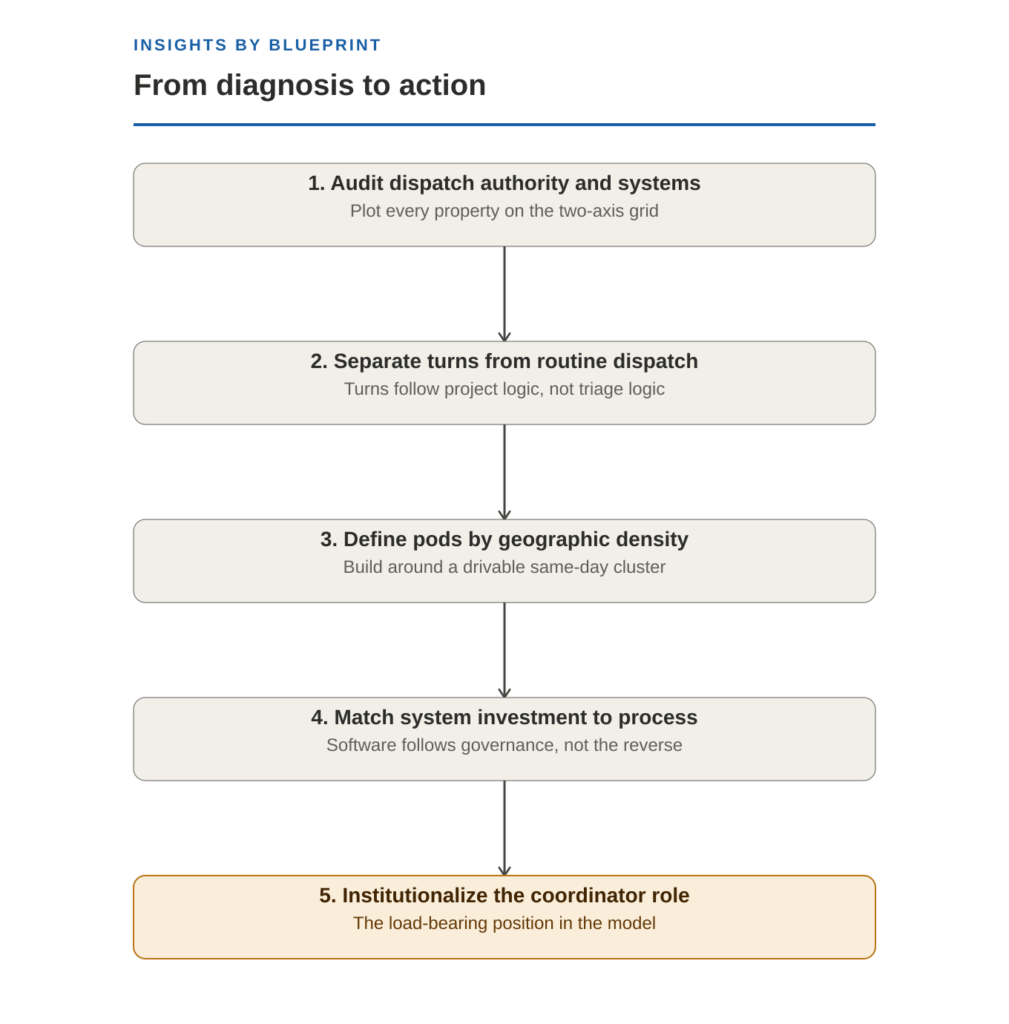
The framework identifies where an organization actually stands. Converting that diagnosis into progress requires a specific sequence of moves. The steps below move from audit to structural decisions to the staffing choice that determines whether the rest of the model works.
Plot every property on the two-axis grid before selecting a vendor or org structure. An audit that captures both who currently has dispatch decision authority and which system that authority runs through will reveal whether the organization’s real gap is process, systems, or both. It also prevents a software purchase from being mistaken for a centralization strategy.
Separate turn maintenance from routine dispatch as an early, self-contained move. Because turns follow a project-management logic rather than a triage logic, they can be centralized or outsourced independently of the broader dispatch model. Doing so removes a major source of contention between emergency work orders and turn deadlines without requiring a full organizational redesign.
Define maintenance pods by geographic density, not organizational convenience. A pod should be built around properties close enough that a technician can reasonably serve all of them in a single day. Operators that have ignored this constraint in favor of administrative simplicity have generally seen the pod model underperform relative to expectations.
Match system investment to the actual level of process centralization. A centralized triage team running on spreadsheets is a signal to invest in unified dispatch software. A fully licensed maintenance module with no regional decision authority is a signal to address governance and reporting lines before buying additional tools.
Institutionalize the regional coordinator or dispatch-lead role as the load-bearing position in the model. The operators who have reported the clearest gains from centralization, across both the survey data and independent reporting, consistently point to a specific role such as a regional maintenance lead, a dispatch coordinator, or a call-center manager that has the authority and data access to make cross-property allocation decisions. Without that role explicitly defined and staffed, neither process nor system investments produce the coordination benefits centralization is meant to deliver.
Centralization isn’t a yes-or-no question
The conversation about centralization in multifamily maintenance has been asking the wrong binary question. “Are you centralized?” invites a yes-or-no answer that flattens the real variation between an operator running a regional dispatch team off a shared spreadsheet and one routing every work order through a unified platform with portfolio-level visibility. Both might call themselves centralized. Only one has actually built the coordination the term implies. The framework introduced in this report matters because it replaces that binary with a diagnostic. It tells an operator not just where they stand, but which of the two projects — process or systems — still needs work. And it prevents the common mistake of treating a software purchase or an org chart change as a complete solution.
The operators making the clearest progress share a common thread. They’ve matched their system investment to their actual level of process maturity, they’ve separated turn maintenance from routine dispatch rather than forcing both through the same triage logic, and they’ve built pods around geographic density rather than administrative convenience. None of that requires a large technician headcount or a wholesale platform migration. Instead, it requires an honest audit and a willingness to treat processes and systems as two separate problems that reinforce each other when solved in the right order. For an industry still moving toward full centralization incrementally rather than all at once, that sequencing is likely to be the difference between operators who close the gap and those who spend another budget cycle rediscovering it.
– Nick Pipitone