
Every proptech product on the market now carries an AI label. The distance between the products that genuinely change how a portfolio operates and the ones that have simply repackaged a feature has never been harder to measure from the outside. For operators trying to allocate a technology budget, the signal-to-noise problem is now the problem.
The questions worth asking have moved past whether AI works. They have shifted to where it actually moves NOI, which parts of the operating model it reshapes, whether it erodes the competitive moats operators have spent years building, and what happens to the roles and org charts underneath it. Those are operational questions with real dollars attached, and they are best answered by the people running large portfolios rather than the vendors selling into them.
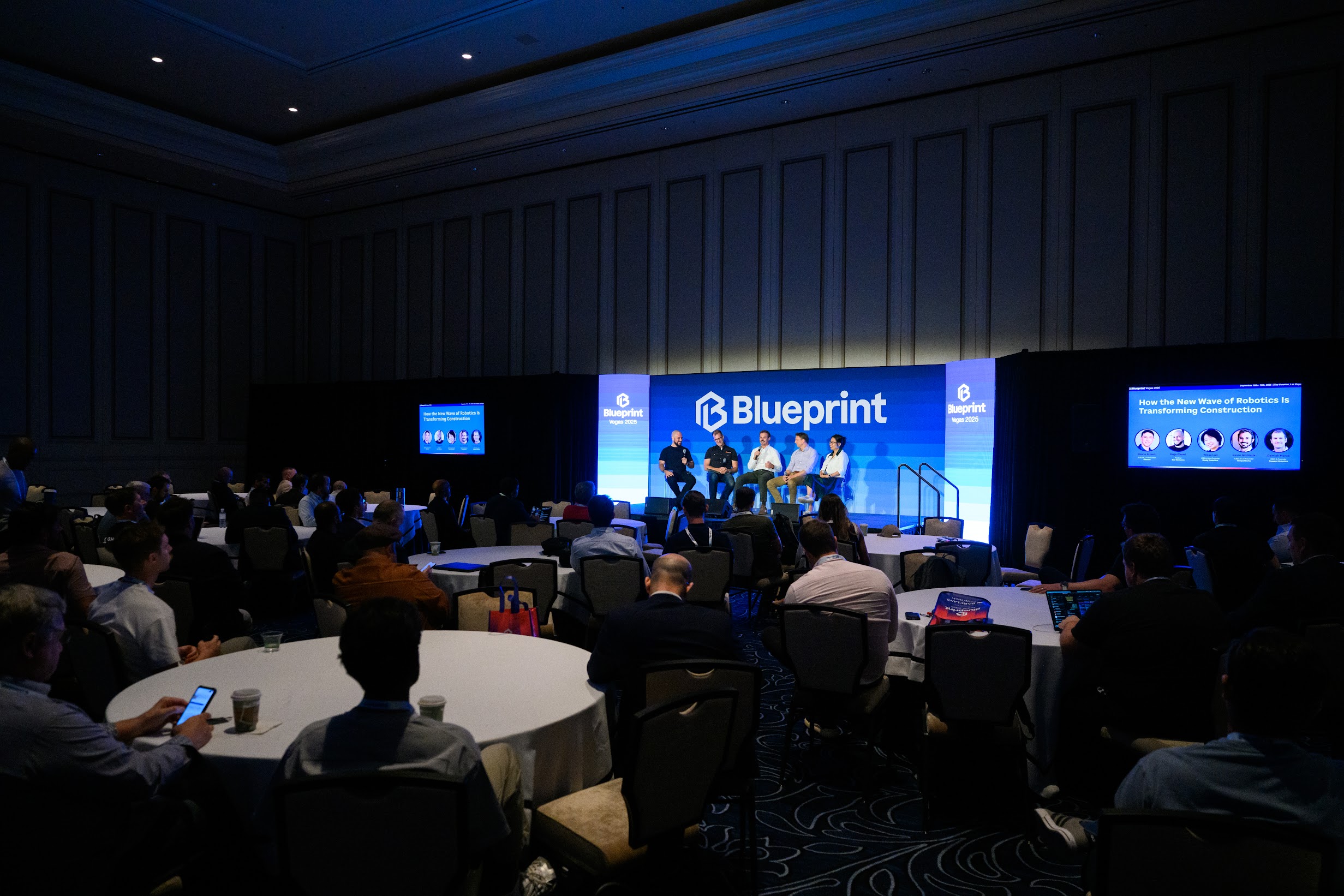
Blueprint 2026 (September 22–24 in Las Vegas) has programmed dozens of sessions across the AI stack, from multifamily NOI to construction ROI to the future of the workforce. The eight below are the ones built to answer those questions directly, each anchored by operators and investors who are living the decisions rather than theorizing about them. Register for Blueprint 2026 and see the full agenda here.
1. What Does “AI-First” Have to Do With Multifamily NOI?
The AI hype cycle shows no sign of slowing, but a closer look at adoption reveals that some applications are vastly more effective than others, reshaping entire categories of software and enabling change at previously unattainable levels. This session cuts through the noise to focus on real examples of operators achieving transformation through AI, and how it flows through to NOI. The discussion examines how the combination of chat and agentic AI is changing what operators can know about their residents, how that reshapes leasing, renewal, and maintenance decisions, and how AI-first design collapses traditional software categories and the competitive moats built on top of them. The panel pairs a leading multifamily technology analyst with three operators making these calls across large, geographically diverse portfolios, which keeps the conversation anchored in what actually changed the numbers rather than what looked promising in a demo.
Confirmed speakers: Dom Beveridge, Founder, 20for20 (moderator); Douglas Pearce, EVP of IT, Waterton; Aaron Ross, President, Birge & Held; Jeremy Voigtmann, Managing Director, Harbor Group.
2. If AI Commoditizes Leasing, What Makes You Different?
Leasing has long been one of the most defensible functions in multifamily — a mix of local knowledge, response speed, and human touch that was hard for competitors to replicate. As AI absorbs more of the leasing funnel, from first inquiry to tour to application, the parts that once separated a great operator from an average one are increasingly available to everyone. This session takes the differentiation question head-on: when the leasing engine becomes a commodity, where durable competitive advantage actually lives: in the resident experience, in the asset itself, in proprietary data, or in the operating model. Pairing a proptech investor with operators who run leasing at scale across large residential portfolios, the panel gets specific about which advantages survive commoditization and which were never as durable as they looked.
Confirmed speakers: Aaron Ru, Principal, RET Ventures; Garrett Hrncir, VP & Chief Customer Experience Officer, Continental Properties; Dean Holmes, SVP of Residential Operations, QuadReal Property Group.
3. Non-Hype AI: Practical Applications Across Real Estate Asset Classes
Most AI conversations in real estate stay at the altitude of promise. This one is designed to stay on the ground. Bringing together investors and operators working across flexible accommodations, residential, and the built environment, the session focuses on the applications already producing results in live portfolios rather than the ones still confined to pitch decks. The panel digs into what separates a use case that scales from one that stalls after the pilot: the data readiness, the integration work, and the operational discipline that determine whether a tool graduates from experiment to standard practice. Because the speakers span multiple asset classes and both the operating and investing sides of the table, the discussion also surfaces which AI applications travel well from one property type to another and which are far more context-dependent than the marketing suggests.
Confirmed speakers: Alex Shtarkman, Founder, Managing Partner & CIO, Antithesis Ventures; Roman Pedan, CEO & Founder, Kasa; Jerry Coleman, CEO, Build To Stay; Wan Li Zhu, Managing Director & Co-Founder, Suffolk Technologies.
4. AI in Action: Turning Operational Data Into Real ROI
Portfolios have never had more operational data, and most of it still sits unused. Part of the RET Ventures Multifamily Kickoff Summit, this session focuses on the mechanics of turning maintenance, leasing, and resident signals into measurable financial outcomes: the connective tissue between a data strategy on a slide and a return that shows up in the P&L. The panel gets into where operators are actually capturing value today, what infrastructure has to exist before the data becomes usable, and how to separate the metrics that move decisions from the ones that just fill a dashboard. Pairing an investor with senior operating leaders, the discussion stays grounded in returns that have already been realized rather than the ones still being modeled.
Confirmed speakers: Jameson Hartman, VP, RET Ventures; Mariana Estrada, Chief Strategy Officer, RPM Living; Paul Seifert, EVP of Operations & Chief Legal Officer, Continental Properties.
5. From AI Adoption to Enterprise Intelligence: The Multifamily Operator’s Next Competitive Edge
Adopting AI tools is now table stakes; the harder work is turning scattered pilots into enterprise-wide intelligence that compounds across a portfolio. This session looks at what that transition actually requires: the data foundations, the organizational structure, and the governance that separate operators running a handful of experiments from those building a genuine, portfolio-level capability. The conversation gets into where the intelligence layer actually lives, how operators avoid recreating data silos with every new tool, and what it takes for insights generated in one part of the business to change decisions in another. The panel brings together a veteran C-suite operator, a capital markets leader, and an innovation executive to map what the next competitive edge looks like when AI stops being a collection of point solutions and becomes an operating capability.
Confirmed speakers: Jamie Gorski, Founder, Catchpoint Collective (moderator); Hope Dunleavy, Managing Director, Newmark; Whitney Kidd, SVP of Innovation and Technology, Preiss.
6. AI and the Real Estate Workforce: Bigger, Smaller, or Both?
The workforce question is the one operators are asked most and answer least clearly. Automation compresses some roles while creating demand for entirely new ones, and the net effect varies enormously by portfolio strategy and asset class. This session gathers a transformation officer, a CIO, an academic studying the shift, and an investment banker who watches how it reprices companies, a deliberately wide lens on whether AI ultimately makes real estate organizations leaner, larger, or something more complicated than either. The discussion moves beyond headcount to the harder questions of how teams get restructured, which skills become scarce, and how the economics of an AI-enabled operating platform change the way investors value the businesses that run on it.
Confirmed speakers: Thais Galli, Chief Transformation Officer, JLL; Colin Joynt, SVP & CIO, BXP; Steve Weikal, Industry Chair of the Real Estate Transformation Lab, MIT Center for Real Estate; Deborah Smith, Co-Founder & CEO, The CenterCap Group.
7. Your Job in 2027: How AI Is Rewriting Four Core Roles
Where the workforce panel takes the macro view, this session zooms in on specific jobs. It walks through how AI is changing the day-to-day of four core real estate roles and what the people in those seats will actually be doing a year from now: which tasks disappear, which get amplified, and where human judgment becomes more valuable rather than less. The panel spans brokerage, multifamily operations, investments, and capital markets, giving the discussion a cross-functional read on how far the rewrite has already gone and how unevenly it is landing across functions. For operators planning next year’s org chart and hiring plan, it is a concrete look at where the work is headed rather than a forecast about the industry in the abstract.
Confirmed speakers: Stuart Bern, Managing Director, JLL; John Carlson, CEO, Mark-Taylor Residential; Sophie Tulkoff, Principal, Investments Team, Osso; Craig Lashley, CEO & President, Valiant Residential; Alicia Miller-Yodder, Head of Capital Markets, Black Salmon Capital.
8. From Pilot to Platform: How Construction AI Delivers Measurable ROI
AI in the built world does not stop at the leasing office. On the construction side, the gap between an interesting pilot and a repeatable platform is where most of the value is won or lost. This session brings together contractors and investors to examine what it takes to move construction AI from a one-off project into infrastructure that delivers measurable ROI across a book of work. The panel gets specific about how to tell early which tools will make that jump, what the integration and change-management costs look like on a job site, and how the return actually shows up — in schedule, in controls, in rework avoided — rather than in a vendor’s projected savings. It rounds out the picture of AI in real estate by extending the conversation from operations into the physical process of building.
Confirmed speakers: Rachael Ferrera, Manager of Investments & Ideation, Zachry Construction Corporation; Kamran Azarbal, VP of Strategy, Primepoint; Travis Putnam, Co-Founder & Managing Partner, Navitas Capital; Curtis Smith, Group Controls Manager, Building Group, Sundt Construction.
Taken together, these eight sessions trace the full arc of AI in real estate: where it moves NOI, where it threatens existing advantages, where the hype gives way to real returns, how scattered tools become an enterprise capability, and what it all means for the people doing the work. Operators who sit through all eight will leave with a grounded, practitioner’s view of what is real, what is early, and where to place the next bet.
-Brad Hargreaves