


Most multifamily portfolios have done the easy part with mass-notification and emergency-response systems. Email lists exist, and resident portal platforms send SMS. The baseline broadcast systems are largely in place, and operators have reasonable grounds to believe they can reach their residents when it counts.
New survey data from the Insights by Blueprint Advisory Council suggest that there’s more work to be done. The majority of multifamily operators we surveyed rely primarily on digital notification channels, such as SMS, email, and in-app push notifications. But these channels can and do fail during emergencies due to network congestion and telecom outages when delivery matters most. Regulatory frameworks from FEMA and NFPA treat them as supplementary rather than primary life-safety channels.
The survey flagged other problems: a lack of integration with public emergency alert systems, and notification responsibilities split across multiple personnel. Without a clear governance structure and ownership of responsibility for emergency response communications, the task can easily become out of sight and out of mind.
Through the survey, we’ll map the current state of emergency-response communications across the multifamily industry as well as introduce a framework for assessing emergency communication readiness, examine the vendor landscape, and provide an implementation path for portfolios looking to move from basic digital channel broadcast toward a system that functions when performance is most consequential.
What the survey data tells us
Mass notification and emergency response communications across multifamily portfolios remain a work in progress, according to our new Advisory Council survey. Email and SMS are near-universal adoption points — 86% and 79% of respondents, respectively — and in-app push notifications have reached 71%, reflecting the broad rollout of resident-facing portal platforms across the industry.
Below those baseline channels, however, the systems thin quickly. Voice blast reached just one respondent, intercoms one, and digital signage none, suggesting that the redundancy layers most emergency management frameworks recommend are largely absent. One respondent reported no formal notification system at all.
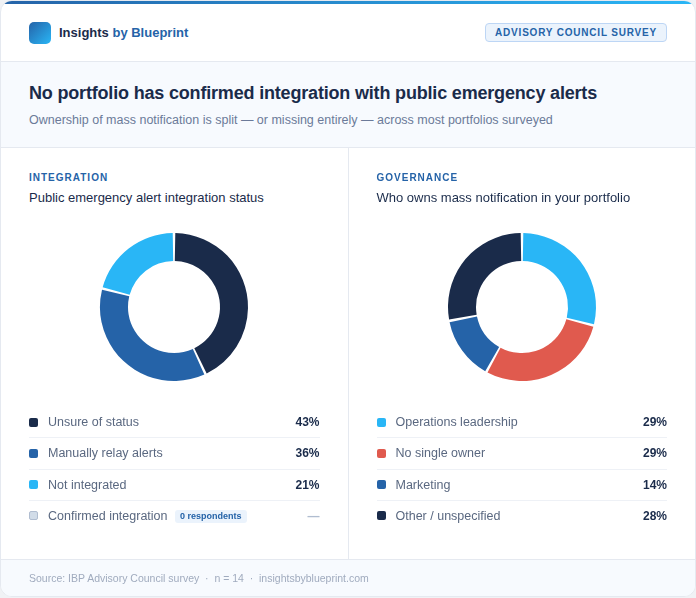
Not a single respondent confirmed active integration with public emergency alert systems, such as Wireless Emergency Alerts, FEMA, or equivalent municipal systems. The majority (43%) said they were unsure of their integration status, a finding that itself signals the degree to which emergency communications have not been prioritized. Another 36% acknowledged manually monitoring public alerts and relaying them to residents themselves. That’s a process that introduces latency, inconsistency, and dependence on individual staff judgment at precisely the moments when speed and accuracy matter most.
The ownership structure of mass notification compounds the gaps. Operations leadership and “no single owner” tied as the most common governance model, each cited by 29% of respondents, with marketing holding the function at another 14%. The diffusion of accountability across roles — and in many cases the explicit absence of a designated owner — means that the integration shortfalls and gaps described above are unlikely to be prioritized without a deliberate governance intervention. Portfolios that treat mass notification as a shared operational responsibility rather than an owned function tend to discover their system’s limitations during an emergency, not before.
Climate risks & wrong tools for the job
In addition to the gaps highlighted above, climate-driven severe weather and natural disasters are intensifying pressure on multifamily operators to rethink emergency mass notification. Yet many still rely on tools that weren’t built for the job.
Climate exposure is expanding. The frequency of extreme weather events, such as wildfires, flooding, tornadoes, and extreme heat, is increasing the probability that any given portfolio will face a mass-notification scenario in a given operating year. FEMA’s National Risk Index now flags “relatively high” or “very high” hazard ratings for a growing share of multifamily markets. Climate exposure is no longer a tail risk for coastal or Sun Belt markets. It is a current operating reality across the map.
PMS software wasn’t built for this. Modern property management software platforms include resident communication modules that can send emails, push notifications, and SMS through resident portals. These are operationally capable tools for maintenance updates, lease renewals, and community announcements. But they are not engineered for emergency delivery. They cannot guarantee message delivery under power outages or cellular congestion. They lack two-way accountability, so operators cannot confirm who received and acknowledged an alert. And they depend on the accuracy of resident contact data, which most portfolios may not maintain at a standard suitable for emergency use. The gap is structural because it reflects a fundamentally different design intent, not a missing feature that a software update can address.
Building an emergency readiness framework
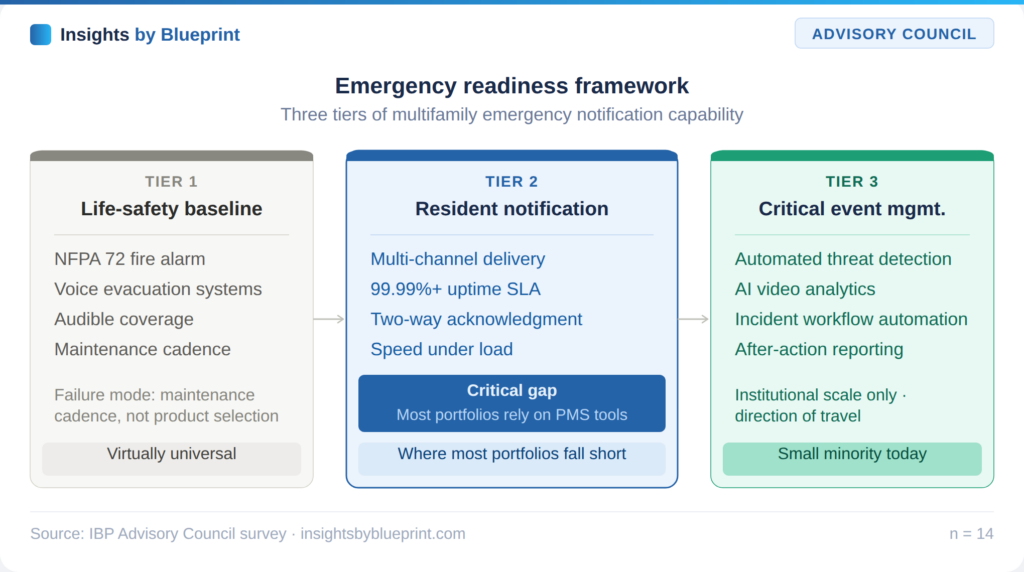
Advisory Council conversations surface a consistent misunderstanding in how multifamily operators assess their emergency notification posture. The typical response — “we send alerts through the portal” — conflates three different levels of capability. The framework below maps those levels explicitly, distinguishing between the regulated baseline, the notification gap, and the full critical event management capability that larger portfolios are beginning to require.
Tier 1: Life-Safety Baseline. In-building fire alarm and voice evacuation systems governed by NFPA 72 represent the non-negotiable compliance floor. Virtually all stabilized multifamily assets meet this threshold. The failure mode at this tier is not product selection but maintenance cadence, such as alarm systems installed but not tested, audible coverage that degrades as building use changes, and documentation gaps that create compliance exposure.
Tier 2: Resident Notification Capability. The ability to reach residents across multiple channels with sufficient speed and reliability constitutes the critical gap for most multifamily portfolios. Dedicated mass notification platforms are designed for this: multi-channel, simultaneous delivery; guaranteed uptime SLAs of 99.99 percent or higher; and two-way acknowledgment that tells operators who has received and confirmed an alert. Advisory Council conversations indicate that few portfolios have deployed a dedicated mass-notification platform at the property level. The majority rely on PMS communication tools that do not meet the requirements for emergency delivery.
Tier 3: Integrated Critical Event Management. Full-cycle capability involves automated threat detection triggered by weather feeds, access control events, or AI video analytics; simultaneous multi-channel alert delivery; real-time response tracking; incident workflow automation across response teams; and structured after-action reporting. This is the domain of enterprise platforms like Everbridge, whose High Velocity CEM platform expanded its collaboration with Johnson Controls in September 2025 to offer managed CEM services combining Everbridge’s AI-driven platform with Johnson Controls’ global security operations expertise. Tier 3 is relevant for large portfolios with centralized operations teams and mature technology governance. It represents a small minority of the current multifamily operator landscape but is the direction toward which institutional-scale portfolios are moving.
The mass notification vendor landscape
The mass notification vendor landscape spans three categories for multifamily operators: dedicated enterprise platforms designed for workforce notification, access control, and smart building platforms with alert capabilities, and PMS resident communication modules that are not purpose-built for emergency delivery. Each category has a different cost structure, integration model, and fit profile.
Everbridge’s High Velocity CEM platform is the dominant enterprise option, offering SMS, voice, email, desktop, app, and Teams/Slack delivery with a strong fit for centralized operations teams. AlertMedia occupies the Tier 2–3 range with a comparably broad channel set — including SMS, voice, email, app push, desktop alerts, WhatsApp, and Teams/Slack — and a stronger fit for distributed-workforce notification across multiple locations. OnSolve/Crisis24 competes in the same tier with an emphasis on risk intelligence, but operators evaluating the platform should weigh the November 2025 ransomware attack that permanently destroyed the legacy CodeRED environment, forced a full platform migration, and exposed subscriber contact data, including passwords stored in plaintext. Omnilert sits in the Tier 2–3 range with a campus- and multi-site focus, adding AI gun detection and PA integration, making it relevant for larger multifamily properties with on-site security infrastructure.
At Tier 2, Regroup offers a straightforward, cost-effective platform suited for portfolios that want a single tool for both routine and emergency communications, without the governance complexity of an enterprise CEM suite. Its strongest market identity is education and campus safety, but it serves a range of mid-market organizations. InformaCast by Singlewire is best suited to properties where overhead paging, IP speakers, and on-premises audio infrastructure already exist on-site. Healthcare, education, and manufacturing are its core markets, but it is also relevant to large multifamily campuses with legacy audio systems.
The access control layer occupies different positions depending on the platform depth. ButterflyMX and Brivo have an advantage that purpose-built mass notification platforms lack: existing adoption of resident and staff apps. Because residents and staff already use these apps for daily building access, that installed base represents a potential notification channel. But operators should note that neither ButterflyMX nor Brivo currently documents operator-initiated mass notification to residents as a core feature. Their push notifications are tied to access events, not emergency broadcasts.
Coram is a different category: its platform combines access control with a full emergency management system, including mass notifications, lockdowns, AI-powered threat detection, and 911 integration, positioning it closer to Tier 2–3 than the other two. Across all three, the underlying point holds: access control platforms represent underutilized infrastructure in most portfolios, but the gap in notification capabilities between them is significant, and operators should confirm channel functionality before treating any of them as an emergency broadcast layer.
At the bottom of the notification stack, Yardi, RealPage, and Entrata resident communication modules fall below a dedicated Tier 2 capability. They can send emails, SMS, and in some cases, voice calls through the portal, but are not engineered for emergency delivery. None document uptime SLAs, guaranteed delivery, or two-way acknowledgment. They also carry two compounding contact data problems that purpose-built platforms are designed to work around. Residents who never opted in to SMS cannot be reached by text, and those who have opted in may have provided contact information that most portfolios cannot verify as current.
Implementing true emergency alert readiness
The following steps represent a sequenced approach to moving from PMS broadcast capability toward genuine emergency readiness. The sequence is deliberate. Each step creates the foundation required for the next. Operators who attempt to skip the governance and data steps in favor of platform procurement typically find that the platform underperforms not because of product limitations but because the preconditions for effective deployment were never established.
1. Conduct a readiness audit across the portfolio. Map each asset against the three-tier framework. Identify which properties have only Tier 1 capability (in-building life safety only), which have functional Tier 2 tools (including the PMS tools currently in use), and which — if any — have Tier 3 integration. This audit should include an honest assessment of delivery reliability. A PMS email blast is not equivalent to a multi-channel emergency notification, and counting it as Tier 2 overstates readiness. The audit output should include a heat map of exposure by property, risk-stratified against FEMA’s National Risk Index for each asset location.
2. Establish contact data governance as a prerequisite. Before evaluating notification platforms, audit the quality of resident contact data in the PMS. Define minimum standards for required fields (primary mobile number, email, language preference), opt-in status, and update cadence. Assign operational ownership of data quality — which team is responsible for updating records, on what trigger, and with what verification. A platform deployed on top of a degraded contact database will underperform. The governance structure should be in place before the platform RFP is issued.
3. Define alert authority by property type and time-of-day scenario. Determine, for each property type and staffing model in the portfolio, who has the authority to trigger a notification, via which channel, and the escalation path if the primary responder is unavailable after hours. Document this in a formal emergency communications policy that is specific enough to be actionable under stress, not a high-level principles document that requires interpretation during an incident. The policy should explicitly address centralized vs. distributed decision rights.
4. Evaluate platforms against operational context, not feature lists. The platform appropriate for a 150-unit garden-style community with no overnight on-site staff is different from the platform appropriate for a 1,200-unit urban high-rise with 24/7 concierge. Match the tier requirement to the property profile before entering vendor evaluation. For most mid-market portfolios, the right starting point is a Tier 2 platform with two-way acknowledgment, multi-channel delivery, and a demonstrated uptime record. Tier 3 capability should be scoped for the centralized operations layer, not prematurely deployed at the property level. Require SOC 2 Type II documentation, uptime SLA specifics, and vendor incident response history from every finalist.
5. Integrate notification testing into the standard safety drill calendar. Emergency notification systems deliver value only if operators can use them under stress without consulting documentation. Build quarterly notification tests — not just fire alarm pulls — into the standard safety program. Each test should include a live deployment of the platform across at least one full channel set, channel-level delivery rate measurement, and response acknowledgment tracking. After-action review should be documented and used to update contact data, refine templates, and identify training gaps. Testing cadence is an operational metric, not a compliance formality.
Closing the gap before it matters most
The Advisory Council survey data point to a consistent pattern: multifamily portfolios have built mass-notification broadcast capabilities without building true emergency readiness. The channels exist, but the integration, governance, and ownership structures that make those channels reliable under stress largely do not. That gap is a prioritization problem, and one that tends to remain invisible until it isn’t.
The three-tier framework introduced in this report provides a basis for assessing where each property actually sits, rather than where operators assume it sits. Portfolios that close the Tier 1-to-Tier 2 gap now will be better positioned as climate exposure expands and resident expectations for real-time communication in high-stakes emergencies continue to rise. The cost of building that capability before an event is a fraction of the operational, reputational, and legal costs of discovering its absence during one.
– Nick Pipitone