

For most of the past decade, battery storage sat on the multifamily balance sheet as a sustainability add-on. That calculus is changing, and not because operators have suddenly discovered a new appetite for climate mitigation. Four separate and largely unrelated forces, including grid capacity scarcity and the sheer size of demand charges on the utility bill, are converging on the same conclusion at the same time.
Utilities facing surging demand from data centers and industrial users are rationing scarce interconnection capacity, leaving fully entitled multifamily projects waiting years for permanent service. States that pioneered generous net metering have gutted it, turning existing rooftop solar arrays into stranded assets unless paired with storage. Demand charges, often 30 to 70 percent of a property’s electric bill, remain among the largest controllable expense line items that most operators have never seriously underwritten. A growing list of jurisdictions is writing resilience requirements into building codes and, increasingly, into commercial lease negotiations.
Taken together, these trends mean the question facing operators is no longer whether battery storage belongs in the portfolio, but which properties can capture its value and under what ownership structure.
This report addresses those problems by laying out three distinct value layers that operators routinely collapse into a single investment decision when, in practice, they are three separate ones with different underwriting logic, physical requirements, and capital structures. It then walks through where battery investments most often go wrong. It closes with a sequential, portfolio-level playbook designed to screen, site, and structure a battery strategy before committing a single dollar of hardware capital.
The energy squeeze hitting multifamily operators
Four separate forces are turning battery storage and on-site generation from a sustainability line item into a core multifamily operating decision, including power grid capacity issues, demand charge management, a policy shift on solar power, and a regulatory environment that is increasingly treating resilience as a requirement.
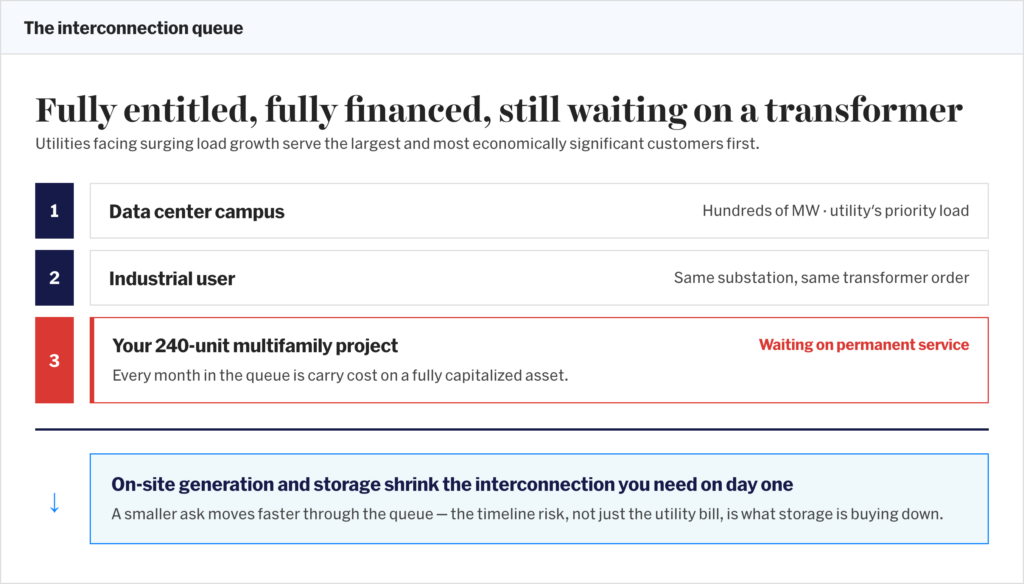
Grid capacity has become a scarce and contested resource. Multifamily developers are increasingly competing for the same substations, transformers, and interconnection slots as data center campuses and industrial users. High-voltage transformer backlogs now run years for new orders, and utilities facing surging load growth are prioritizing the largest and most economically significant customers first. For a multifamily developer, this can mean a project that is otherwise fully entitled and financed sitting idle while it waits for permanent utility service. That’s a timeline risk that on-site generation and storage can directly mitigate by reducing the load a new interconnection needs to serve on day one.
Net metering reform has eliminated the free storage that solar once relied on for new installations. Under the original net energy metering framework in states like California, utilities effectively banked excess daytime solar production at near-retail value for owners to draw down at night. This made a standalone solar array pencil out without a battery attached. In April 2023, California replaced that framework with NEM 3.0 (formally the Net Billing Tariff), which cut export compensation by roughly 75 percent for any system interconnected after that date, from retail-rate crediting to a lower “avoided cost” rate. Systems installed before the cutoff remain grandfathered on the old terms for up to 20 years, so the change affects new solar decisions going forward rather than the NOI of solar arrays already in place. For multifamily owners installing solar today, the practical effect is the same. Either use the power in real time or sell it back at a steep discount and buy it back at full price later. Battery storage has become the mechanism that preserves the NOI case for new solar investment, rather than an optional add-on.
Demand charges represent a large and controllable share of the utility bill. Utilities levy demand charges based on a property’s peak draw during a billing period rather than total consumption. Across commercial and industrial customers generally — a category multifamily properties on demand-metered tariffs fall into — demand charges can account for 30% to 70% of the total bill, according to research from NREL and the Clean Energy Group. Multifamily load profiles, with concentrated evening cooking, cooling, and increasingly EV charging peaks, are well suited to the kind of short-duration peak shaving that a properly sized battery can deliver.
Battery costs have fallen sharply while grid-interactive program revenue has scaled. According to BloombergNEF’s 2025 Lithium-Ion Battery Price Survey, average lithium-ion battery pack prices fell to $108 per kWh in 2025, with stationary storage packs specifically falling to $70/kWh. Utilities in constrained markets have built out virtual power plant and demand response programs specifically to recruit distributed load flexibility instead of building new peaker plants. Multifamily properties enrolled in a program like Con Edison’s GridRewards in New York can earn cash back for reducing consumption during peak events. Logical Buildings, which operates the program, reports that average participants earn around $100 a year, roughly a month’s electricity bill, with some large buildings earning considerably more in aggregate. They often do so with smart meters and thermostats already in place and little additional capital required.
Regulatory and resident pressure are converging on the same requirement. More than 50 U.S. jurisdictions now require energy benchmarking for commercial and multifamily buildings. A growing subset has gone further, enacting true building performance standards with binding reduction targets and financial penalties, including New York City’s Local Law 97, which fines buildings exceeding their carbon caps $268 per metric ton of CO2 equivalent. Separately, commercial tenants in mixed-use and adjacent office properties are increasingly naming battery backup as a lease negotiation point, driven by concerns about grid reliability during extreme weather. Some jurisdictions — so far concentrated mainly around data centers — are tightening or proposing restrictions on fossil fuel backup generators, which is pushing battery storage further into consideration as an on-site resilience option in those markets.
Pick your battery thesis
Operators evaluating battery storage or on-site generation are typically evaluating three distinct value layers that require different underwriting and physical siting, and in some cases different ownership structures. Advisory Council conversations consistently surface confusion where operators default to treating storage as one investment decision when it is more accurately three separate ones that happen to use similar hardware.
Defensive value: resilience and code compliance. This layer covers emergency backup power for life-safety systems, elevators, and increasingly a dedicated resilience space for residents during outages. Building codes in many jurisdictions already require backup power for multifamily buildings above a certain height, historically satisfied with diesel generators. The Kenzi, a 50-unit Passive House affordable project in Boston developed by Preservation of Affordable Housing, demonstrates how this requirement can be met with a battery system instead. The project secured a $250,000 grant from the Massachusetts Clean Energy Center that supported a 440 kWh battery paired with a 65 kW rooftop solar array. Under an agreement with the Boston Fire Department, roughly 16 percent of battery capacity is permanently reserved for backup power. This combines the code-required minimum for life-safety loads with an additional reserve POAH voluntarily built in to power a resident resilience center offering phone charging, HVAC, and medication refrigeration during outages. The defensive layer generates no direct revenue. But it removes a compliance and site-selection risk that is becoming more consequential as jurisdictions move toward all-electric mandates and as commercial and life sciences tenants in mixed-use product treat battery backup as a leasing prerequisite rather than a differentiator.
Economic value: demand charge reduction and arbitrage. This layer is most directly tied to controllable operating expense. A battery sized to a property’s peak demand profile discharges during the hours that drive the demand charge. When paired with solar, the battery stores midday production for evening self-consumption rather than exporting it at NEM 3.0’s reduced rate. Properties enrolled in utility demand response or virtual power plant programs add a further revenue stream on top of the savings, generally requiring little additional capital investment where smart meters are already installed. This layer is where the underwriting case is strongest and most quantifiable. It is also the layer most operators should model first when evaluating a new site.
Infrastructure monetization: hosting third-party generation and storage. A distinct model has emerged in which a developer installs, owns, and operates a battery system on underutilized property under a long-term lease with fixed payments to the property owner and no capital outlay or operating risk on the owner’s side. A 4.29 MW / 8.58 MWh Tesla Megapack project developed by Catalyze in the Bronx illustrates the model at scale in a dense, highly regulated market. It’s a distinct installation from NineDot Energy’s earlier, smaller Bronx Megapack project (3.08 MW / 12.32 MWh), which is more widely cited as the first Tesla Megapack installation in New York City. This layer applies most cleanly to properties with excess land rather than to the buildings themselves. The model converts an otherwise unproductive site feature into a passive, long-duration revenue stream. However, it depends on proximity to suitable grid infrastructure and a developer willing to underwrite the specific site.
Where battery investments go wrong
The three value layers outlined above describe the opportunity in the abstract. But four practical complications determine whether a given property can actually capture it, including physical siting limits, permitting timelines, ownership structure, and gaps in how the industry underwrites these assets today. Each of these has tripped up otherwise well-planned energy storage investments in Advisory Council conversations, and each deserves its own scrutiny before capital moves.
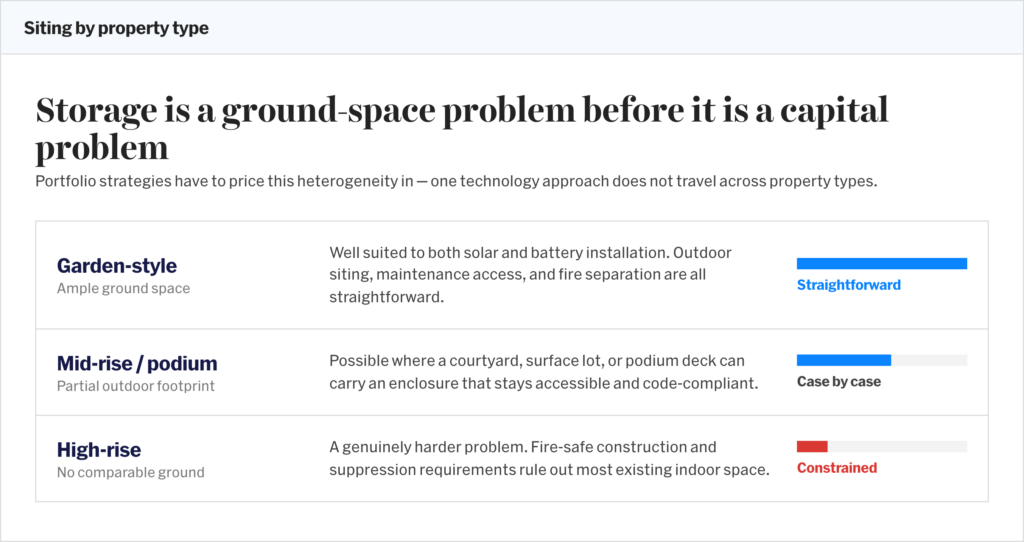
Physical siting constrains which properties can participate at all. Garden-style properties with ample ground space are well suited to solar and battery installation. Taller buildings without comparable outdoor footprint face a genuinely harder problem, since large battery systems must be housed outdoors, remain accessible for maintenance, and meet fire-safe construction and suppression requirements that rule out most existing indoor space. Portfolio-wide storage strategies need to account for this heterogeneity explicitly rather than assuming a single technology approach applies uniformly across property types.
Permitting and fire authority approval can take the better part of a year. The Kenzi’s design team spent nine months working with Boston’s Inspectional Services Division and Fire Department to secure approval for a battery system in place of a diesel generator. The process required a building management system linking the fire alarm to the battery, a documented emergency operations plan, clear shutoff signage, and a specialized sprinkler system. Operators pursuing this path on new development should build the permitting timeline into the schedule from the earliest design stages rather than treating it as a late-stage engineering detail.
Ownership structure determines capital exposure and who captures the upside. Operators can own the system outright, finance it through a solar or storage developer under a long-term power purchase or lease arrangement with no upfront capital, or host third-party infrastructure entirely passively in exchange for fixed rent. Each structure trades capital exposure against upside capture. The right choice depends on the operator’s cost of capital, appetite for a new operating line item, and whether the property in question has land to host rather than rooftop or garage space to retrofit.
Underwriting and valuation practices have not caught up to the technology. Solar and storage systems require little routine maintenance once installed. This has produced a recurring problem in acquisitions where site staff and even brokers assume a quiet, well-functioning system is broken. They may also understate an array’s output because the underwriting team lacks familiarity with how the asset performs. Advisory Council discussions have flagged specific instances where a broker’s inaccurate output estimate on a solar array translated into an underwriting error exceeding $500,000. This underscores the need to technically verify existing energy assets during diligence rather than relying on seller-provided figures.
Screen first, site second, structure third
The following playbook lays out a disciplined, sequential approach to evaluating battery storage across a multifamily portfolio. It starts with hard financial screening on demand charges, then layering in physical eligibility, ownership structure, and capital appetite before any hardware decision is made. It’s designed to help operators avoid both under- and over-investing in storage by matching the right ownership and deployment model to each asset’s specific financial, physical, and structural profile.
Audit demand charge exposure across the portfolio before evaluating any hardware. Pull twelve months of utility tariff data by property and calculate the demand charge as a share of total electric spend. Properties where demand charges exceed 40% to 50% of the bill are the strongest early candidates for a battery investment, independent of any solar consideration.
Segment properties by physical eligibility before building a portfolio-wide plan. Evaluate garden-style and low-rise assets with ground-level parking or landscaped areas for on-site storage and potential land-lease monetization. Evaluate high-rise assets without a comparable footprint primarily for smaller-format or distributed battery solutions designed for constrained sites, or exclude them from storage plans in favor of demand-side management alone.
Match ownership structure to capital appetite and asset hold period. Properties held long-term with available capital are better candidates for direct ownership, which captures the full economic and defensive value layers. Properties with a shorter hold period or capital constraints are better suited to a developer-financed lease structure or, where land is the primary asset, a passive infrastructure host arrangement.
Build permitting and fire authority engagement into any new development pursuing all-electric backup power. Where local code allows battery backup in place of a fossil fuel generator, initiate discussions with the local fire authority and code officials during design rather than construction.
Verify existing energy assets during acquisition diligence rather than relying on seller disclosures. Any property with an existing solar or storage installation should receive an independent technical assessment of actual output and system health as part of underwriting. This is due to the documented risk of both broker misstatement and site-level misunderstanding of asset performance.
Screening now beats scrambling later
For many multifamily operators, battery storage has moved from a marketing amenity to an underwriting variable. The properties with the clearest case aren’t necessarily the newest or the most sustainability-branded. They’re the ones with high demand charges, available ground space, and an ownership horizon long enough to capture the full value stack. Getting there requires the same discipline as any other capital decision. Audit the data before pricing the hardware, match the ownership structure to the hold period, and verify rather than assume when a system is already in place.
Operators who build this screening into standard acquisition and asset management workflows now will be positioned to capture value that the market is still pricing inconsistently. Those who wait for the technology or the incentives to simplify will find that the properties best suited to capture it have already been identified by someone else.
– Nick Pipitone