

Property tax is one of the largest controllable line items in a multifamily operating budget but one of the least systematically managed. Most owners have outsourced the appeal itself to a consultant, paid on contingency, and treated the relationship as settled. But outsourcing the work is not the same as having visibility into it. A survey of the Insights by Blueprint Advisory Council survey data suggests that gap is wider than most operators assume.
The numbers tell a consistent story. Ninety-two percent of respondents rely on some form of outside consultant, and not a single one reported using a dedicated proptech platform to manage appeals or track assessments in-house. Fewer than a third have automated assessment tracking, deadline alerts, or savings forecasting in place, and only 23% have a portfolio-level dashboard. Asked what stands between them and maximizing savings, operators pointed to the obvious fragmentation: inconsistent processes across markets and no consistent view of what’s happening jurisdiction by jurisdiction.
With appeal authority scattered across more than 14,000 assessing jurisdictions nationally, each with its own forms, deadlines, and evidentiary standards, no single consultant relationship or spreadsheet was ever going to hold the full picture. This report breaks down what the survey data reveals about how operators currently source, structure, and technologize their tax appeal process. It also maps the vendor landscape reshaping who builds for whom, and lays out a five-step path for operators to build the visibility and prediction layers that their current sourcing model, on its own, was never designed to provide.
Consultants in, technology out
Advisory Council survey data on property tax appeal management reveals an industry still operating well below the maturity level its consultant relationships would suggest. Fifty-four percent of respondents rely on a third-party tax consultant or firm, another 38% use a mix of in-house and outsourced management, and only 8% run appeals entirely in-house. Compensation for those outside relationships skews decisively toward contingency arrangements. Sixty-two percent of respondents structure third-party engagements on a contingency or percentage-of-savings basis and another 23% use a hybrid fee structure. This concentration matters because it shapes what consultants are incentivized to build. A contingency fee rewards winning the individual appeal, not building the reporting infrastructure an owner would need to see across a multi-market portfolio.
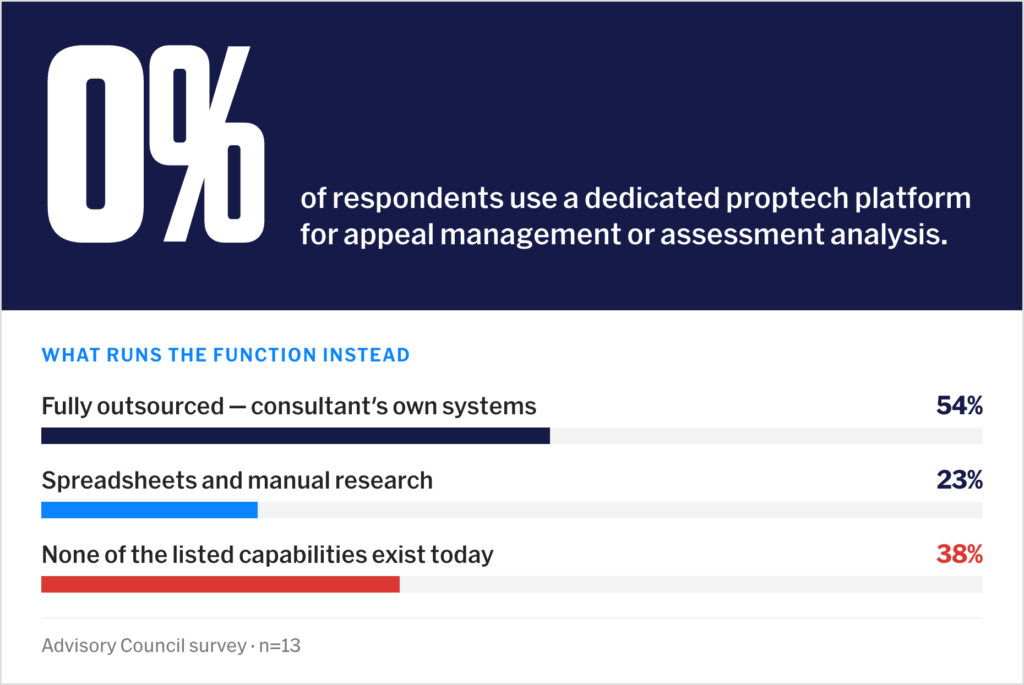
That incentive gap shows up directly in the technology data. Not a single respondent reported using a dedicated proptech platform for appeal management or assessment analysis. Instead, 54% said the function is fully outsourced to a consultant who handles technology on their own systems, and 23% rely primarily on spreadsheets and manual research. Among the specific capabilities respondents’ current processes include, none cleared a third of the sample: automated assessment tracking (31%), appeal deadline tracking and alerts (31%), and ROI or savings forecasting before filing (31%) were the most commonly cited. Portfolio-level dashboarding sat at just 23% and document or evidence generation for appeals at 15%. Thirty-eight percent of respondents reported that none of the listed capabilities existed in their current process.
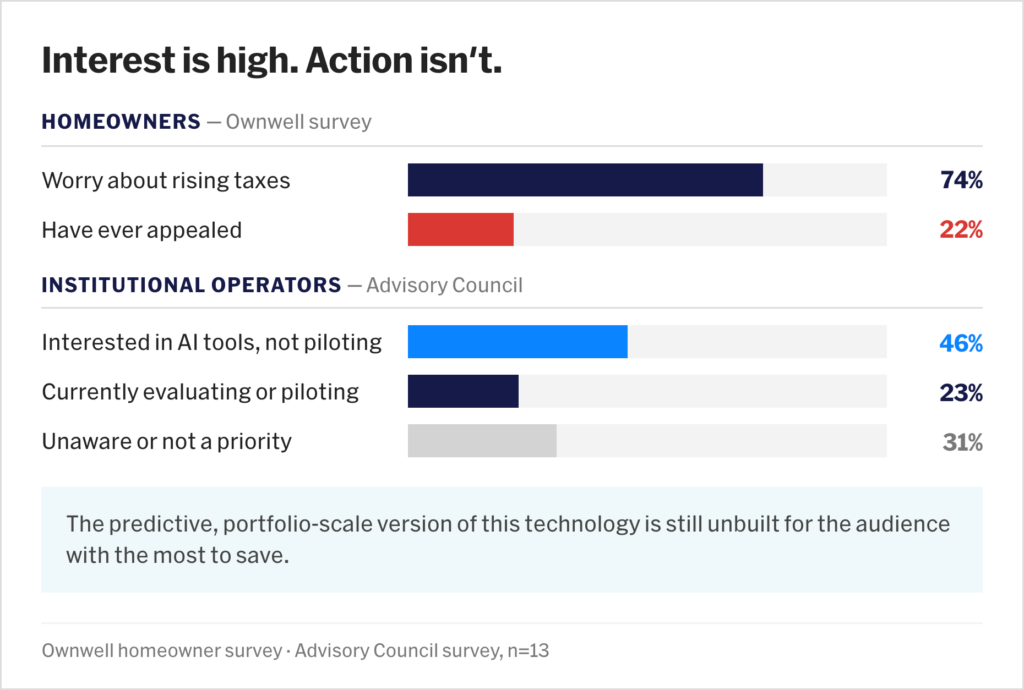
Asked to name the single biggest barrier to maximizing tax appeal savings across the portfolio, respondents pointed overwhelmingly to structural fragmentation rather than cost or staffing. Forty-six percent cited inconsistent processes across markets or regions as the top obstacle, ahead of lack of visibility into assessment changes across jurisdictions (23%). That was well ahead of insufficient staff or time (15%), difficulty proving comparable value (15%), and the cost of third-party consultants itself (15%). One respondent operating across 13 markets with roughly six different local firms described the reality behind that fragmentation directly, noting that the sourcing approach varies by jurisdiction rather than following a single portfolio-wide model. On the emerging technology side, adoption remains early. Twenty-three percent of respondents are currently evaluating or piloting AI-driven tools for assessment prediction or appeal automation, while 46% are not doing so yet but expressed interest. The remaining 31% are either unaware of such tools or do not see them as a priority.
3 trends reshaping the vendor landscape
Three simultaneous forces are reshaping the property tax appeal vendor landscape: consolidation among the national consultants operators already hire, a new layer of appeal-management software built for those same consultants rather than owners, and a wave of AI-native entrants targeting individual homeowners before institutional portfolios. Each trend points to the same conclusion. The technology is advancing quickly, but almost none of it has been built with the multifamily operator as the direct buyer.
Consolidation at the top. Ryan LLC has spent the past several years rolling up the property tax consulting and software space. Ryan acquired Paradigm DKD Group, one of the largest independent property tax firms in the country, in 2022. That followed earlier acquisitions of Marvin F. Poer and Company, the second-largest property tax consulting firm in the United States, and Greystone Property Tax Advisors. In a $700 million CAD deal that closed in January 2025, Ryan then acquired Altus Group’s entire global property tax business, bringing Altus’s itamlink property tax management software into Ryan’s broader tax.com software suite and adding a UK presence alongside deeper Canada and U.S. reach. Roughly 1,000 Altus employees joined Ryan as part of the transaction. The net effect is that Ryan is now the dominant full-stack player, combining services and software for large multifamily owners who outsource appeals to a national consultant.
A challenger layer that sells to the consultants, not the owners. A newer crop of purpose-built appeal-management platforms is trying to unseat the spreadsheet-and-consultant default. CSC AppealTrack, built by a 125-year-old, 8,000-employee company, helps firms assess appeal strength, prepare and track appeals, and centralize documents, deadlines, and invoicing across more than 700 clients. Tax Appeal Plus, launched in late 2025 by Erik Wind, targets high-volume property tax professionals managing hundreds to thousands of appeals a year. AppealPal, in the market since 2015, stores case details and syncs jurisdiction-specific workflows and deadlines across all 50 states. Nearly all of these tools are sold to the tax firms that operators already outsource to, not to the multifamily owner directly. This helps explain why zero percent of respondents in our Advisory Council survey reported using a dedicated proptech platform in-house. The software exists, but it lives on the vendor side of the outsourcing relationship, invisible to the operator paying the bill.
AI is arriving through the consumer edge first. A separate wave of AI-forward entrants is going after property owners directly rather than consultants. Ownwell raised $50 million in Series B financing to expand its AI-powered property tax appeal services and now operates in Texas, Illinois, Florida, Georgia, California, Washington, and New York on a contingency basis. Ownwell charges no upfront fee and instead takes a share of realized savings. Ownwell cites its own survey data finding that 74% of homeowners worry about rising property taxes, yet only 22% have ever appealed. It’s an awareness-action gap that echoes almost exactly what Blueprint’s own data found on the institutional side: 46% of Advisory Council members say they are interested in AI tools for tax appeals but are not yet piloting anything, and another 23% are not even aware of what exists in the category. Most of these AI-native entrants, including tools like Smart Appeal AI, are built and priced around individual homeowners and small landlords rather than institutional multifamily portfolios. That leaves the predictive, portfolio-scale version of this technology largely unbuilt for the audience that stands to save the most.
The property tax maturity curve
Blueprint’s survey findings and the current vendor landscape condense into three layers of property tax technology maturity: sourcing, visibility, and prediction. The sourcing decision (outsourced, hybrid, or in-house) is the one most portfolios have already made and revisit infrequently. The visibility and prediction layers, by contrast, are largely independent of that sourcing decision and hold most of the unrealized opportunity in the survey data.
Layer 1: The sourcing layer. This is the question of who manages the appeal itself. Advisory Council survey respondents split between third-party consultants (54%), a hybrid model combining internal oversight with outsourced execution (38%), and a fully in-house tax team (8%). Relationship structures skew heavily toward contingency, with 62% of respondents compensating third parties on a contingency or percentage-of-savings basis and another 23% using a hybrid fee structure. This layer determines who does the work of filing and arguing the appeal, but it says nothing about whether the operator itself retains visibility into the process.
Layer 2: The visibility layer. Regardless of the sourcing model, portfolios need an owned view of assessment history, appeal status, and deadlines across every jurisdiction in the portfolio. That exists independent of whichever consultant currently holds the relationship. This layer shows the widest gap in the Advisory Council survey data. Only 31% of respondents report automated assessment tracking, only 31% report deadline tracking or alerts, and only 23% report a portfolio-level dashboard. The underlying problem is significant. The U.S. property tax system is radically fragmented. Assessment and appeals authority typically sits at the county or township level rather than the state, meaning there are thousands of separate assessing jurisdictions across the country, commonly estimated at somewhere north of 14,000. Each sets its own appeal forms, evidence requirements, and filing deadlines. New York State alone has more than 1,100 independent assessing units, and most states have their own distinct rules on top of that. The result is a patchwork of filing rules and deadlines that no single database tracks nationally. Without a visibility layer above any single consultant relationship, a multi-state multifamily portfolio has no way to answer a simple question such as how many properties are currently under appeal and what each one is worth, without calling around.
Layer 3: The prediction layer. The most advanced tier uses AI to flag over-assessment risk before a notice arrives, rather than reacting afterward. A structured version of this process typically follows five steps: scanning the portfolio to calculate the ratio of assessed value to market value and rank properties by dollar-savings potential; building comparable evidence using sales, income, and cost approaches, with the income approach, generally the most defensible method for income-producing multifamily assets; generating formal appeal documentation and evidence packages; preparing counterarguments and settlement-range modeling ahead of the hearing; and tracking outcomes to build an institutional record of what evidence and arguments succeed in each jurisdiction over time. Only 31% of survey respondents currently do any form of ROI or savings forecasting before filing. Only 23% are actively evaluating or piloting AI tools for this purpose, which leaves most of the industry well behind where the technology already stands.
5 Steps to Portfolio-Level Control
None of this requires waiting for the vendor market to catch up. Operators can close most of the visibility and integration gaps within their existing sourcing model, starting with how they audit, structure, and pilot around the relationships they already have.
Audit the sourcing model against the barrier data, not against cost alone. Most operators evaluate their consultant relationship on appeal win rate and fee structure. A more useful audit asks whether the relationship contributes to. Or it masks the barrier of inconsistent processes across markets by mapping which jurisdictions in the portfolio have documented processes, tracked deadlines, and accessible historical data, and which are effectively black boxes managed entirely by the outside firm.
Build an owner-side visibility layer independent of the consultant relationship. Even when appeals stay fully outsourced, the portfolio should maintain its own record of assessment history, filing status, and deadlines for every parcel, rather than relying on the consultant’s system as the single source of truth. This can start as a simple, centrally maintained portfolio dashboard and does not require replacing the sourcing model to deliver value.
Treat the accounting hand-off as a deliverable, not an afterthought. Because the integration gap between appeal tools and the general ledger is where the most value leaks, any new process or vendor evaluation should explicitly require that appeal outcomes and projected savings flow into the accounting system on a defined cadence, rather than being reconciled manually at year-end.
Pilot AI-driven evidence compilation before AI-driven filing. The lowest-risk entry point for AI is the comparable-analysis and documentation stage. This is where models can compile sales comparables, calculate income-approach valuations from existing operating statements, and draft appeal narratives for human review, rather than the filing or hearing stage. Piloting this on properties with the largest dollar-value savings potential — not the largest percentage over-assessment — concentrates returns from a small initial effort.
Renegotiate contingency structures around portfolio-level deliverables. Consultant agreements can be restructured to require dashboard access, standardized deadline reporting, and documented evidence packages as part of the engagement, rather than compensating purely on appeal outcome. This directly addresses the incentive misalignment identified above without requiring a change in who performs the appeal work itself.
The next move isn’t a new vendor
None of the three layers in this report requires an operator to abandon the sourcing model they already have. The consultant relationship, the contingency fee, the local expertise built up over years in a given jurisdiction — all of that can stay in place. The survey data makes clear that sourcing was never the layer generating the blind spot. The gap sits above it, in the visibility and prediction work that no contingency-paid consultant is incentivized to build and that almost no vendor in the current landscape is selling directly to the owner. Closing it means building an owned record of the portfolio’s assessment and appeal history, independent of whichever firm currently holds the relationship in any given market.
The operators who move first on this won’t be the ones who find a better consultant or negotiate a lower contingency rate. They’ll be the ones who stop treating visibility and prediction as the consultant’s problem to solve. As Ryan LLC and the software layer beneath it continue consolidating around the vendor side of the relationship, and as AI-native tools keep building for individual homeowners rather than institutional portfolios, the operators who build their own dashboard, their own accounting hand-off, and their own pilot of AI-assisted evidence compilation will be the ones capturing savings the rest of the industry is still calling around to find.
– Nick Pipitone