

Rent growth has flattened across most primary and secondary multifamily markets in 2026, and concessions have crept back into leasing activity in several metros where operators had gone years without offering them. At the same time, operating expenses have remained structurally elevated. Insurance premiums in coastal and disaster-prone markets are still running 20–50% above pre-2021 levels even as the sharpest year-over-year spikes have cooled since their 2023 peak. The gap between top-line revenue and bottom-line NOI has widened, and portfolio-level teams have responded by treating ancillary income as a primary operating lever rather than a secondary budgeting line.
Resident Benefits Packages (RBPs) have become the most organized vehicle for capturing that ancillary revenue. What began as a scattered set of opt-in add-ons has consolidated into a single monthly line item bundled into the lease, typically running $20 to $150 per unit depending on market and service mix. Industry benchmarking puts ancillary income at roughly 6–12% of gross potential income across well-run multifamily assets. Some operators report a wider spread between garden-style and urban high-rise properties depending on how much move-related and amenity revenue a portfolio captures. RBP contribution to NOI ranges from a few percentage points to upwards of 10%, depending on portfolio and execution.
The programs themselves are converging on a fairly standard service mix: credit and rent reporting, renters insurance or liability coverage, identity theft protection, air filter delivery, 24/7 maintenance coordination, and increasingly pest control and move-in concierge services. But the speed at which RBPs have become table stakes has outpaced the regulatory framework governing them. This year has produced the clearest signal: mandatory fee bundling is drawing sustained scrutiny from both federal regulators and municipal governments. This report examines the operational case for RBPs, the framework operators use to structure them defensibly, and the specific legal exposure that has emerged from recent enforcement actions and litigation.
Why RBPs are having a moment now
Resident Benefits Packages have quietly become one of multifamily’s most consequential operating tools, and one of its biggest legal liabilities. Here’s how RBPs moved from a differentiator to table stakes, why the same mechanics that make them profitable are now drawing regulators and plaintiffs’ attorneys, and what operators need to know before the enforcement wave catches up with their own leases.
The macro story is straightforward. Operators facing flat or declining asking rents cannot easily raise base rent to offset rising insurance, payroll, and utility costs. So ancillary income has become the mechanism for protecting NOI without moving the headline rent number that shows up in market comps and renewal notices. RBPs are attractive because they generate recurring, predictable revenue largely decoupled from market rent cycles.
Adoption has shifted from differentiator to baseline expectation. Large multifamily operators have run bundled fee programs for years. Greystar’s own mandatory charges for services like pest control, valet trash, and package concierge date back to at least 2019, according to the FTC complaint that produced its $24 million settlement. The model has also spread into the single-family rental space. Advisory Council conversations reflect a consistent theme. Operators that adopted RBPs early treated them as a competitive differentiator, but the current generation of adopters is implementing them defensively. That’s because competing properties in the same submarket already have one in place, and the absence of an RBP now reads as a gap in the service offering rather than a point of restraint.
Insurance-premium pressure is pulling renters insurance into the center of the RBP conversation. Because renters insurance or liability coverage is one of the highest-value components operators can bundle, it is among the most heavily marketed pieces of most RBPs, with vendors increasingly pitching it as a revenue line rather than a compliance requirement. It is also, per the litigation discussed below, the component generating the most legal exposure.
Junk fee scrutiny has moved from consumer advocacy rhetoric to active enforcement. The FTC’s junk fee rulemaking and a wave of state-level consumer protection activity have specifically targeted mandatory add-on fees in rental housing. RBPs sit inside that enforcement perimeter because they are, by design, mandatory, bundled, and disclosed after the advertised base rent rather than as part of it.
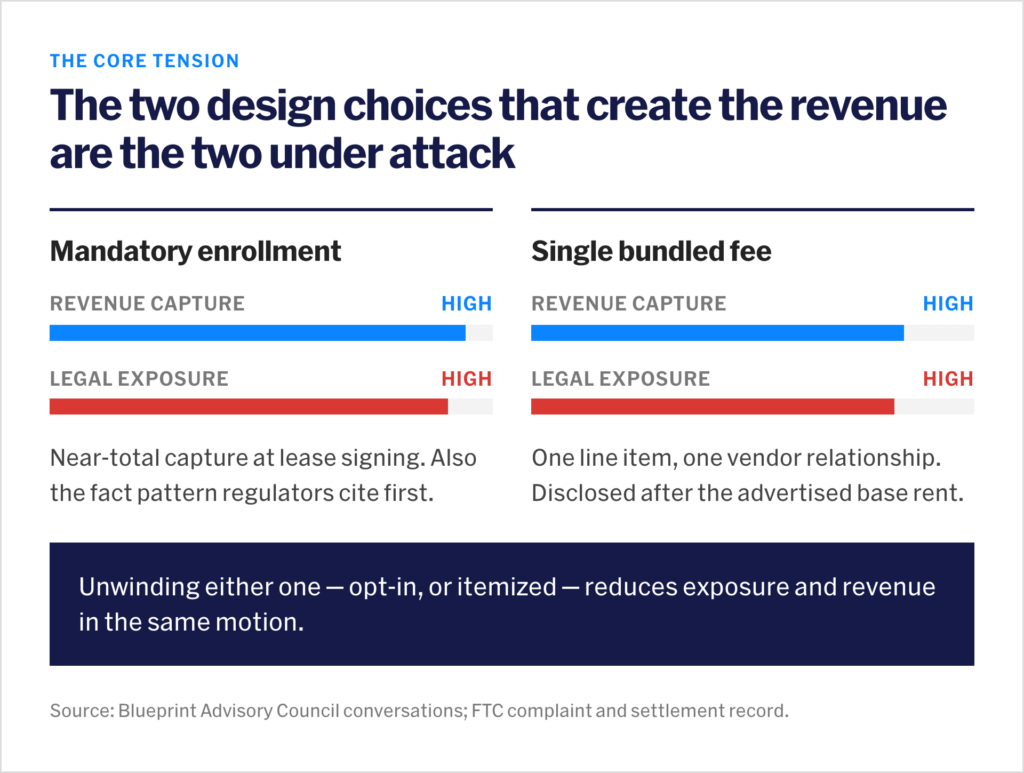
The core tension operators face is that the two things that make an RBP financially attractive — making it mandatory rather than opt-in, and bundling multiple services into one fee rather than itemizing them — are the same two things regulators and plaintiffs’ attorneys are targeting. Mandatory enrollment maximizes revenue capture because optional RBPs consistently underperform mandatory ones on adoption. One vendor operating an opt-in-only model reports an average enrollment rate of roughly 40%, well below the near-total resident base that mandatory enrollment at lease signing typically captures. Bundling maximizes perceived value and administrative simplicity by consolidating vendor relationships and billing into a single line item, rather than requiring residents to shop for and enroll in each service independently.
Stress-testing an RBP against enforcement standards
The framework that is emerging from recent enforcement activity is best understood as a three-part defensibility test, and operators structuring or auditing an existing RBP should evaluate the program against each part independently.
Test one: advertised-price integrity. The FTC’s January 2025 suit against Greystar in Colorado federal court, joined by the Colorado Attorney General, centered on allegations that the company advertised base rents while omitting mandatory fees from that advertised price. The complaint charged violations of the FTC Act, the Gramm-Leach-Bliley Act, and Colorado’s Consumer Protection Act. The operational lesson is that the RBP fee needs to appear in the total price shown to prospective residents at the point of marketing and application, not surfaced for the first time at lease signing. Portfolios still marketing net effective rent without the RBP fee folded into the headline number face the same exposure that drew federal action.
Test two: coverage-value alignment. A D.C. class action that was allowed to proceed this year involved a mandatory RBP that included bundled renters insurance. After a fire, tenants discovered the bundled policy covered their losses up to only $10,000 while covering the landlord and owner for substantially more. The court let a Consumer Protection Procedures Act claim move forward on that basis. This is the sharpest signal in the current landscape: bundling insurance into an RBP is not the legal problem. Marketing coverage without disclosing limits materially lower than what a resident might reasonably assume creates direct litigation exposure. Operators offering bundled renters insurance or liability coverage as an RBP component should treat coverage-limit disclosure as a compliance requirement, not a marketing afterthought.
Test three: service-to-fee proportionality. Journalistic investigations into mandatory RBPs, including reporting from Jacobin and The Lever, have focused specifically on cases where the fee charged bears little relationship to the actual cost or value of the underlying service. The recurring example cited across multiple sources is an air filter delivery service, which typically costs $9 or less per filter at retail, bundled into a package priced well beyond what that individual line item would justify. Vendor guidance in this space, including from Paylode, now explicitly frames this as the central risk. A package that overcharges relative to delivered value creates resident distrust that surfaces as complaints, negative reviews, and, as a program draws regulatory attention, increasingly as the evidentiary basis for consumer protection claims.
3 tensions without clean answers
Applying this framework in practice is complicated by factors that vary meaningfully across portfolios. Multifamily operators should treat the following as genuine tensions, not problems with clean resolutions.
Municipal regulation is fragmenting the compliance landscape. Seattle has passed one of the country’s most restrictive rental fee ordinances. It prohibits specific categories like administrative service charges, pet rent, and package fees while permitting a narrower, itemized list of fees under a transparency requirement taking effect in July 2027 that mandates upfront all-in pricing. Operators with multi-market portfolios are now managing RBP structures that may be fully compliant in one jurisdiction and prohibited or restructured in another, which argues for building fee-disclosure and itemization capability into property management systems now rather than retrofitting it market by market as ordinances pass.
Fully managed vendor programs shift but do not eliminate liability. Vendors offering fully managed RBPs that handle vendor coordination, billing, and service delivery reduce the operational burden on property management staff. But the marketing claims, disclosure practices, and coverage terms embedded in those vendor programs remain the operator’s legal exposure when a resident or regulator raises a complaint. Advisory Council operators evaluating vendor RBP programs should treat the vendor’s marketing and disclosure language, not just its service catalog, as a due diligence item during vendor selection.
Mandatory versus optional is not a purely legal decision. Vendor guidance and Advisory Council discussions consistently show optional RBPs underperform mandatory ones on adoption. As a result, they generate substantially less ancillary revenue, while mandatory enrollment draws the most regulatory attention. Operators do not have a clean choice between a compliant program and a revenue-generating one. Portfolios are resolving this tension by keeping RBPs mandatory while investing considerably more than in prior years in the disclosure, coverage transparency, and price-integrity practices described above.
5 steps toward a defensible RBP
Operators looking to align an existing RBP with the current enforcement environment, or to structure a new program defensibly from the outset, should take the following steps.
Audit total advertised price against total charged price. Pull marketing materials, listing syndication feeds, and application-stage pricing disclosures across the portfolio and confirm the RBP fee is included in every advertised price a prospective resident sees before applying, not introduced for the first time in the lease packet.
Obtain and review actual coverage terms for any bundled insurance component. Request the specific policy limits, exclusions, and beneficiary structure for any renters insurance or liability coverage bundled into the RBP. Compare resident-facing coverage limits against what a standalone renters insurance policy would typically provide at a comparable price point.
Cost out each RBP component against its market retail price. For services like air filter delivery, pest control, and identity protection, obtain the vendor’s per-unit cost and compare it against the portion of the RBP fee attributable to that service. Flag any component where the markup is difficult to justify against delivered value.
Map jurisdiction-specific fee regulations across the portfolio. Identify which markets have passed or are considering junk fee ordinances, transparency requirements, or all-in pricing mandates. Build a compliance timeline instead of waiting for each ordinance’s effective date and scrambling.
Formalize a disclosure and communication protocol at lease signing. Present the RBP as part of the total cost of occupancy during touring and application, not as a surprise addendum. Document that disclosure consistently across the resident file to establish a defensible compliance record.
Compliance is now the differentiator
Resident Benefits Packages have moved from a competitive amenity to a structural component of multifamily NOI, and that shift is not reversing. But the regulatory environment governing mandatory fee bundling has caught up to the ancillary revenue model faster than most operators anticipated. The operators best positioned going forward will treat price integrity, coverage transparency, and service-to-fee proportionality as compliance infrastructure, not marketing choices.
Portfolios that get this right will continue capturing the ancillary revenue RBPs were built to generate while insulating themselves from the enforcement actions and litigation now targeting the programs that overpromised, underdisclosed, or simply priced the bundle without a defensible relationship to the value residents actually receive.
– Nick Pipitone