


Commercial real estate is awash in data, but the industry has never been built for large, unified datasets or one-size-fits-all analytics. Assets are idiosyncratic, portfolios are fragmented, and tenants remain rightly sensitive about how their information is used. Despite these constraints, data has become one of the most powerful tools operators have to improve how buildings are run.
Across our interviews and an exclusive survey of the Insights by Blueprint Advisory Council, a clear pattern emerges: operators are turning data into an operational strength. They’re using it to reduce emergency repairs, prevent equipment failures, standardize procurement, optimize leasing and investment decisions, and deliver a more responsive, high-touch tenant experience.
This report examines how that shift is playing out in practice. We explore CRE’s structural data challenges, the shift from passively consuming insights to building internal tools, the growing role of benchmarking, and how AI is lowering the barrier to advanced analytics.
Most importantly, we show why the next decade will belong to operators who use data as the backbone of operational excellence, paired with human expertise that understands the nuances no tech system can capture.
The Limits of Data Monetization
Unlike industries where scale naturally produces large, unified data sets, such as e-commerce, digital advertising, and fintech, CRE is structurally incapable of generating the kind of aggregated, homogenous data that can be sold “as a product.”
Four structural realities make this challenging:
- No single operator has a meaningful market share
Even the largest owner-operator in U.S. multifamily, Greystar, controls roughly ~2% of the rental housing market. Most of its peers own far less. Because data sets rely on scale, a small sliver of the market cannot form the basis for pricing benchmarks, portfolio risk models, market intelligence products, or leasing optimization models.
2. Every asset is unique
CRE’s idiosyncrasy makes aggregation incredibly difficult.
Buildings differ radically by geography and submarket, year built, renovation cycles, floor plan mix, HVAC systems, amenities, maintenance history, utility structure, and tenant demographics. Because the assets themselves are inconsistent, the data they produce is structurally inconsistent.
3. Even internal definitions aren’t standardized
The industry doesn’t necessarily have foundational metrics. Jonas Bordo, the CEO of Dwellsy, said he used to work for a real estate operator that had 20 different definitions of return on investment inside the same company. Dwellsy is a rental-listing platform that aggregates homes and positions itself as a one-stop marketplace for renters.
Other inconsistencies include what counts as delinquency, when a lease “starts,” what constitutes a renewal, what qualifies as unit downtime, and how to categorize concessions. If you can’t standardize data within one organization, you definitely can’t standardize it across the market.
“The first and often hardest step for any organization that wants to actually use its data is standardizing, normalizing, and cleaning it,” says Bordo. “That work is labor-intensive and difficult. Doing it for your own data is already a significant effort, but it’s also highly valuable as long as you’re going to use it.”
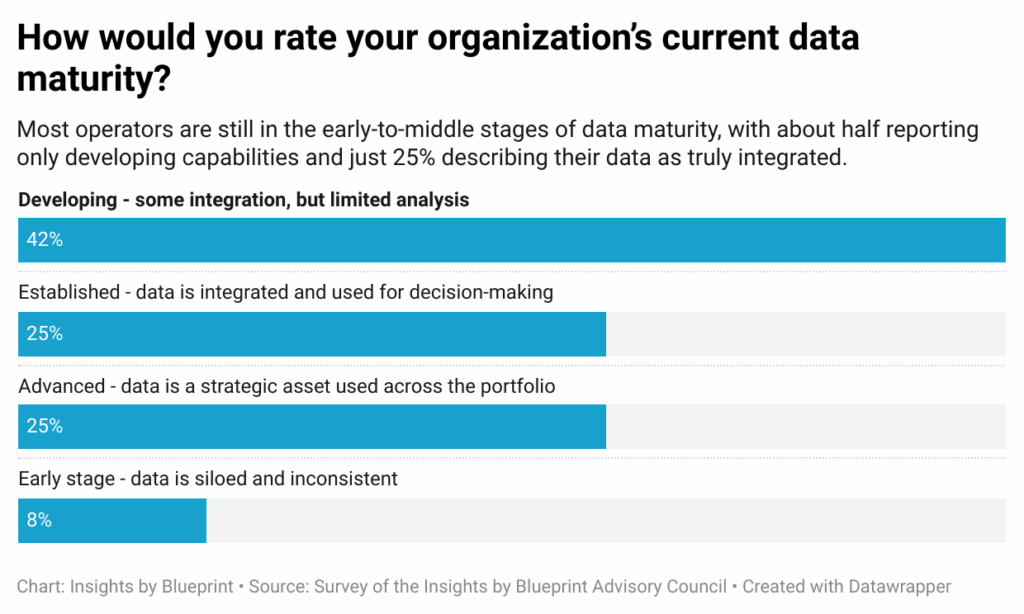
Operators on the Insights by Blueprint Advisory Council generally place themselves in the middle of the data-maturity spectrum. Most (42%) say they are still developing their capabilities, integrating data across systems, but conducting only limited analysis. A majority (58%) also reports being only somewhat confident in the quality and reliability of their building and portfolio data.
4. Privacy and consent concerns
Despite enthusiasm for data-driven operations, operators remain uneasy about the ethical and compliance implications. Tenant privacy and consent top the list of concerns, with 58% of Advisory Council members saying they are “very concerned” about how data is gathered and handled.
One operator told us, “We have no strategy to try to monetize resident data due to privacy concerns, so if we did explore it would need to be focused on market/community data for investors.”
Another operator said, “We would not monetize data, as that would open us up to risks we are not interested in undergoing at the present moment.”
Yet another operator told us, “We know some of our third-party partners are doing monetization with our residents. We are not happy about it and are worried about the lack of disclosures and additional risks this adds.”
From data consumption to data construction
Industry leaders emphasized that there are two fundamentally different ways organizations acquire and use data—one common, one still emerging.
The dominant model is data consumed through products.
Most operators interact with data indirectly, embedded inside software tools they already use. Checking stock performance is one everyday example. In CRE, this takes the form of revenue management platforms, underwriting tools, marketing intelligence products, and acquisition software.
In these cases, the operator is not buying raw data. They are purchasing a productized layer of insights assembled from multiple datasets.
This model remains the industry norm because it removes the need for operators to manage infrastructure, clean data, or build analytics workflows themselves.
The emerging model is acquiring raw data or tapping into APIs.
Far less common but rapidly growing is the direct purchase of raw or semi-processed data via APIs or flat files. This allows operators to build their own internal tools.
“We see property managers who buy our data to build their own revenue management software,” notes Jonas Bordo of Dwellsy. “Others tap into our comparables API to power an acquisition engine that they’ve built.”
This shift reflects a major change in the technical barrier to entry.
Five years ago, building an internal revenue management system would have required a full engineering team. Back then, Bordo says, “I would have told you you were insane if you tried to build your own revenue management system.” But advancements in analytics tools and AI have changed that calculus.
“Honestly, a Tableau license and a subscription to a vendor’s third-party dataset—plus your own internal information about visits, pricing, and occupancy—you probably have everything you need,” Bordo says. “Hire a smart analyst, give them the data, and they can build their own revenue management system in a couple of months.”
The threshold for custom data-driven tools has “gotten so much lower,” thanks not only to modern analytics platforms but to AI, which Bordo describes as “instrumental in helping all of us become coders.” He adds, “It certainly wasn’t within reach for me before. Now I find myself coding on a regular basis.”
Productized data remains the easiest and, therefore, most common way operators gain insights. But a growing number of sophisticated owners are moving toward API-driven raw data acquisition, reflecting a broader industry trend toward internal analytics capability and bespoke operational tooling.
Imagining a new benchmark model
Still, Robbie Beyer, Director of Data Science and AI at RSM US, underscored that the only realistic path to direct data monetization in CRE is through benchmarking, such as market rent comparisons, expense benchmarks, renewal trends, CapEx cycle analysis, leasing velocity metrics, and energy use intensity performance.
But three major barriers limit this opportunity today.
First, smaller and mid-market operators often can’t participate because benchmarking platforms require large, clean datasets, standardized reporting, and API connectivity.
Many operators lack these capabilities due to limited data hygiene, limited technical resources, limited adoption of modern PMS/CRM systems, or basic data governance. As a result, they are excluded from both contributing to and benefiting from benchmarking ecosystems.
Second, Beyer says the benchmarks that do exist are too shallow to be actionable. Most platforms provide high-level, slow, and overly generic comparisons, often released quarterly, while operators increasingly need granular insights at the unit, floor plan, HVAC type, or micro-market level. No provider offers that level of precision yet.
Third, the cost structure is prohibitively high. Marketplace operators charge steep subscription fees, per-asset add-ons, and expensive integration packages. This leads to a vicious cycle in which high costs suppress adoption, low adoption limits data volume, low volume yields shallow insights, and shallow insights reduce value.
Benchmarking may eventually evolve into a viable direct monetization model, but today it remains immature. It has long-term potential, not near-term revenue impact.
“While direct monetization of data isn’t very common today, I wouldn’t be surprised if someone eventually figures out a model that brings smaller operators into the fold, or at least reaches them up to a certain threshold, in ways we’re not seeing right now,” Beyer says. “When you look at the size of the largest operators, there are compelling reasons for them to want that data at scale and use it for a variety of purposes.”
Beyer says he could see this becoming a bigger trend. “On almost every client call, if people can get benchmarking data about what their competitors are doing without paying an arm, a leg, and a torso for it, that’s extremely appealing,” he says. “So it’ll be interesting to see whether a new model or marketplace emerges around direct data monetization in the future.”
Data-driven operations that drive NOI gains
If “selling data” isn’t a realistic path, data monetization in CRE becomes an exercise in using information to make better decisions—what can be called indirect monetization. This is already where operators of all sizes are seeing real financial impact.
The first and most immediate lever is reducing operating expenses.
By implementing predictive maintenance, standardized bulk purchasing, optimized building startup and shutdown schedules, vendor performance analytics, and fewer emergency repair calls, owners boost NOI almost instantly.
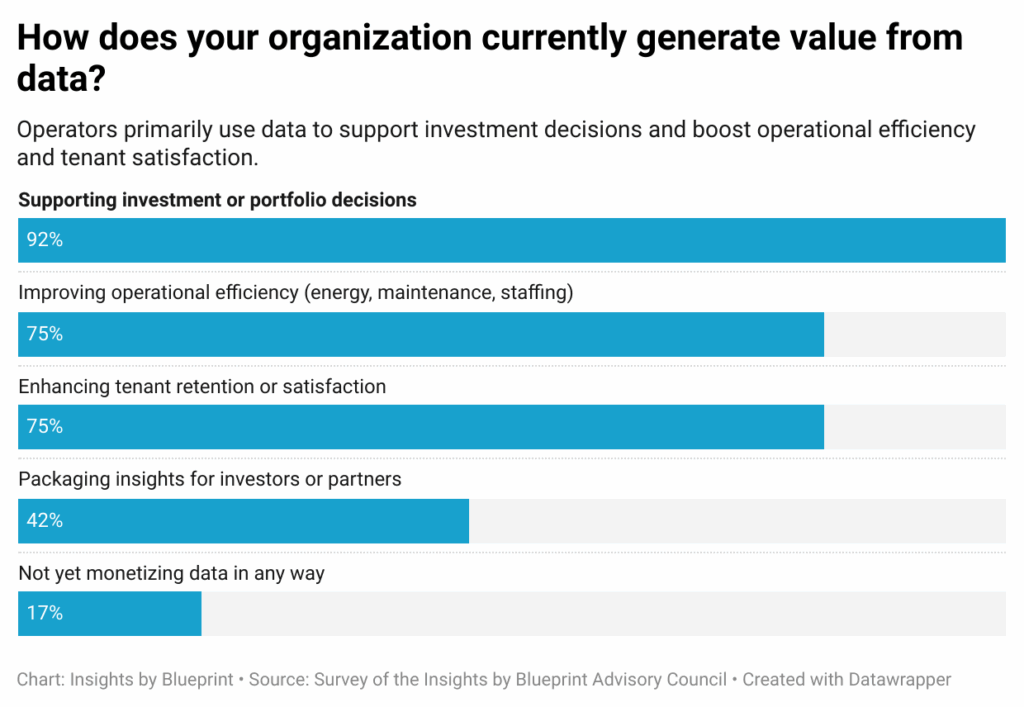
According to our survey of the Insights by Blueprint Advisory Council, 92% of operators say data creates the most value when it sharpens investment and portfolio decisions. Meanwhile, 75% report that data also delivers measurable gains in operational efficiency and in boosting tenant retention and satisfaction.
Advanced purchasing platforms are one exciting use of data optimization. They are beginning to use AI to map entire properties to standardize procurement, according to Kerry W. Kirby, Founder and CEO of 365 Connect. This company provides a unified marketing, leasing, and resident engagement platform for the multifamily industry.
Using AI to standardize procurement solves a long-standing issue for smaller operators: inconsistent, ad-hoc purchasing by maintenance staff.
As Kirby notes, a technician might need a ceiling fan, “run down to Home Depot,” and pick something that “looks right.” After years of these decisions, properties end up with mismatched fixtures and fragmented inventories that drive higher costs.
AI purchasing systems reverse this by creating a set list of approved items and automatically sourcing them at the best price. “For example, this property always uses Hampton Bay Model 106 ceiling fans,” Kirby notes.
Early results are significant. Kirby says operators he works with are “seeing about a 20% savings in operating under that model.” For many, especially in tightening markets, AI-enabled purchasing is becoming one of the most practical paths to immediate efficiency gains.
Other ways operators are using data to drive NOI gains include:
- Enhanced tenant communications
Tenant communications are becoming a defining element of forward-looking property operations. The goal is not just responsiveness, but creating a “high-touch” experience where residents feel seen, supported, and proactively engaged.
Operators now have access to detailed service-level data that enables this. Properties can track patterns such as repeated hot–cold calls, recurring maintenance issues, or service requests that point to deeper mechanical problems, according to Adam Segal, CEO of Cove. Cove is a unified SaaS platform for commercial property operations and tenant/resident experience.
AI systems then link tenant-level issues to broader building-level data, such as the last preventive maintenance performed on the blower or chiller that serves the affected unit. This allows operators to address the root cause rather than treating issues piecemeal.
More importantly, AI can support the tenant-facing side of the process.
“We send the tenant a nice note saying, ‘Hey, we’re on it,’” Segal says. With agentic AI, the system not only analyzes the data but also drafts the message, flags it for operator approval, and closes the loop with the tenant.
For busy property teams, this shift is transformative. “Operators just don’t have time to do these things,” Segal says. “What’s exciting is that now you can be a great operator and also learn from every touchpoint, getting in front of issues with AI as a true service partner.”
The result is an elevated tenant experience, fewer service disruptions, and a more proactive operating model rooted in real-time data.
2. Using IoT and AI to prevent equipment failures
Interviewees emphasized that predictive maintenance is becoming one of the most valuable applications of data analytics, AI, and IoT in property operations.
As Kirby, CEO of 365 Connect, notes, “There are two buckets to look at,” and the first is preventing major equipment failures, particularly HVAC breakdowns in hot-climate markets like Texas or New Orleans.
Newer building systems increasingly ship with IoT sensors that allow operators to detect early signs of trouble. These can include unusual compressor behavior, abnormal runtime patterns, or alerts from leak detectors indicating moisture where it shouldn’t be. With AI layered on top, operators identify these anomalies before they escalate into emergencies.
Historical data is equally important. Kirby offers a simple example: “If unit 101 has had the AC changed three times, but 202 has never had an issue, there’s got to be something else wrong.” In such a scenario, the underlying cause might be electrical surges, improper installation, or structural conditions, not the HVAC unit itself.
AI models correlate service history, IoT sensor readings, and component-level replacements to flag patterns that operators might otherwise miss. By “knowing when things are being changed,” owners gain a leg up in diagnosing and preventing recurring failures.
Insights by Blueprint Advisory Council operators highlighted predictive maintenance and cost reduction as a top priority in our survey, with 58% saying it is the data-driven strategy they’re most interested in. Leasing optimization and pricing strategy ranked higher, cited by 75% of operators.
Real estate isn’t “behind”—it’s built differently
When asked whether real estate companies are “behind the curve” in their use of data, Jonas Bordo of Dwellsy offered a nuanced answer: yes, but for reasons that make sense given the nature of the asset class.
Real estate is fundamentally different from industries like finance or e-commerce. As Bordo explains, “One of the things I love most about the real estate industry is how idiosyncratic every asset is. Each asset is truly unique.”
Unlike digital industries, where data sets can be fully standardized, Bordo says, “there is no perfect data set for the real estate industry.”
This uniqueness limits how far automated systems can go. Even sophisticated revenue management tools must be paired with human oversight.
“You have to have a human intervention in that process,” he says, “because there is always on-the-ground knowledge that nobody else has digitized.”
Bordo offered a couple of examples:
- A rental unit that chronically underperforms might be “cold because they forgot to put insulation in that wall.”
- Another unit might require aggressive pricing because “there’s a construction site coming across the street in two weeks,” and it needs to be leased before disruption begins.
“No system knows those things,” Bordo says. “People on the ground do.”
Compared to industries dominated by fully digital assets, real estate simply has a lower ceiling for data sophistication. “If you’re trading bonds or stocks, everything is digitized, so you have to be all over the data,” Bordo notes. In those industries, hedge funds may employ “hundreds of data scientists.”
“There’s not a real estate company in existence that has 100 data scientists on its team,” Bordo adds. The industry “doesn’t have the scale to have that level of sophistication and doesn’t need it.”
This makes partnerships essential. Whether a company manages 20,000 units or 150,000, it will never achieve the data scale of an organization working with a million units or 10 million units. Vendors with broader datasets and tooling will always be necessary.
Bordo compares the industry’s transition to the one depicted in Moneyball. Michael Lewis’s 2003 book is a nonfiction deep dive into baseball’s analytics revolution. Oakland A’s general manager Billy Beane sought to digitize baseball scouting, while traditional scouts clung to old methods.
Real estate is experiencing a similar tension.
“You can have all the data,” Bordo says, “but there’s still a true old-fashioned way to do business that will never go away.”
As Bordo says, a star player’s statistics may look perfect, but “his wife is sick with cancer, and he’s going to have a real hard season. That doesn’t show up anywhere in his stats.” Similarly, a property’s performance can be shaped by human realities that no model can capture.
A generational tech clash
James Shannon, Chief Product and Technology Officer at essensys, views the industry’s modernization, including its relationship to data, through a generational lens.
He argues that the biggest challenge and opportunity facing commercial real estate today is the widening gap between how long-time industry leaders see the built environment (“very analog”) and what younger occupiers, especially Gen Z, expect not only from workplaces but from workplace data.
Gen Z assumes that every interaction is logged, pooled, and used to improve their experience. “They want to be able to book a meeting room as easily as tapping to buy a sandwich,” Shannon says. They expect mobile access, digital wallets, real-time data, and frictionless movement through a space.
They also expect the system to “know” them: where they’ve worked before, what rooms they prefer, where their team is sitting, and which spaces are crowded or quiet. Plastic key cards and manual booking processes feel like relics.
But real estate changes slowly, both culturally and physically. Shannon explains, “Real estate takes generations to change, not only because of the people, but because the physical assets take time to age and be refreshed.”
Even when data is available, older buildings may lack the infrastructure to capture it, and leadership may lack the mindset to act on it. The result is a “double whammy”: legacy decision-makers with analog assumptions and physical portfolios that inherently lag behind, facing a younger generation that expects data-driven experiences.
“This is both an opportunity and a risk,” Shannon says. Operators who embrace digital systems, unified data layers, and tenant-facing insights will attract and retain the next wave of occupiers. Those who dismiss modernization may see a slow decline in occupancy, relevance, and revenue.
Shannon’s lesson: Modernization is about creating the data-rich environments that younger tenants now see as standard.
Operational excellence, supercharged by data
Commercial real estate may never monetize data the way tech companies do, and that’s not a flaw. It reflects the nature of the industry: asset-specific, locally informed, operationally complex, and resistant to the uniformity that external data marketplaces require.
The real value of data in CRE is internal. Operators are already using information to run buildings more efficiently, anticipate equipment failures, improve tenant communication, optimize pricing, and boost retention.
These forms of indirect monetization (higher NOI, lower operating costs, fewer emergencies) are the most reliable returns data can deliver today.
AI is accelerating this shift. By lowering the barrier to analytics, enabling predictive maintenance, standardizing procurement, and making custom tools accessible to mid-sized firms, AI is giving operators new leverage over the data they already possess. It narrows the capability gap between institutional owners and the rest of the market.
But data alone isn’t enough. CRE assets are too idiosyncratic, and tenant behavior is too human, for models to operate without oversight.
As Bordo notes, no system may ever know about that uninsulated wall or the construction site breaking ground next week. And as James Shannon observes, younger tenants expect real-time data experiences, but those experiences still depend on operators who interpret the data and design meaningful spaces.
The next decade will belong to operators who embrace this hybrid model: data-rich systems paired with human insight. AI-powered workflows informed by real-world context. And modernization aligned with the physical realities of buildings.
Direct data monetization may remain elusive, but operational excellence powered by data is already here, and it’s becoming the new competitive standard.
As Bordo puts it, AI is in its “1998 internet moment,” evolving at breakneck speed. But its destination is clear: much simpler, much easier, much more efficient access to data, so people can answer questions and create value from it.
– Nick Pipitone