


Multifamily operators are learning (sometimes the hard way) that the rules of online reputation management are changing fast.
An apartment community can have hundreds of five-star reviews. But in an era of conversational AI search, a single extremely negative comment can be elevated by a chatbot and scare a potential resident away. “With the rise of AI search, reputation may play a much bigger role in how prospects find properties than ever before,” one multifamily operator and Insights by Blueprint Advisory Council member told us in a recent survey.
The shift cuts both ways. AI-powered platforms are moving online reputation management from reactive, manual work to scalable, automated responses.
This report synthesizes insights from multifamily experts alongside exclusive survey data from the Insights by Blueprint Advisory Council. We examine how operators must rethink reputation management as conversational search and generative AI become central to the rental discovery journey.
Keeping it real-time
Reputation management in multifamily has traditionally been reactive and manual.
Property teams monitored Google, Facebook, and listing sites, drafted responses to each review, and escalated negative feedback internally as needed. The process was time-consuming, inconsistent, and often dependent on whoever happened to be managing the property that week.
That model is breaking down.
Reputation management is shifting from a side task squeezed in between tours and renewals into a system-driven function embedded within the operating model.
AI systems can now monitor reviews in real time, generate context-aware responses aligned with brand voice and compliance standards, flag risk-sensitive issues, and route concerns to the right teams instantly. This brings speed, consistency, and accountability to a process that was once fragmented and ad hoc.
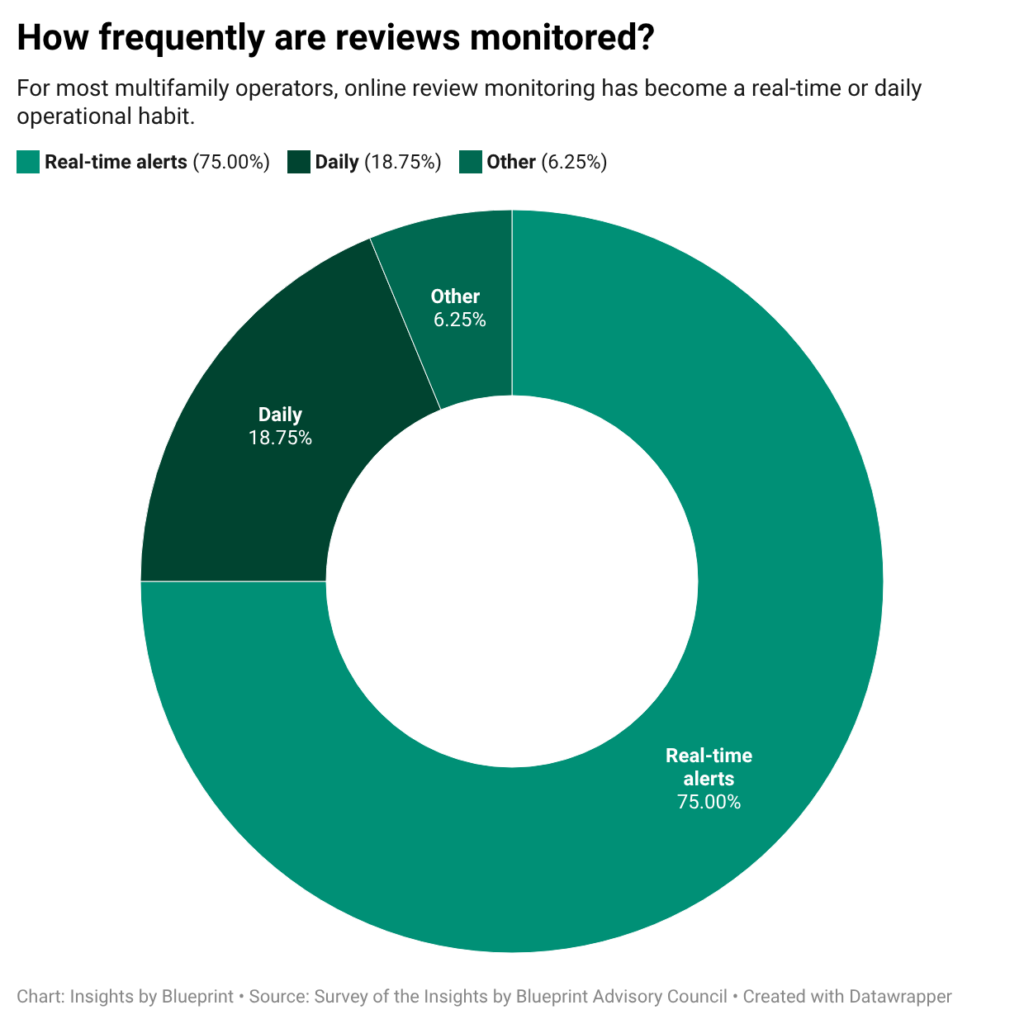
Review monitoring has become a near-constant activity for many operators. Seventy-five percent of Insights by Blueprint Advisory Council survey respondents say they monitor reviews in real time, with an additional 19% doing so daily.
Response rates are high among Advisory Council members. Sixty-five percent say they respond to nearly all reviews, with an additional 18% responding to most, reflecting a proactive approach to reputation management.
“Timeliness and professionalism are of utmost importance,” one multifamily operator told us in the survey. “I recommend centralization of these efforts versus onsite management responding.”
Google remains the main reputation gatekeeper
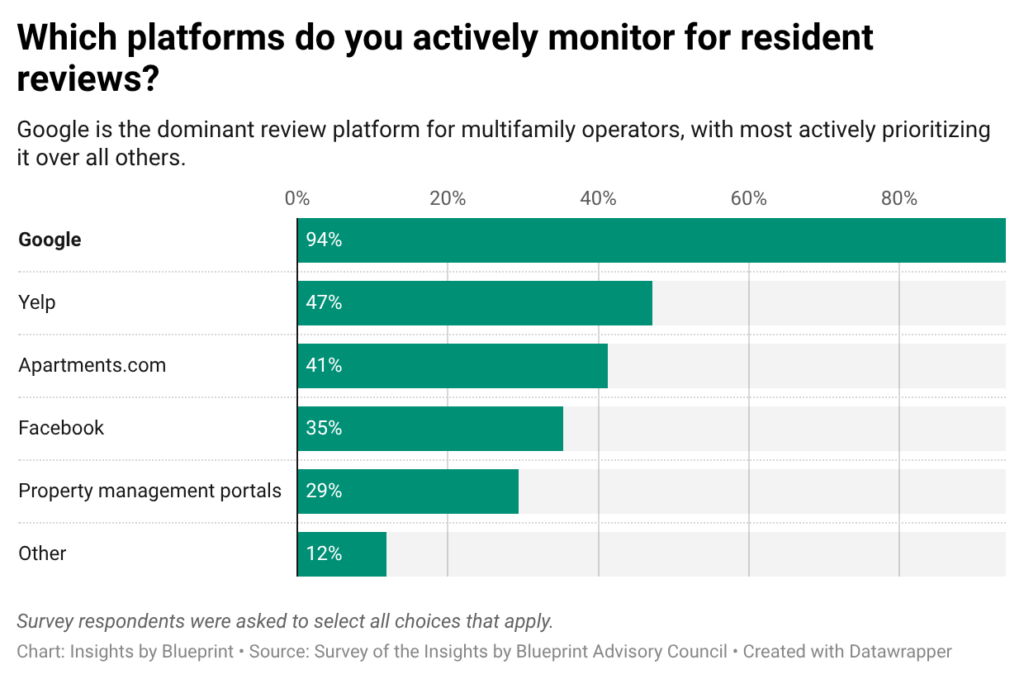
Across review platforms such as Yelp, Apartments.com, and Facebook, one channel dominates: Google.
An overwhelming 94% of Insights by Blueprint Advisory Council members say they actively monitor Google reviews, reinforcing Google’s role as the primary reputation channel for multifamily operators. By comparison, far fewer respondents regularly track other platforms, including Yelp (47%), Apartments.com (41%), and Facebook (35%).
Google is the primary authority on apartment reputation for several reasons.
Reviews are embedded directly in search results, Google Business Profiles are publicly verifiable, AI models reference Google review data, and reviews are tied directly to the property entity. As conversational search replaces “blue links,” Google’s structured business data becomes even more influential.
“Apartment operators need to feed Google with positive reviews. Take care of Google,” advises Kerry W. Kirby, CEO of 365 Connect. “It’s by far the most prominent source.”
For multifamily operators, this means regularly monitoring Google Business Profiles, encouraging authentic reviews on Google specifically, and ensuring business profile data is accurate and complete. This is doubtless something operators have already been doing. But a laser focus on Google reviews specifically is imperative.
“With the advent of AEO (AI overviews), and because we manage our website footprint internally, we solve for Google’s ‘EEAT’ (Google’s quality framework for evaluating content credibility),” an operator from the Advisory Council said. “Review and reputation scores are a heavily weighted factor because Google only cites sources it trusts.”
Beware of automation without oversight
Property managers juggle tons of tasks, including leasing, maintenance coordination, resident issues, and vendor management.
AI provides leverage to help manage reviews and responses. Kirby describes a hybrid model in which 4–5-star reviews are automatically responded to with approved AI tone variations, while 1–3-star reviews trigger escalation for human oversight.
AI can generate varied language to avoid canned responses, and guardrails prevent inappropriate phrasing. When done correctly, AI can reduce response times, maintain consistency, avoid repetitive copy-paste language, and preserve brand tone.
But automation without oversight is risky.
Kirby offers a simple example of an AI system responding to a negative review about parking. “The AI can’t just say, ‘Thank you for the feedback. We’re working to fix the parking situation,” he said. “That might not be true. You may not be able to build a new garage or change the situation at all. That’s why AI needs guardrails, so it can respond intelligently, honestly, and in a way that reflects operational reality.”
An often overlooked risk
One of the most under-discussed dimensions of online reputation management is regulatory compliance. In multifamily marketing, Fair Housing rules apply to many public-facing communications, including social posts, leasing ads, promotional copy, and potentially, review responses
“Compliance is now one of the most critical and overlooked elements of online reputation,” Kirby says. “Every response must navigate Fair Housing regulations, privacy protections, and brand liability. A well-intentioned but poorly worded reply can create unnecessary legal exposure.”
Kirby says that when properly configured, AI can strengthen compliance rather than compromise it. “Systems can be prompted to avoid protected-class language, prevent disclosure of resident-specific information, maintain neutral tone, and follow approved response frameworks,” he says.
Responding to negative reviews
A growing challenge is AI chatbots surfacing old or isolated negative reviews in summary results. Conversational search engines often summarize a community’s reputation and, occasionally, surface a single extreme review that casts a multifamily property in a bad light.
AI chatbots like ChatGPT or Claude may blend outdated Yelp feedback with current Google ratings or present misleading information without prompting users to click the source link. This creates asymmetry. A property may have 200 strong reviews, but one severe negative review may dominate an AI summary.
There is no perfect fix for this. According to Kirby, the only reliable strategy for now is to generate consistent, authentic positive reviews over time.
Operators must proactively request reviews at key lifecycle points, such as 30 days after move-in, after completed maintenance requests, and lease renewals.
“The negative ones will find you,” an operator from the Advisory Council said in a survey response. “Have your team ask for reviews in positive interactions to offset. Add to KPIs and/or gamify for the team.”
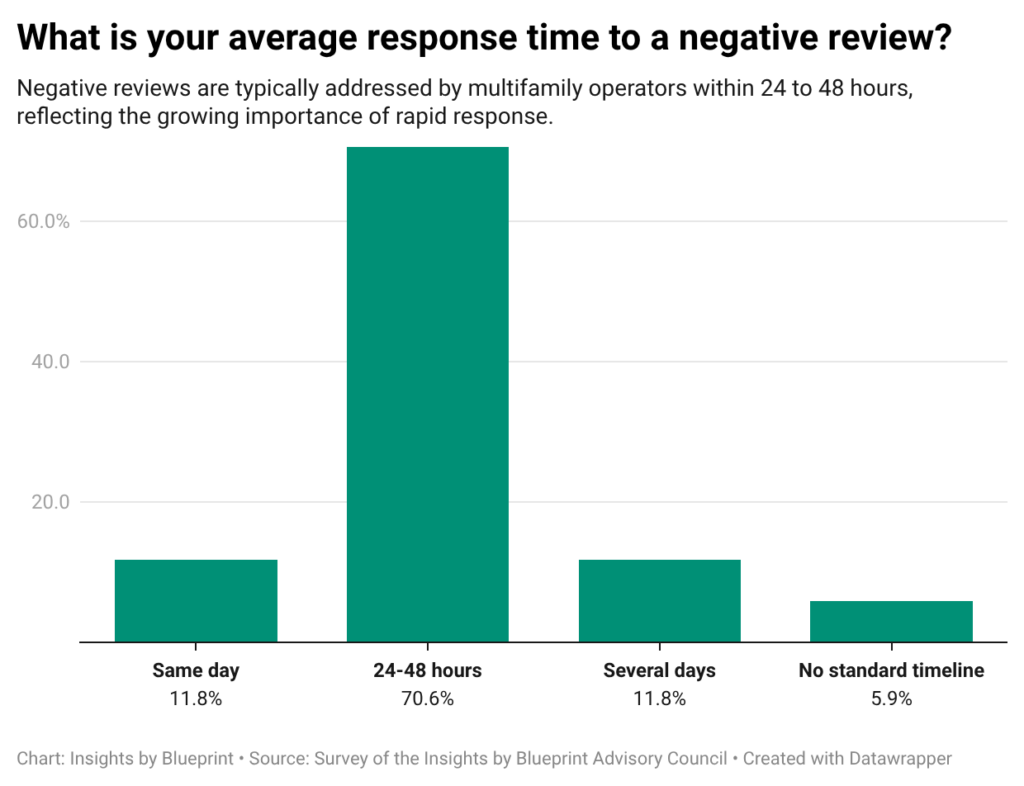
For most operators, negative reviews prompt immediate intervention. Seventy-one percent of Insights by Blueprint Advisory Council survey respondents respond within 24 to 48 hours, while 12% take action the same day.
“Companies should monitor reviews in real time, analyze sentiment by operational theme, and make needed improvements,” an operator from the Advisory Council told us in the survey. “Reputation should be treated as a living performance metric, measured monthly, owned cross-functionally, and used to predict occupancy, renewals, and brand strength.”
‘It makes sense to outsource’
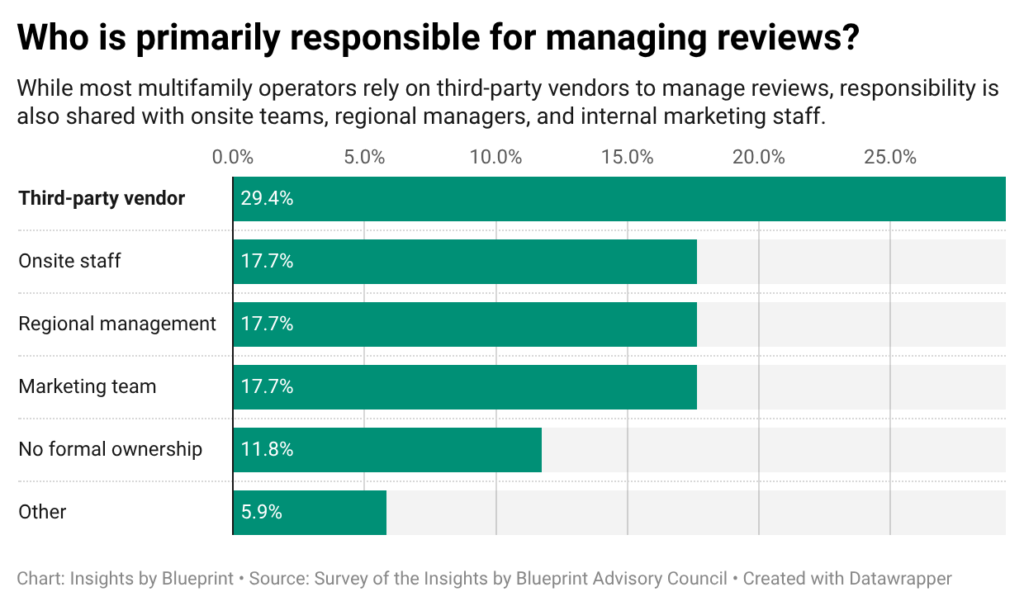
Online reputation management is rarely owned by a single internal role. While 29.4% of Advisory Council survey respondents rely on third-party vendors to manage reviews, responsibility is otherwise fragmented evenly across onsite teams, regional management, and marketing departments, each cited by 17.7% of respondents.
Reputation management is also increasingly software-driven. Nearly 65% of Advisory Council respondents use dedicated platforms to manage and respond to reviews, while fewer than one in five still rely on manual processes.
“Depending on the number of units involved, it makes sense to outsource your reputation management to a third-party vendor,” one multifamily operator and Advisory Council member told us in the survey.
Dedicated platforms now centralize review monitoring, response workflows, sentiment analysis, and reporting across Google and other major review channels, enabling faster response times and greater consistency at scale.
Enterprise-grade providers such as Reputation.com, Birdeye, and ReviewTrackers are commonly used to manage high volumes of reviews across large portfolios.
Multifamily-focused firms like J Turner Research and SatisFacts provide industry-specific benchmarking and performance insights.
Together, these tools reflect a shift away from manual review management toward always-on, systematized reputation strategies that align with rising consumer expectations and AI-driven discovery.
“Work with a platform like Reputation. AI will summarize your reputation for prospects, and management companies must focus on shaping the narrative rather than just protecting the star rating,” one operator from the Advisory Council told us.
Reputation in a bot-to-bot world
Kirby posed a provocative question: “Is there a point where my bot talks to your bot?”
He was describing an era that is already underway in online reputation management, where AI becomes the primary layer of discovery.
Instead of renters reading dozens of reviews themselves, they increasingly ask AI tools whether a property is safe, responsive, or well-managed. Those systems don’t just surface reviews but also interpret them, summarize sentiment, and decide which themes matter.
At the same time, generative AI is entering both sides of the equation.
Residents can use AI to draft reviews, while operators can use AI to generate responses at scale. The feedback loop that once centered on human judgment starts to look more like bot-to-bot interactions.
In that environment, reputation is no longer defined by star ratings or clever replies. It’s defined by how AI systems read, weigh, and contextualize your digital footprint across platforms. The operators who win will be the ones who understand how those systems discover information, assess credibility, and surface conclusions.
The next competitive frontier in online reputation management isn’t merely response speed or tone. It’s AI visibility engineering: shaping your online presence so that when bots talk to bots, the story they tell about you is the right one.
Building an ‘always-on’ reputation strategy
Online reputation management is no longer a reactive function or a box to check. It has become a core visibility strategy in the AI era.
Reviews, responses, and business profile data are interpreted by AI like Claude and ChatGPT before they are ever read by humans.
The operators best positioned to compete will be those who treat reputation as an always-on system rather than an ad hoc task.
That means centralizing ownership, leveraging software and AI with clear guardrails, prioritizing Google as the primary reputation channel, and viewing reviews as a living performance signal tied to operations, compliance, and brand trust.
In an era where bots increasingly summarize reality for multifamily prospects, reputation management goes well beyond defending star ratings. It’s also about shaping the narrative AI systems surface in the first place.
– Nick Pipitone