


Renters insurance occupies a strange position in multifamily operations. It’s mandatory in name at most properties, murky in practice at nearly all of them. Estimates vary, but most surveys put uninsured renters somewhere in the 40 to 55 percent range nationally at any given time. The gap isn’t primarily about affordability. Most uninsured renters either never think about coverage or wrongly assume their landlord’s policy protects their belongings. And most operators, for their part, never built a system to verify coverage past the day it was first checked. Many properties confirm the policy once, at signing, and then trust that the box stays checked. It often doesn’t.
This coverage gap matters more as loss exposure climbs. Fire, water damage, and smoke rarely stay contained to a single unit, and when an uninsured resident causes a loss that spreads into common areas or neighboring units, the operator absorbs the cost through its own deductible. Insights by Blueprint Advisory Council conversations describe the resulting blind spot as one of the more dangerous ones in current operations, precisely because portfolio dashboards report enrollment rates rather than active, verified coverage rates. The two numbers look close enough to ignore until a claim forces the issue.
Meanwhile, the vendor landscape hasn’t consolidated the way other multifamily categories have. Foxen and Assurant’s Cover360 each hold meaningful share among dedicated renters insurance compliance platforms, while many operators still rely on general commercial brokers to place resident coverage rather than a purpose-built platform. No platform has claimed a dominant position.
What has converged, even without that consolidation, is operator expectation. Renters insurance should function as an automated, embedded part of the leasing workflow, not a manual verification task bolted onto it after the fact. This report lays out the four operating models operators are actually running, the revenue math vendors pitch against what operators budget for internally, and the practical steps for closing the gap between the two.
4 models, and why revenue lags behind risk
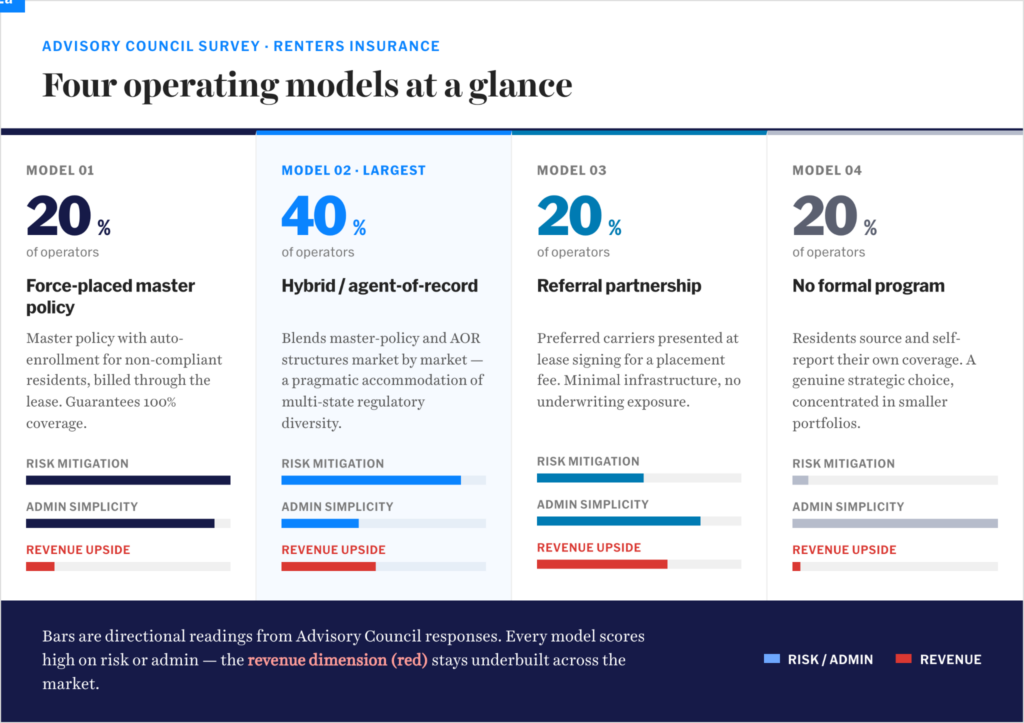
Advisory Council survey data on current renters insurance programs surfaces a market segmented into four distinct operating models, each reflecting a different balance between risk mitigation, administrative simplicity, and revenue generation.
Model 1: Force-placed master policy. Under this model, the operator maintains a master policy and either requires proof of third-party coverage or automatically enrolls non-compliant residents into a force-placed policy billed through the lease. This model appeared in a fifth of the operators we surveyed as their primary structure. It is the simplest to administer from a legal and enforcement standpoint, since it guarantees 100 percent coverage without relying on resident follow-through. But it generally captures the least revenue upside because force-placed premiums are typically priced to cover risk rather than to generate a spread.
Model 2: Agent-of-record and hybrid market-by-market approaches. The largest single response in the Advisory Council survey, representing 40 percent of operators, was a hybrid model that blends master-policy and agent-of-record structures depending on the market. This reflects the reality that renters insurance regulation varies significantly by state and locality. Portfolios spanning multiple jurisdictions often find that a single enforcement model does not translate cleanly across markets with different insurance regulatory regimes. Operators running this model tend to describe it as a pragmatic accommodation of portfolio diversity rather than a deliberate revenue strategy.
Model 3: Referral partnership. Roughly a fifth of surveyed operators run a referral-based program, in which the operator presents one or more preferred carriers to residents at lease signing and collects a placement fee or commission for each policy purchased. This model requires minimal infrastructure investment. Much of the enrollment flow can be embedded through vendor platforms rather than built internally, and it generates a direct, if modest, per-unit revenue stream without requiring the operator to take on underwriting exposure.
Model 4: No formal program. A full fifth of the Advisory Council respondents reported no formal renters insurance program, relying instead on residents to source and self-report their own coverage. This group is worth naming explicitly because it represents a genuine strategic choice rather than an oversight in most cases. This group consists of typically smaller portfolios or those where insurance administration has not risen to a leadership priority. Given rising loss exposure industry-wide, this cohort is likely to face increasing pressure to formalize a program over the next several years.
The critical finding underlying this framework is that risk mitigation, not revenue generation, remains the dominant justification operators use internally for maintaining a renters insurance program. Half of Advisory Council respondents cited risk mitigation and liability protection as the primary driver behind their current model, while only 10 percent pointed to ancillary revenue generation as the primary motivation.
This creates a meaningful strategic tension: the compliance and enforcement infrastructure already exists at most operators, funded and justified on risk grounds. But the revenue capture layer on top of that infrastructure remains underbuilt relative to what the market positions as available. Vendors and carriers marketing renters insurance programs externally lean heavily on the revenue narrative. Captive insurance providers point to roughly $100 in net income per unit annually as an achievable benchmark for larger portfolios. However, operators internally continue to frame and budget for these programs primarily as cost avoidance rather than profit centers.
Hybrid by necessity, not design
No single renters insurance model works uniformly across a diversified portfolio. Regulatory variation by state, uneven revenue infrastructure, and the reality that most programs still lean on manual tracking all push operators toward hybrid approaches rather than a single dominant structure. Yet the biggest constraint isn’t the technology or the carrier partnerships behind it, but on-site staff capacity to actually introduce, explain, and enforce the requirement at the leasing office level.
Portfolio diversity undermines a single enforcement model. Operators managing units across multiple states encounter meaningfully different regulatory environments governing renters insurance requirements, force-placement rules, and disclosure obligations. A model that works cleanly in one market can create compliance exposure in another. This explains why the hybrid approach captured the largest share of the Advisory Council survey rather than a single dominant structure. Any monetization strategy has to be evaluated market by market rather than applied uniformly across a portfolio.
Revenue capture requires infrastructure that risk mitigation does not. A program built purely to guarantee compliance can function adequately with manual tracking and a force-placed backstop. A program designed to generate meaningful referral or premium-markup revenue requires embedded enrollment flows, carrier partnership agreements, and ongoing reconciliation between enrollment data and revenue recognition. Advisory Council survey data on revenue structure shows an even three-way split between premium markup, flat referral fees, and no direct revenue at all, each representing 20 percent of respondents. This suggests the operational lift required to move from a cost center to a revenue center is nontrivial, and many operators have not yet made the investment.
Staff capacity and training remain the practical bottleneck. Even the most automated renters insurance platforms still depend on leasing office staff to clearly introduce the requirement, answer resident questions, and handle exceptions. Advisory Council conversations consistently identify on-site staff bandwidth as a limiting factor in program effectiveness, independent of which vendor platform or carrier partnership sits behind the program.
5 moves for operators ready to act
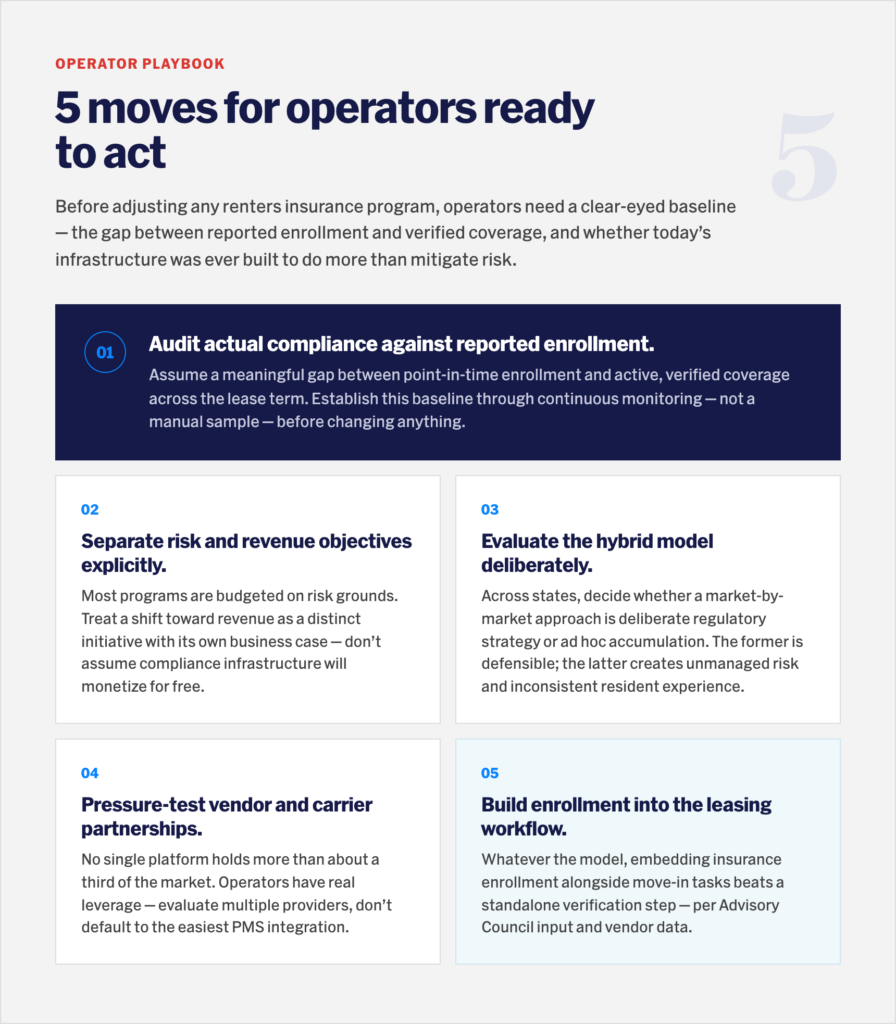
Before adjusting any renters insurance program, operators need a clear-eyed baseline. They must answer how much space actually exists between reported enrollment and verified, active coverage, and whether current infrastructure was ever built to do more than mitigate risk. The recommendations below walk through that audit process and the deliberate decisions that should follow.
Audit actual compliance rates against reported enrollment rates. Most operators should assume a meaningful gap exists between point-in-time enrollment figures and active, verified coverage across the full lease term. Establishing this baseline, ideally through a continuous monitoring platform rather than a manual sample audit, is the necessary first step before evaluating any change to the underlying program structure.
Separate the risk mitigation and revenue objectives explicitly. Because the majority of current programs are justified and budgeted on risk grounds, operators evaluating a shift toward revenue generation should treat it as a distinct initiative with its own business case, rather than assuming the existing compliance infrastructure will automatically support monetization without further investment.
Evaluate the hybrid model deliberately rather than by default. Portfolios operating across multiple states should assess whether a market-by-market approach reflects a deliberate regulatory strategy or simply an accumulation of ad hoc site-level decisions. The former is defensible; the latter creates unmanaged risk and inconsistent resident experience.
Pressure-test vendor and carrier partnerships against the fragmented landscape. With no single platform commanding more than roughly a third of the market, operators have real negotiating leverage and should evaluate multiple providers rather than defaulting to whichever platform integrates most easily with an existing PMS.
Build the resident-facing enrollment flow into the leasing workflow itself. Regardless of which monetization model an operator selects, embedding insurance enrollment alongside utility setup and other move-in tasks consistently produces higher participation than a standalone verification step, according to both Advisory Council input and vendor-side data.
The gap is operational, not technological
The gap this report keeps returning to isn’t a technology problem. It’s the distance between what an enrollment dashboard reports and what’s actually true on the ground six months into a lease. Operators aren’t wrong to prioritize risk mitigation over revenue; that’s the correct order of operations. But the tension the survey data surfaces is real. The compliance infrastructure most portfolios already have was built and budgeted to answer one question: is this resident covered right now? That’s a different system than one built to also answer, is this program making money? Conflating the two, or assuming the first automatically produces the second, is where most stalled monetization efforts start.
None of the four models in this report is categorically right, and the survey data bears that out. The hybrid approach won the largest share not because it’s the most elegant answer but because it’s the most honest one, a reflection of regulatory reality rather than a deliberate strategy in most cases. What separates operators getting real value from this category isn’t which model they picked. It’s whether they’ve audited the gap between reported and verified coverage, decided whether they’re building for risk mitigation or revenue, and given on-site staff the tools to actually execute either one. Absent that groundwork, any platform or renters insurance carrier partnership is just a more expensive version of the same blind spot.
– Nick Pipitone