

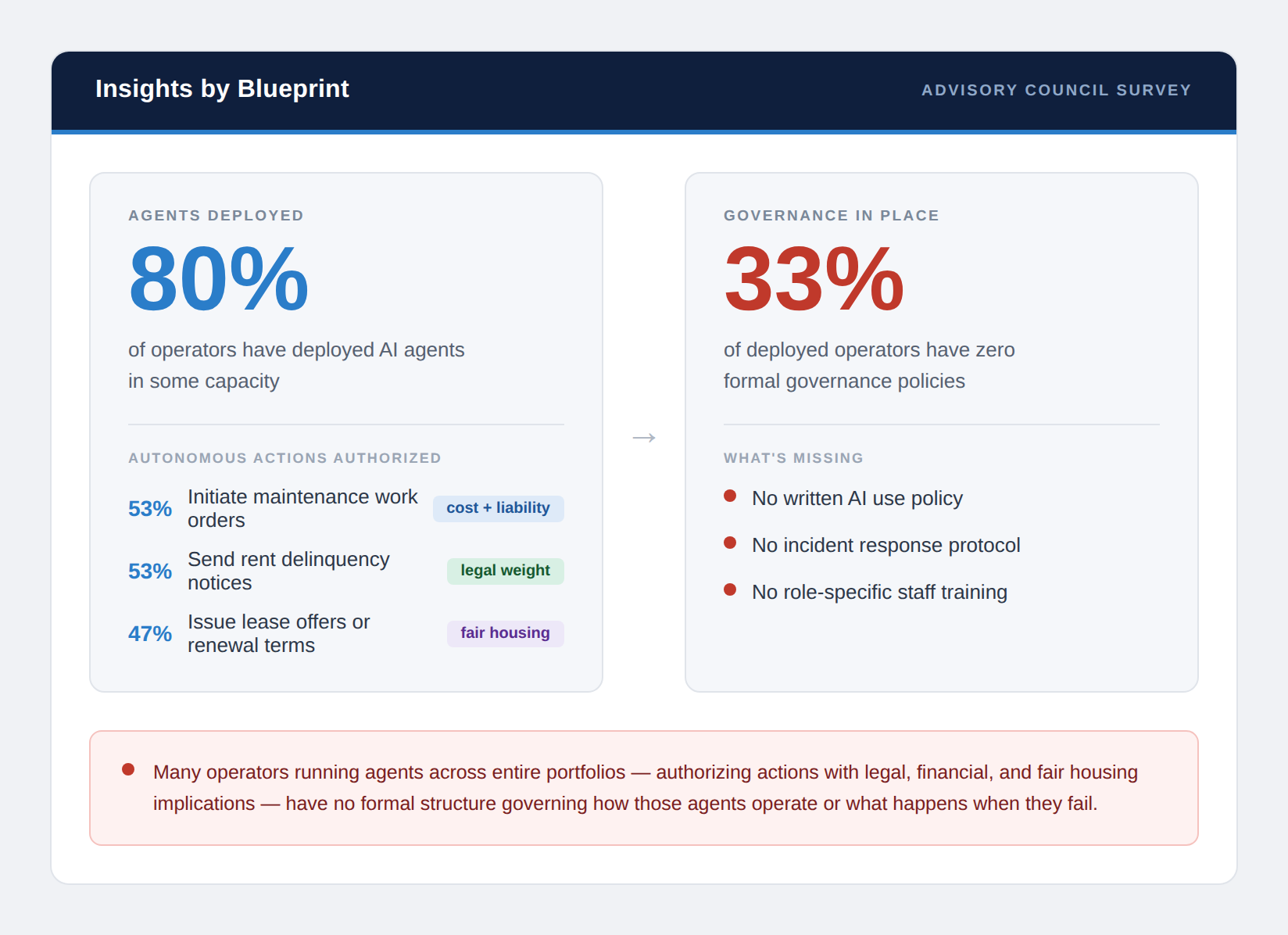
Multifamily operators are moving quickly to deploy AI agents across leasing, maintenance, and resident communication. But the governance policies required to manage those agents responsibly lag significantly behind. A new Insights by Blueprint Advisory Council survey of multifamily operators found that 80% have deployed AI agents in some capacity, with nearly half running them across most or all of their portfolios. The autonomous action surface is already broad: 73% of agents can schedule tours without human approval, 53% can initiate maintenance work orders and issue delinquency notices, and 47% can send lease offers or renewal terms.
The governance picture tells a different story. A third of operators who have deployed agents have zero formal governance policies in place today. Fewer than half have liability clauses in their vendor contracts covering AI errors or fair housing violations. Only 50% have an incident response protocol. The gap between what AI agents are authorized to do and the governance structures in place to manage those actions is not a minor administrative lag. It is an exposure that could have material consequences for portfolios that do not close it.
This report examines where governance gaps are most acute, introduces a framework for building AI agent governance policies, and outlines implementation steps operators can take to close the exposure gap before a high-stakes failure forces the issue.
AI agent deployment is outpacing governance
Eighty percent of Advisory Council survey respondents have deployed AI agents in some capacity, but the majority have done so only in limited pilots or at select properties. Only 47% have deployed across most or all of their portfolios. This distribution reflects an industry in the early consolidation phase of a technology cycle: broad experimentation, uneven operationalization, and limited standardization of either the technology stack or the governance structures surrounding it.
The range of actions AI agents are currently authorized to take without human approval has expanded well beyond tour scheduling, the entry-level use case most operators started with. Among survey respondents, 53% of deployed agents can initiate maintenance work orders autonomously, 53% can communicate rent delinquency notices, and 47% can send lease offers or renewal terms.
These are not low-stakes communications. Delinquency notices carry legal weight. Lease offer terms can create fair housing exposure, and initiating a maintenance work order has cost and liability implications. Each of these authorized actions represents a point in the resident lifecycle where an agent error results in a consequence that the operator is ultimately responsible for managing.
A third of operators who have deployed agents have zero formal governance policies in place today. This is not a group of operators who are behind on technology. Many are running agents across their entire portfolios, authorizing a wide range of autonomous actions, and doing so without a written AI use policy, an incident response protocol, or role-specific staff training.
The forces in favor of governance
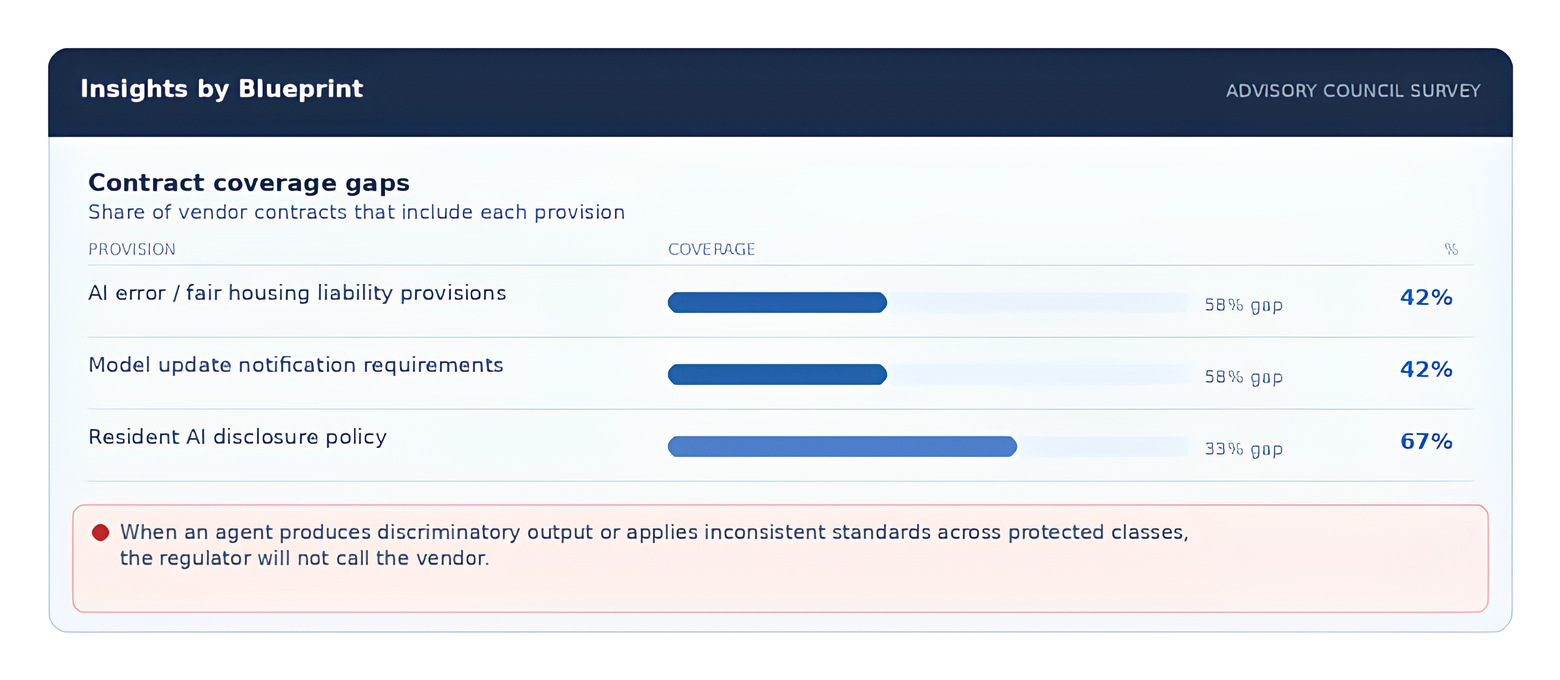
Fair housing liability does not transfer to the vendor. Operators are ultimately responsible for the communications their AI agents send to prospective and current residents, regardless of who built or hosts the agent. With 47% of agents authorized to send lease offers or renewal terms autonomously, communications that carry material fair housing implications, the contractual coverage picture is alarming: only 42% of vendor contracts include liability provisions covering AI errors or fair housing violations. The remaining 58% of operators are absorbing that liability directly, often without knowing it. When an agent produces discriminatory output or applies inconsistent communication standards across protected classes, the regulator will not call the vendor.
Model updates change agent behavior without operator knowledge. AI agents are not static software. The underlying models that power them are retrained, updated, and tuned on a schedule controlled by vendors. Most operator contracts do not require vendors to disclose it. Only 42% of contracts in the Advisory Council survey include notification requirements for model updates that affect agent behavior. An agent that was reviewed for fair housing compliance in Q1 may be operating on a materially different model by Q3, with no contractual trigger requiring the vendor to inform the operator or the operator to revalidate compliance. This is a blind spot that no amount of internal governance can compensate for if it is not addressed at the contract level.
Resident disclosure requirements are multiplying at the state level. Only 67% of operators in the survey currently inform residents that they are interacting with an AI agent. The remaining third are operating without a disclosure policy at a moment when state-level AI transparency legislation is accelerating. Several states have enacted or are advancing disclosure requirements for AI-generated communications in consumer-facing contexts, and multifamily operators are likely regulatory targets. Operators without a resident disclosure policy today are not simply behind on best practice; they are accumulating regulatory exposure that will become increasingly difficult to remediate retroactively across a large, distributed portfolio.
Proposing an AI agent governance framework
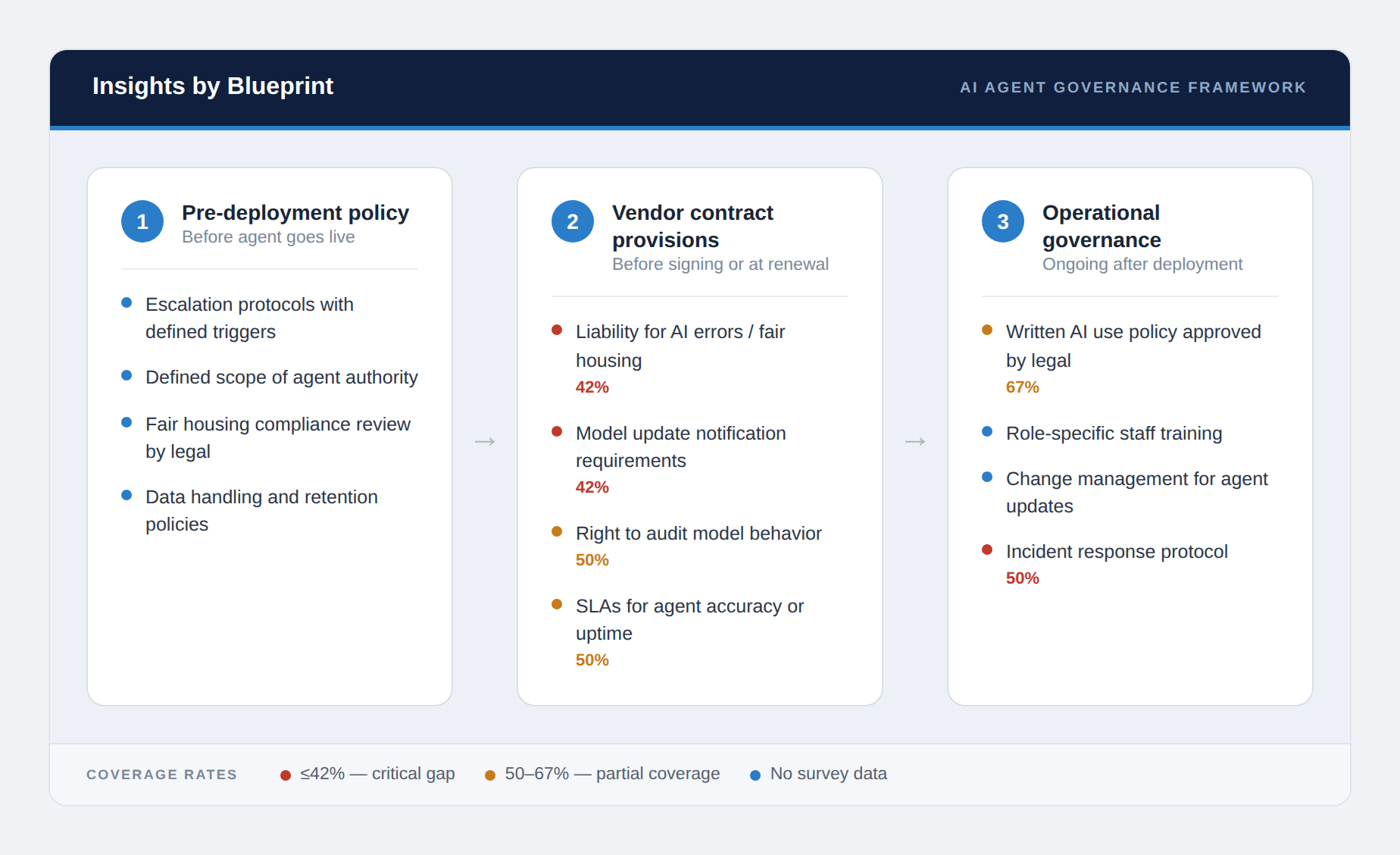
Advisory Council discussions consistently surface the same pattern: operators who built governance policies before or alongside initial deployment are significantly better positioned than those who deferred it. The governance challenge is organizationally complex, and the organizations that treat it as an operational discipline rather than a compliance afterthought are the ones closing the gap. The framework below organizes AI agent governance into three sequential layers, each addressing a distinct category of exposure.
Layer 1: Pre-deployment policy. Before any agent is authorized to communicate with residents or take autonomous action on behalf of the portfolio, four policies should be formally documented and approved. First, escalation protocols that define precisely when and how the agent hands off to a human, including the conditions that trigger escalation, the staff role responsible for receiving it, and the expected response time.
Second, a defined scope of authority that specifies what the agent can and cannot commit to on behalf of the operator, with particular attention to any communications that carry legal or financial weight. Third, a fair housing compliance review of the agent’s standard responses and communication patterns, conducted by legal or compliance before the agent goes live.
Fourth, data handling and retention policies that govern how resident interaction data is stored, accessed, and eventually purged. Advisory Council survey data show that operators who documented these four policies before deployment are significantly more likely to have comprehensive governance policies in place today.
Layer 2: Vendor contract provisions. The vendor contract is the governance instrument that most operators underuse. Data ownership and portability, the most commonly negotiated clause, appearing in 75% of contracts, is a data portability protection, not a governance mechanism. The four provisions that govern agent behavior and risk allocation appear in far fewer contracts.
Liability for fair housing violations and AI agent errors appears in only 42% of contracts, despite being the single highest-stakes exposure in the stack. Notification requirements for model updates are present in only 42% of contracts, creating the silent model-change risk described above. Right to audit model behavior or training data appears in 50% of contracts, a reasonable starting point, but one that is only meaningful if operators actually exercise it. SLAs for agent accuracy or uptime are present in 50% of contracts, providing at minimum a contractual standard against which performance degradation can be measured. Operators should treat these four provisions as a minimum threshold for any AI agent vendor agreement, and should plan to renegotiate contracts that lack them at the next renewal cycle.
Layer 3: Operational governance policies. Once an agent is deployed and the vendor contract is structured appropriately, four operational governance policies are required to maintain ongoing accountability. A written AI use policy approved by legal or compliance, present in only 67% of current deployers, establishes the institutional baseline for how AI agents are used, what they are permitted to do, and who is responsible for oversight.
Role-specific training for staff who supervise or escalate from agents ensures that the human layer of the system understands its responsibilities and is equipped to catch the errors that agents will inevitably produce. A change management process for agent updates governs how the organization reviews and approves changes to agent behavior before deployment to the portfolio. An incident response protocol is present in only 50% of deployers, making it the single most dangerous gap in the current landscape. This defines what happens when an agent makes a resident-facing error, including who is notified, how the incident is documented, and which remediation steps are triggered.
AI Agent Governance Challenges
Portfolio diversity complicates standardization. Large portfolios rarely operate a single AI agent product across all properties. Different asset classes, PMS environments, local regulatory contexts, and technology mean that the agent stack at a Class A lease-up looks different from that at a stabilized workforce housing community. Building governance infrastructure that is both consistent enough to be manageable at the portfolio level and flexible enough to accommodate property-level variation is an organizational challenge that requires governance to be designed as a framework with defined parameters rather than as a single policy document that applies uniformly across contexts.
Vendor maturity varies significantly across the market. Not all AI agent vendors in the multifamily market are equally prepared to negotiate the contract provisions the framework above requires. Smaller or earlier-stage vendors may resist liability clauses, lack the infrastructure to provide audit rights, or be unable to commit to notification requirements for model updates. This reality creates a selection problem: operators who adopt governance standards that include strong contract provisions will, over time, select toward vendors who can meet those standards. They will also be better positioned to evaluate vendor maturity as part of the procurement process. In the near term, operators who cannot negotiate full contract compliance with an existing vendor should, at minimum, document the gaps and build compensating controls at the operational governance layer.
Assigning ownership is the step most organizations defer longest. Governance frameworks fail not because the policies are wrong but because no one is accountable for maintaining them. In most organizations, AI agent governance currently exists in a gray area among IT, operations, legal, and compliance. It is acknowledged by all, owned by none. The governance framework described above requires a named owner: a role with the authority to enforce policy, the visibility into the vendor relationship to manage contract compliance, and the organizational standing to escalate governance failures to senior leadership. In larger portfolios, this may be a dedicated role. In smaller organizations, it may be a formal addition to the remit of an existing SVP of Technology or VP of Operations. What it cannot be is a committee responsibility without a single point of accountability.
Five steps to close the gap
Audit current agent authorization scope against existing policy coverage. Map every autonomous action currently authorized across the deployed agent stack against the governance policies that currently govern each action. The gaps will be visible immediately. Prioritize closures in order of resident-facing consequence severity, starting with any agent authorized to send communications with legal or financial weight.
Run a vendor contract review against the four minimum provisions. Pull every AI agent vendor agreement currently in effect and evaluate it against four criteria: liability for fair housing violations and AI errors, notification requirements for model updates, right to audit model behavior, and SLAs for agent accuracy. Document the gaps and flag contracts coming up for renewal as the priority renegotiation targets. For vendors who cannot meet minimum provisions, build compensating operational controls and document the rationale for continuing the relationship.
Establish a resident disclosure policy and confirm compliance with state-level requirements. A resident disclosure policy is one of the lowest-cost, highest-impact governance actions available to operators today. Draft a standard disclosure statement, integrate it into agent interaction flows, and confirm that the approach meets the requirements of every state in which the portfolio operates. This step is also an opportunity to review disclosure language for clarity. Residents who understand they are interacting with an AI and who are given a clear path to reach a human are more likely to have productive interactions and less likely to escalate complaints.
Build an incident response protocol before the next agent update cycle. The incident response protocol is the single most underbuilt element of current AI agent governance policies, and it is the one that will be needed first when something goes wrong. The protocol should define: what constitutes a reportable AI agent incident (including a threshold for resident impact), who is notified and in what sequence, how the incident is documented, what remediation steps are triggered, and how the incident is reviewed to prevent recurrence. The protocol should be tested against at least one simulated scenario before it is needed in production.
Assign a named owner for AI agent governance. Designate a specific role as accountable for AI agent governance across the portfolio. That role should own the vendor contract review cycle, the incident response protocol, the fair housing compliance review process, and the internal policy update calendar. Governance infrastructure degrades without active maintenance; the named owner is the mechanism that prevents institutional drift from eroding the framework over time.
Scale is unlocked by governance
The governance gap in multifamily AI agent deployment is a structural risk, not a maturity gap that resolves itself as the technology matures. Operators who have deployed agents at portfolio scale without incident-response protocols, fair-housing liability clauses, or formal AI use policies are not simply early in the learning curve. They are carrying concentrated exposure in a regulatory environment that is becoming less forgiving, with a vendor contract structure that transfers less risk than most operators assume.
The three-layer framework described in this report is not a theoretical construct. It reflects the practices that the most operationally mature operators in the Blueprint Advisory Council have developed through experience deploying agents at scale. The framework is achievable at any portfolio size, and the implementation sequence prioritizes the highest-consequence gaps first.
Operators who build governance infrastructure now will be better positioned to responsibly expand the scope of agent authorization as the technology continues to develop. The competitive advantage in AI agent deployment over the next three to five years will belong to the operators who built the institutional infrastructure to deploy at scale without producing the fair housing incidents, resident trust failures, and regulatory exposures that will constrain the portfolios that did not do so.
– Nick Pipitone