

Multifamily pre-leasing has often been treated solely as a leasing team problem. Get units filled before the doors open, keep the marketing funnel full, and hit the numbers investors expect at stabilization. That framing isn’t wrong, but it’s incomplete in a way that matters more with every cycle. Construction lenders routinely tie loan draws and permanent-financing conversion to pre-leasing thresholds, which means the tools operators use to fill units before they exist aren’t just a marketing function anymore. They’re a covenant compliance problem, too, and a gap in reporting or execution shows up on a term sheet, not just a leasing dashboard.
That shift has scrambled the vendor landscape. What used to be a relatively narrow category of listing syndication and virtual tour tools has expanded into a stack spanning demand capture, prequalification, showing and application infrastructure, and investor reporting, with a newer layer of revenue intelligence platforms now sitting on top of all of it. Capital has followed the expansion. For an operator trying to build a pre-leasing technology plan, the practical challenge isn’t finding vendors. It’s figuring out which layer each vendor actually serves, and whether that layer matches the specific risk profile of the asset in question.
This report maps that stack layer by layer, examines where vendor claims tend to diverge from post-deployment reality, and lays out a five-step framework for evaluating pre-leasing tools against the requirements that actually carry consequences.
The real stakes of pre-leasing technology
Most vendor content in this category frames pre-leasing tools around lead generation and conversion lift. That framing is not wrong, but it understates the more binding constraint. Construction lenders commonly require 40 to 60 percent pre-leasing before releasing final loan draws or permitting conversion from a construction loan to permanent financing. That threshold is not a marketing target set by an asset manager trying to hit a stabilization date for investor reporting purposes. It is a covenant, and missing it has direct capital-structure consequences, such as delayed draws, renegotiated terms, or, in worse cases, a forced bridge financing arrangement at less favorable rates. Operators evaluating pre-leasing technology should treat live absorption reporting to lenders and investors as a first-class requirement, not an afterthought bolted onto a marketing dashboard.
Inquiry volume spikes in a compressed window and breaks manual processes. When a new building opens, or a portfolio acquisition is announced, inquiry volume does not ramp gradually. It spikes sharply over a period of days or weeks, often before the leasing office is fully staffed or before on-site systems are configured. Teams relying on manual intake face inconsistent prospect handling, delayed follow-up, and qualification errors that compound as volume increases, precisely at the moment when first impressions matter most for a property with no track record, no reviews, and no reputation to fall back on.
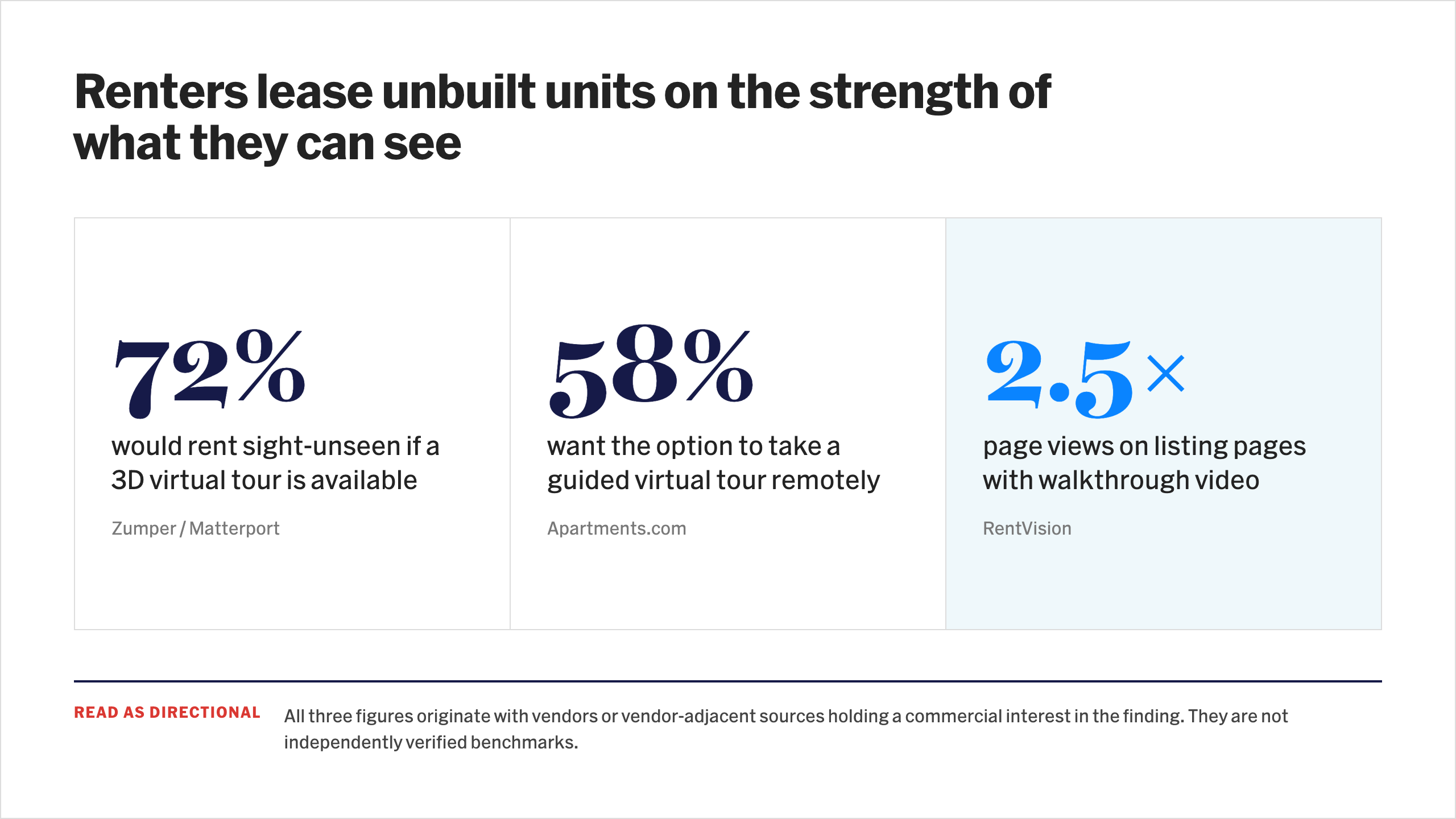
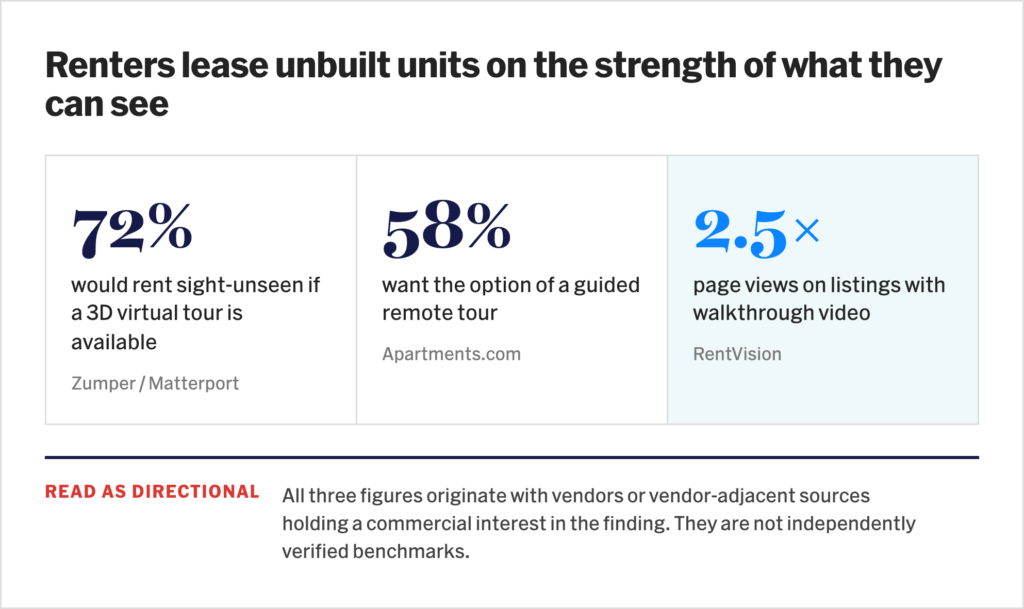
Renters are evaluating unbuilt units on faith, and vendors have data suggesting visualization quality moves the needle. A Zumper/Matterport survey found that 72% of renters would rent an apartment without seeing it in person first if a 3D virtual tour was available. A separate Apartments.com survey found that 58% of renters want the option to take a guided virtual tour remotely. RentVision, a multifamily media vendor, reports that website pages with walkthrough video tours get 2.5 times the page views of pages without them. These figures come from vendors and vendor-adjacent sources with a commercial interest in the underlying finding, so they should be treated as directional rather than independently verified benchmarks. But the underlying logic holds: a prospect signing a lease for a unit they cannot physically walk through needs more information, not less, to feel confident.
Proptech funding into the category has scaled meaningfully. Companies like AppFolio, EliseAI, and Entrata recur frequently across vendor rankings and buyer guides in the broader leasing-technology and automation space, though they occupy somewhat different positions within it. EliseAI is more narrowly positioned as a leader in AI-driven leasing automation specifically, while AppFolio and Entrata are typically categorized as full property management platforms that have layered in their own leasing-automation features (AppFolio’s Realm-X, Entrata’s ELI+). That level of capital inflow, and the resulting churn in vendor positioning, means the landscape will keep shifting, and point solutions bought today carry real replacement risk over a three-to-five-year hold period.
Mapping the pre-leasing stack
Operators evaluating this category benefit from separating tools by the specific functional layer they occupy, rather than treating “pre-leasing software” as a single undifferentiated purchase decision. Blueprint Advisory Council conversations have surfaced four distinct layers, and most vendors in the space occupy one or two of them rather than all four, despite marketing language that often implies broader coverage.
Layer one: demand capture and syndication. This layer covers the mechanics of getting a not-yet-built or not-yet-available unit in front of prospective renters across the channels where they search. It includes listing syndication to rental marketplaces, AI-driven inquiry response that engages a prospect within seconds of an inquiry rather than hours, and live absorption reporting that tracks how quickly a given floor plan or unit type is filling relative to plan. The core value proposition is speed and reach. Vendors here compete primarily on the number of syndication partners, the sophistication of the AI response layer, and the accuracy of real-time availability data feeding into that syndication.
Layer two: prequalification and scoring. Once demand is captured, the operational bottleneck shifts to sorting signal from noise. Prequalification tools filter out unqualified applicants before they consume leasing staff time, and scoring engines rank prospects by fit against specific unit types, income requirements, or move-in timelines. This layer matters disproportionately during the surge period described above, when inquiry volume outpaces the leasing team’s capacity to manually triage every lead with equal attention. A property manager evaluating tools in this layer should ask specifically how the scoring logic handles edge cases and whether it is auditable, since fair housing exposure is a live concern whenever automated systems are making or influencing decisions that affect who gets a tour.
Layer three: showing and application infrastructure. For larger lease-ups and build-to-rent deployments in particular, the technical requirements become more comprehensive. They include a showing scheduler that supports self-guided, group, and virtual tours with two-way calendar sync; tenant screening and fraud detection with configurable decision rules; and lease generation with auto-fill and e-signature capability. This is the layer where integration quality separates vendors that hold up under volume from those that do not. Point solutions with brittle integrations force manual reconciliation between systems, which in turn produces duplicate leads and skews the occupancy forecasting and ROI modeling that layer four depends on.
Layer four: investor and lender reporting. Given the loan-draw dynamic discussed above, this layer is not optional for ground-up development or major value-add lease-ups carrying construction debt. The requirement is to report live absorption data to investors and lenders throughout the lease-up period in a format that satisfies covenant reporting obligations, not just an internal dashboard optimized for the leasing team’s own KPIs. Operators should confirm during vendor evaluation whether absorption and occupancy data can be exported or accessed in a format their finance and capital markets teams can use directly, rather than requiring a secondary reconciliation step.
A related but distinct category worth naming separately is revenue intelligence, which is showing up more frequently in 2026 vendor conversations. Rather than executing the pre-leasing process, revenue intelligence platforms sit above it. They connect leasing velocity, pricing, renewals, and availability data into a system that interprets performance rather than simply reporting it. The distinguishing capability is surfacing something like slowing leasing velocity for a specific unit type early enough that pricing or marketing can be adjusted before the exposure shows up in a missed stabilization date. Operators should not conflate this category with layer-one demand capture tools; the two are complementary, not substitutes.
The gaps between vendor pitch and reality
Portfolio diversity undermines single-vendor strategies. A portfolio running simultaneous lease-ups across a ground-up suburban garden community, an urban high-rise value-add, and a build-to-rent scattered-site product is unlikely to find one vendor that serves all three well. The showing and screening requirements for a scattered-site BTR product differ meaningfully from a single high-rise asset with an on-site leasing office, and operators who standardize on one platform across property types often discover gaps that get patched with manual workarounds at the site level, quietly reintroducing the fragmentation the platform was purchased to eliminate.
Integration quality is difficult to evaluate before contract signature. Nearly every vendor in this space claims open APIs and PMS integration, but the practical difference between a well-maintained two-way sync and a brittle one-directional feed only becomes apparent under real transaction volume, typically 60 to 90 days into a live deployment. Advisory Council members have flagged this as the single most common source of post-purchase regret. A vendor evaluation process that tested the demo environment thoroughly but did not stress-test the integration against the operator’s actual PMS configuration and data volume.
Vendor claims about lead volume and conversion lift are difficult to verify independently. Statistics like the tenfold lead increase attributed to 3D tours or the 2.5x engagement lift from video walkthroughs originate from vendors selling those exact products. That does not make the figures false, but it means operators should request property-level data from comparable assets in their own market before treating vendor-published statistics as a basis for ROI modeling, rather than as directional evidence that visualization quality matters generally.
5 steps to evaluate pre-leasing vendors
Translating the pre-leasing framework into a vendor evaluation requires more than a feature checklist. The following steps give technology and operations leaders a structured path from framework to procurement decision.
Map the specific layer each candidate vendor occupies before comparing pricing or feature lists. A demand-capture tool and a revenue-intelligence platform are not competing for the same budget line. Treating them as substitutable during evaluation produces apples-to-oranges comparisons that waste procurement cycles.
Confirm lender and investor reporting requirements before selecting a tool for any asset carrying construction or bridge debt. Loan covenants should inform the technology requirements list from the outset, not get discovered as a gap after a platform has already been selected on marketing and leasing team criteria alone.
Stress-test integration claims against actual PMS configuration and realistic transaction volume during the evaluation window, not just a sanitized demo environment. Request a reference client on the same PMS platform and ask specifically about reconciliation issues encountered in the first 90 days of deployment.
Build a segmented technology plan for heterogeneous portfolios rather than forcing a single-vendor mandate. Ground-up, value-add, and scattered-site BTR assets carry different operational requirements. The showing, screening, and reporting infrastructure should be matched to asset type rather than standardized for procurement simplicity alone.
Request property-level performance data, not published marketing statistics, when evaluating visualization and demand-capture claims. Comparable assets in the operator’s own markets provide a far more reliable basis for ROI modeling than industry-wide averages sourced from vendor case studies.
Vendor selection as a capital-markets decision
The throughline across this report is that pre-leasing technology has outgrown the marketing-department budget line it started in. A tool that used to be judged on lead volume and cost per lease now sits upstream of loan covenants, investor reporting obligations, and capital-structure risk that has nothing to do with how good the virtual tour looks. Operators who still evaluate vendors primarily on conversion lift are asking the wrong question, or at least an incomplete one, for any asset carrying construction or bridge debt into a lease-up period.
The framework in this report exists because the market has not sorted itself into clean categories on its own. Vendors will keep describing themselves in the broadest terms their marketing teams can justify, and the burden falls on operators to map what a platform actually does against what a given asset actually needs. That mapping exercise, done before contract signature rather than discovered sixty days into deployment, is the difference between a stack that holds up under real transaction volume and one that quietly reintroduces the fragmentation it was bought to solve.
None of this argues against adopting pre-leasing technology. The inquiry surge, the visualization expectations, and the lender reporting requirements are all real and getting more demanding, not less. It argues for treating vendor selection as a capital-markets decision as much as a leasing decision, and for building the kind of segmented, layer-aware technology plan that a heterogeneous portfolio actually requires.
– Nick Pipitone