
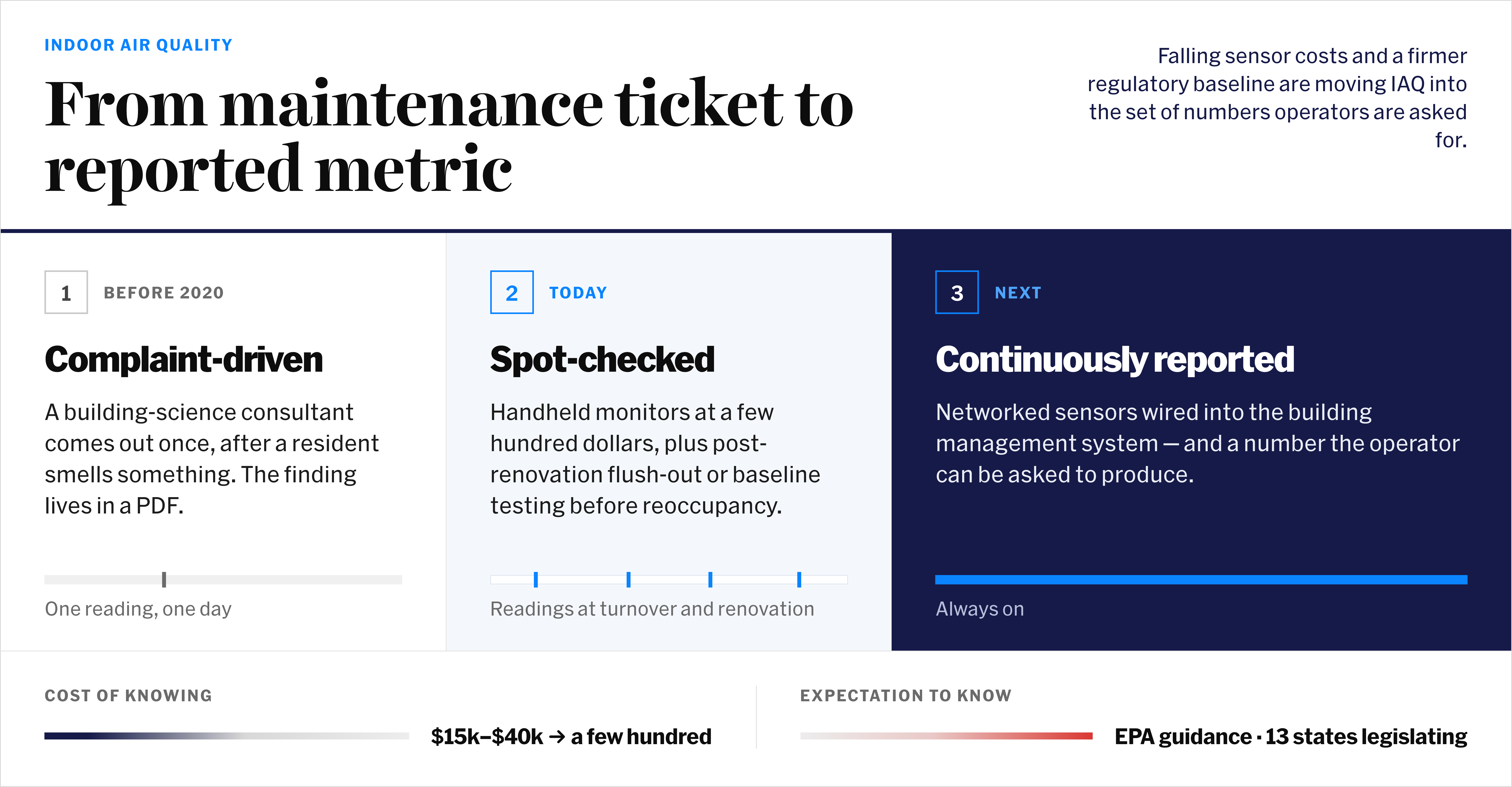
For most of the last two decades, indoor air quality sat firmly in the “nice to have” column of multifamily operations. It has been a maintenance line item invoked mainly when something went wrong. That is starting to change. More residents report IAQ as a growing concern, and a quarter of U.S. states advanced IAQ-related legislation in 2025 alone, years after the pandemic that first put air quality on everyone’s radar. The pattern echoes a familiar arc: acute crisis, followed by a lag, followed by codification. London’s 1952 Great Smog took four years to lead to the Clean Air Act of 1956. IAQ appears to be tracing the same curve, just on a multifamily timeline.
The EPA has already done much of the work of turning that concern into a defensible standard. Its 2021 Energy Savings Plus Health guidelines lay out 24 Priority Issues spanning moisture, radon, combustion safety and VOCs, each with its own assessment protocol and minimum actions. It isn’t a regulation, but it’s becoming the reference point against which liability gets measured after an air quality complaint. At the same time, sensor economics have shifted enough that continuous, fleet-wide monitoring is no longer a specialized consultant’s project costing thousands per site visit.
What’s missing for most portfolios isn’t awareness but a framework for figuring out where they actually stand and what the next investment should be. This report lays out a four-tier maturity model, from reactive IAQ compliance to fully networked, ESG-integrated monitoring, built from Blueprint Advisory Council conversations with operators who have moved through each stage. It also flags where the model gets complicated: certification spend that may not match what tenants actually respond to, portfolio heterogeneity that resists one-size-fits-all sensor rollouts, and the tension between ventilation-driven IAQ gains and energy-reduction targets.
What’s changed with IAQ since the pandemic
Several forces are converging to push indoor air quality from a background maintenance concern toward a metric operators are expected to actively manage and, increasingly, report. Public interest in IAQ has not faded since the pandemic but has shifted from acute crisis response into a more durable concern. Recent survey data shows roughly two-thirds of Americans report being more cautious about indoor air since the pandemic, with a similar share saying that wildfires, pollution, and disease outbreaks have made them more mindful of the air they breathe indoors. Market data reinforces the same trend. The U.S. indoor air quality products market was valued at $10.5 billion in 2024 and is projected to keep growing at a mid-single-digit rate through the end of the decade, as sensor costs fall and monitoring becomes more accessible to a broader range of operators. Legislative activity has also picked up years after the acute pandemic phase, with a quarter of U.S. states now having advanced IAQ-related legislation, echoing the historical lag between crises (like London’s 1952 Great Smog) and regulation (the 1956 Clean Air Act).
This staying power suggests something more than a lingering pandemic habit: air quality is increasingly discussed in the same breath as other basic environmental health concerns, reinforced by recurring exposure to wildfire smoke and seasonal illness rather than a single event. The caveat is that this is mostly awareness and market-growth data, not proof that people pay a premium for it. Separate research on healthy-building features has found mixed results on willingness to pay. Residents respond more to how a space feels during a walkthrough than to formal certification in some studies, suggesting concern doesn’t necessarily translate into sustained willingness to pay a premium.
The regulatory baseline, however, has gotten more specific. The EPA’s Energy Savings Plus Health guidelines for multifamily renovations lay out 24 discrete Priority Issues, from moisture and mold to radon, combustion safety and volatile organic compound emissions, each paired with an assessment protocol, a set of minimum actions and a set of expanded actions. The guidance calls for carbon monoxide detection and warning equipment to be installed and maintained per NFPA 72, with CO alarms required in every unit that shares a floor, ceiling, or wall with a garage. They also call for radon retesting every two years for buildings with active mitigation systems, and post-renovation flush-out or baseline IAQ monitoring before units are reoccupied. This document is not a regulation in itself. It explicitly does not set or modify EPA regulatory requirements. But it is increasingly treated as a reference standard operators can be measured against after a renovation-related air quality complaint.
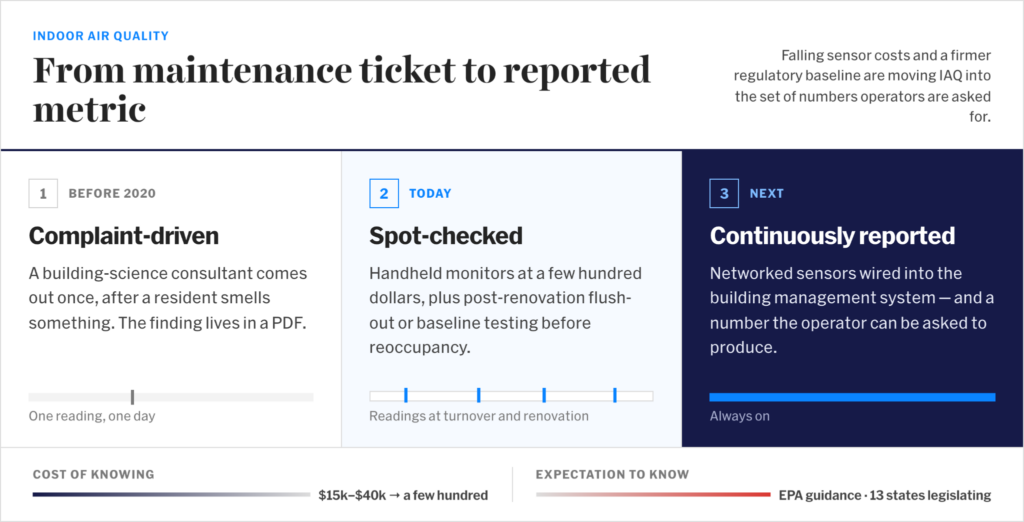
Sensor economics have also shifted decisively. Continuous IoT-based monitoring platforms now operate at price points that make fleet-wide deployment realistic. Low-cost multi-sensor units run a few hundred to a few thousand dollars, a fraction of the $15,000 to $40,000 cost of a single regulatory-grade reference monitor. This is a marked change from an era when comprehensive air quality assessment typically meant bringing in a specialized building science consultant for a one-off visit. Portable spot-check monitors and networked sensors integrated into building management systems now coexist on the market, giving operators a range of entry points depending on budget and portfolio scale.
A 4-tier IAQ monitoring maturity model
Blueprint Advisory Council conversations surface wide variance in how portfolios approach IAQ, ranging from strict code-minimum compliance to fully networked, tenant-facing programs. That variance maps cleanly onto a four-tier maturity model that operators can use to benchmark their current state and plan next steps.
Tier 1: Reactive Compliance. In Blueprint Advisory Council conversations, this is where most portfolios appear to sit today, whether they recognize it or not. Programs at this tier meet code-minimum requirements for smoke and CO alarms, conduct radon testing only when required by financing or local ordinance, and address mold or moisture only after a resident complaint triggers an inspection. Even reaching a defensible compliance floor requires more precision than most Tier 1 programs deliver. CO detection equipment installed and maintained per NFPA 72 (with alarms required in any unit sharing a floor, ceiling, or wall with a garage), a defined radon retesting cadence of every two years for buildings with active mitigation systems, per EPA guidance, and a documented protocol for what happens between a tenant complaint and a completed repair.
Tier 2: Point Monitoring. Portfolios at this tier deploy portable, all-in-one monitors typically tracking carbon dioxide, humidity, temperature, and particulate matter on a periodic or as-needed basis, often tied to specific renovation projects or tenant complaints. This tier satisfies post-construction verification requirements, such as the flush-out or baseline monitoring called for under ASHRAE Standard 189.1 following building product installation. But it does not provide continuous visibility between spot checks and leaves long gaps in the data record.
Tier 3: Continuous Networked Monitoring. This tier introduces fixed IoT sensors integrated with the building management system, generating a real-time data stream rather than a series of snapshots. The critical operational insight at this tier, drawn from operators who have deployed sensors at scale, is that air quality data alone is an incomplete signal. Particulate matter sensors cannot detect pathogens directly. The smallest commercially available sensors track particles down to roughly 0.3 microns, while a virus particle is closer to 0.1 microns and typically attaches to aerosols and droplets of widely varying size. That gap means a particulate spike is, at best, a loose proxy — it can rise for reasons that have nothing to do with pathogen presence, and it can miss real risk that never registers as a detectable particle event. Pairing air quality readings with HVAC airflow performance data that track whether outdoor air intake and exhaust are actually hitting design targets turns a noisy single-metric feed into an actionable operational picture.
Tier 4: Resident-Facing and ESG-Integrated. At the top of the maturity curve, monitoring data is surfaced directly to tenants through lobby dashboards or tenant portal integrations, and rolled up into portfolio-level ESG reporting alongside energy, water, and emissions metrics. This tier converts IAQ from an internal risk-management tool into a disclosed, marketable asset. Commercial real estate operators managing indoor air quality report that buildings with demonstrably clean air command rent premiums and factor into third-party valuations, a dynamic that is beginning to extend into multifamily as tenant expectations catch up with the commercial sector.
3 places where the model meets resistance
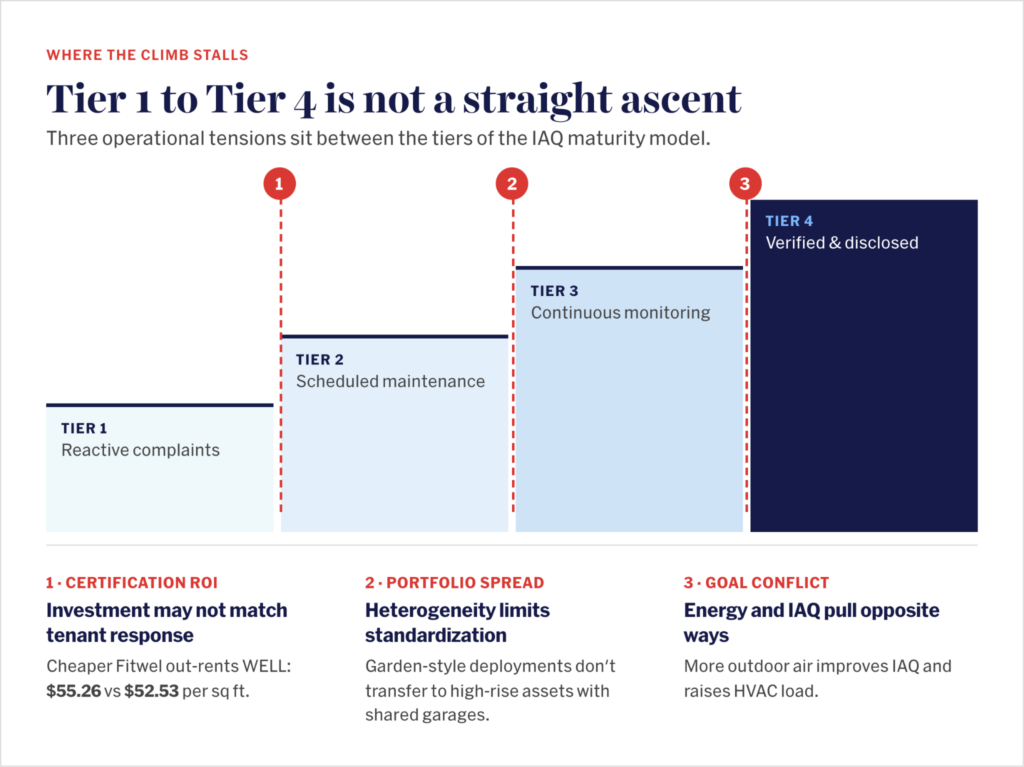
The maturity model provides a useful benchmark, but several operational tensions complicate a straightforward climb from Tier 1 to Tier 4.
Certification investment may not match tenant response. Real-world rent-premium data is more modest than the certification industry often suggests, and it points in different directions depending on the study. A 2025 Cambridge University hedonic-pricing analysis found WELL-certified buildings commanding average annual effective rents of $52.53 per square foot versus $55.26 for Fitwel-certified buildings. These are both healthy-building programs that include criteria for indoor air quality. The less prescriptive, cheaper-to-earn Fitwel certification is associated with higher rent.
NMHC’s Resident Preferences Survey has found renters willing to pay only about $32.64 more per month for a LEED-certified building. It’s a real but modest premium relative to the cost of pursuing and maintaining formal certification. This complicates capital allocation between formal certification programs, which carry direct costs and ongoing recertification requirements, and marketing-forward approaches built around visible monitoring dashboards and staged leasing tours. Advisory Council members are split on which investment produces better returns. The honest answer is likely portfolio-specific. Newer, amenity-rich assets competing on perception may get more mileage from visible dashboards than from certification, while institutional owners answering to ESG-focused capital may need the third-party verification that certification provides regardless of tenant response.
Portfolio heterogeneity limits standardization. EPA’s guidance defines separate low-rise, mid-rise, and high-rise categories for multifamily buildings, and differentiates specific recommended actions by risk factor. Ground contact determines the scope of radon testing, for instance, while garage adjacency determines where CO alarms are required. Known high-risk zones in a building, such as entrances and lobbies, enclosed conference or amenity rooms, basements and mechanical spaces, and units adjacent to parking garages, vary by asset type and site plan. A monitoring deployment designed for a garden-style suburban property will not transfer cleanly to a high-rise urban asset with a shared parking structure. That means portfolio-wide sensor rollouts require site-specific risk mapping rather than a uniform unit-by-unit deployment.
Energy and IAQ goals can pull in opposite directions. Increasing outdoor air ventilation improves air quality but raises HVAC energy consumption, working against the energy-reduction targets that are typically the more mature half of an ESG program. U.S. Department of Energy data on HVAC preventive maintenance consistently points to energy savings in the 5% to 20% range from tasks like cleaning coils, correcting refrigerant charge, sealing filter perimeters, and repairing economizers. That’s enough to offset much of the increased run-time associated with higher ventilation rates when that maintenance is tracked and executed consistently. Without that maintenance discipline, an IAQ push can quietly erode progress on the energy side of the ESG scorecard.
Building the IAQ monitoring program
Operators moving up the maturity curve benefit from a sequenced approach rather than a single large procurement decision.
Establish the compliance floor before adding sensors. Audit the portfolio against the EPA’s Priority Issue framework. Verify CO detection and warning equipment is installed and maintained per NFPA 72, with alarms confirmed in every unit that shares a floor, ceiling, or wall with a garage. Confirm a documented radon retesting cadence for buildings with active mitigation systems. Also, establish a written moisture and mold response protocol that specifies the window between a reported issue and a completed repair. This tier should be fully documented before any capital is committed to Tier 2 or Tier 3 monitoring technology.
Map site-specific risk zones before purchasing sensors. Use known high-exposure areas such as parking garage-adjacent units, basements, mechanical and utility rooms, high-traffic common areas, and enclosed amenity spaces to determine initial sensor placement, rather than spreading a fixed monitoring budget evenly across a property. A concentrated deployment in known risk zones generates more actionable data per dollar than a uniform light deployment across every unit.
Pair every air quality sensor with an airflow or HVAC performance data stream. Carbon dioxide and particulate readings in isolation produce ambiguous signals. Airflow data tied to air handling unit performance clarifies whether a reading reflects an actual ventilation shortfall or a transient condition such as cooking or cleaning activity. This pairing also connects the monitoring data directly to the mechanical systems that on-site staff can adjust, closing the loop between detection and action.
Define condition-to-corrective-action mappings before go-live. A monitoring program that generates alerts without a corresponding action protocol produces dashboard fatigue rather than operational improvement. In Blueprint Advisory Council conversations, operators have recommended building an explicit table mapping specific conditions to specific responses. As a general pattern, worsening IAQ readings with steady airflow performance often points to a filter bypass or seal problem, since unfiltered air can pass around a gapped or poorly seated filter without affecting overall flow. Declining airflow with stable IAQ more often points to a clogged filter restricting throughput. The specific diagnostic logic will vary by system and should be validated with an HVAC professional, but the underlying practice of mapping conditions to a defined response rather than treating every alert as one requiring escalation is what lets site-level teams, often working with limited staffing, act quickly.
Decide the disclosure strategy before deployment, not after. Determine at the outset whether monitoring data will remain an internal operations tool, get surfaced to residents through dashboards and portals, or roll into formal ESG reporting alongside energy and water metrics. This decision shapes vendor selection, data retention requirements, and reporting cadence. Retrofitting a disclosure layer onto a program built purely for internal use is considerably more expensive than designing for it from the start.
IAQ is following a familiar curve
IAQ monitoring is following a familiar arc for building systems that start as maintenance afterthoughts and end as reportable metrics: awareness accumulates for years, then regulation and capital markets catch up all at once. The four-tier model gives operators a way to see where they sit on that curve rather than treating the next sensor purchase as an isolated decision. But the model isn’t a checklist to complete in order. Tier 1 compliance has to be genuinely solid before Tier 2 or Tier 3 technology adds value. The jump to Tier 4 disclosure only pays off if the underlying data is trustworthy enough to put in front of residents and investors.
The operators furthest along aren’t necessarily the ones with the most sensors. They’re the ones who sequenced the work: compliance floor first, site-specific risk mapping before procurement, airflow data paired with every air quality reading, and a disclosure strategy decided before the first dashboard goes live. That discipline is what separates an IAQ monitoring program that produces endless alerts from one that produces better and healthier buildings.
– Nick Pipitone